Floor Decking Roll Forming Machines
Profiled steel decking production lines for composite floors, multi-storey buildings and long-span construction.
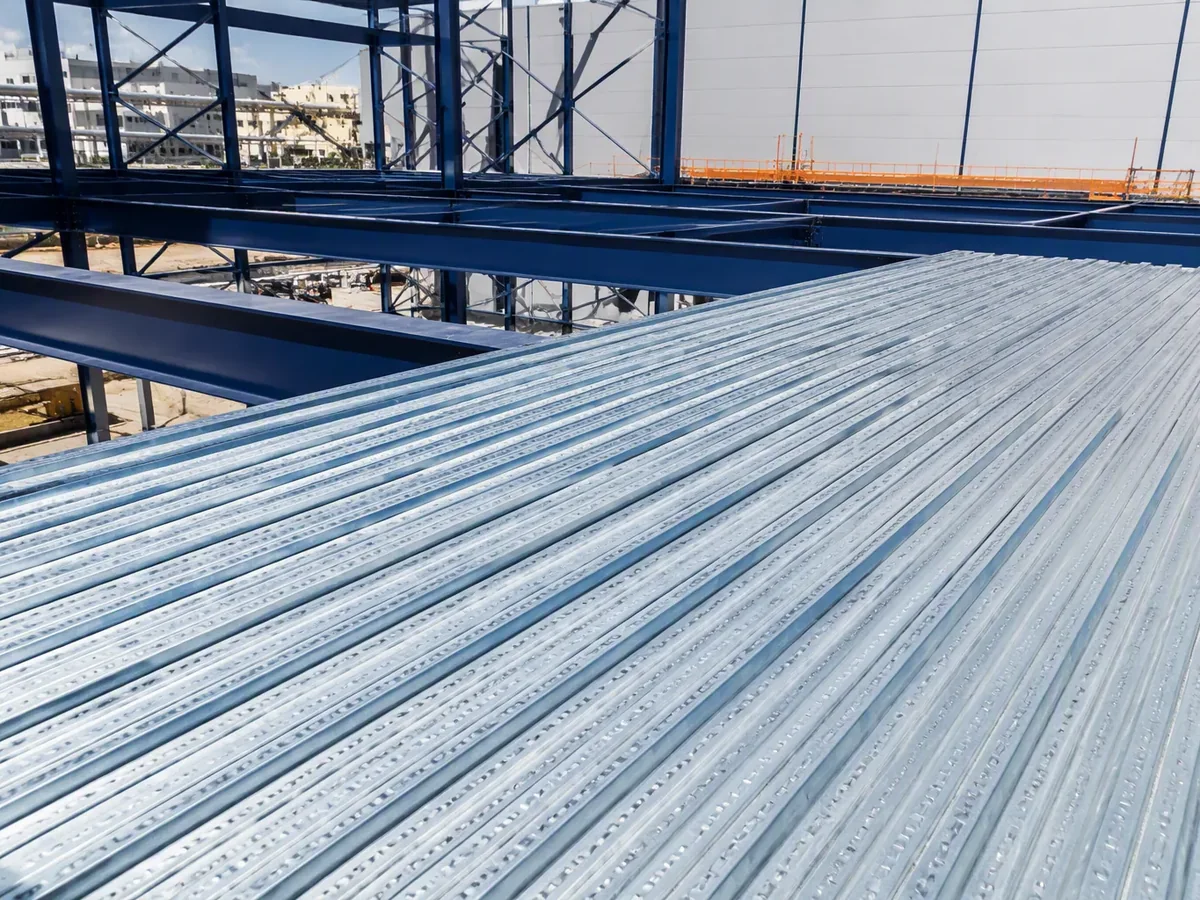
Composite steel floor decking is the structural component that enables the efficient construction of multi-storey buildings in steel.
It acts simultaneously as permanent formwork during the concrete pour and as tensile reinforcement in the finished composite floor slab.
The roll forming machines that produce floor deck panels are among the most specialised in the industry, requiring high station counts, precise embossing capability, and exacting dimensional tolerances.
How Composite Floor Deck Works
A composite floor slab consists of profiled steel decking, structural concrete cast over it, and shear studs welded through the deck to the steel beam below.
The shear studs transfer horizontal shear between the concrete and the steel beam, creating composite action — meaning the two materials work together structurally rather than independently.
The result is a floor system that is lighter, shallower and faster to construct than a traditional reinforced concrete flat slab.
In a typical 9 m x 9 m bay, a composite deck floor might be 130–150 mm deep (deck rib plus concrete) against 200–250 mm for a comparable flat slab.
The deck performs three distinct structural functions: it carries the wet concrete load as permanent formwork during construction, it acts as tensile reinforcement in the finished slab, and the embossed ribs on the deck surface create a mechanical bond with the concrete that prevents the steel and concrete from sliding relative to each other under load.
Composite Deck vs Deep-Rib Deck
The two main floor deck profile families are composite deck (shallow rib, typically 50–55 mm rib height, 0.9–1.2 mm steel) and deep-rib deck (also called long-span deck, 75–80 mm rib height, 0.9–1.5 mm steel). Composite deck at 50 mm rib height is the standard choice for normal multi-storey office and residential construction with spans up to about 3.5 m between secondary beams. Deep-rib deck extends the unpropped span to 4.5–6 m, which reduces the number of secondary beams required and is preferred for long-span construction. Deep-rib deck requires more forming stations (22–26 vs 18–20 for shallow deck) and a higher-capacity embossing unit; most producers build dedicated lines for each product family.
The Embossing Function
The embossed deformations on the flat pan of the deck are not decorative — they are structural.
The embossment geometry must be reproduced precisely to achieve the composite bond characteristic that the structural engineer has used in the design calculation.
Even small deviations in embossment depth or spacing affect the shear bond test results and can invalidate the structural design tables. The embossing unit is integrated into the roll forming machine, not added as a separate pass.
Maintaining this geometry — checking roll condition, replacing worn rolls before the embossments become shallow — is a key part of quality control for a floor deck producer.
Cover Width, Material and Output
Floor deck is sold by cover width — the effective width of completed floor covered by one panel. Standard cover widths are 600 mm, 750 mm and 900 mm.
The corresponding strip widths are calculated from the deck cross-section drawing: for a 600 mm cover-width deck with a 50 mm rib profile, the strip width is typically 720–800 mm.
Galvanised steel 0.8–1.5 mm is standard, normally Z275 or better because the deck stays permanently inside the slab and cannot be repainted.
A floor deck line produces 10–20 m/min depending on rib depth and material thickness, equating to roughly 500–800 m per shift.
Cutting is normally done on the fly so the line does not stop between panels, and a stacker is usually added for panels above 4 m.
Installation Context
Floor deck is installed by steel erectors immediately after the structural steel frame has been erected and before the concrete pour. Delivery timing is critical — deck must arrive on site when the erector is ready to install it.
This means floor deck producers must hit delivery windows precisely, which favours local or regional producers over distant ones despite potential cost advantages elsewhere.
The multi-storey construction market is concentrated in urban areas, so a floor deck producer serving a single major city may find sufficient demand within a 200 km radius to sustain a full-time production line.
Machines for This Application
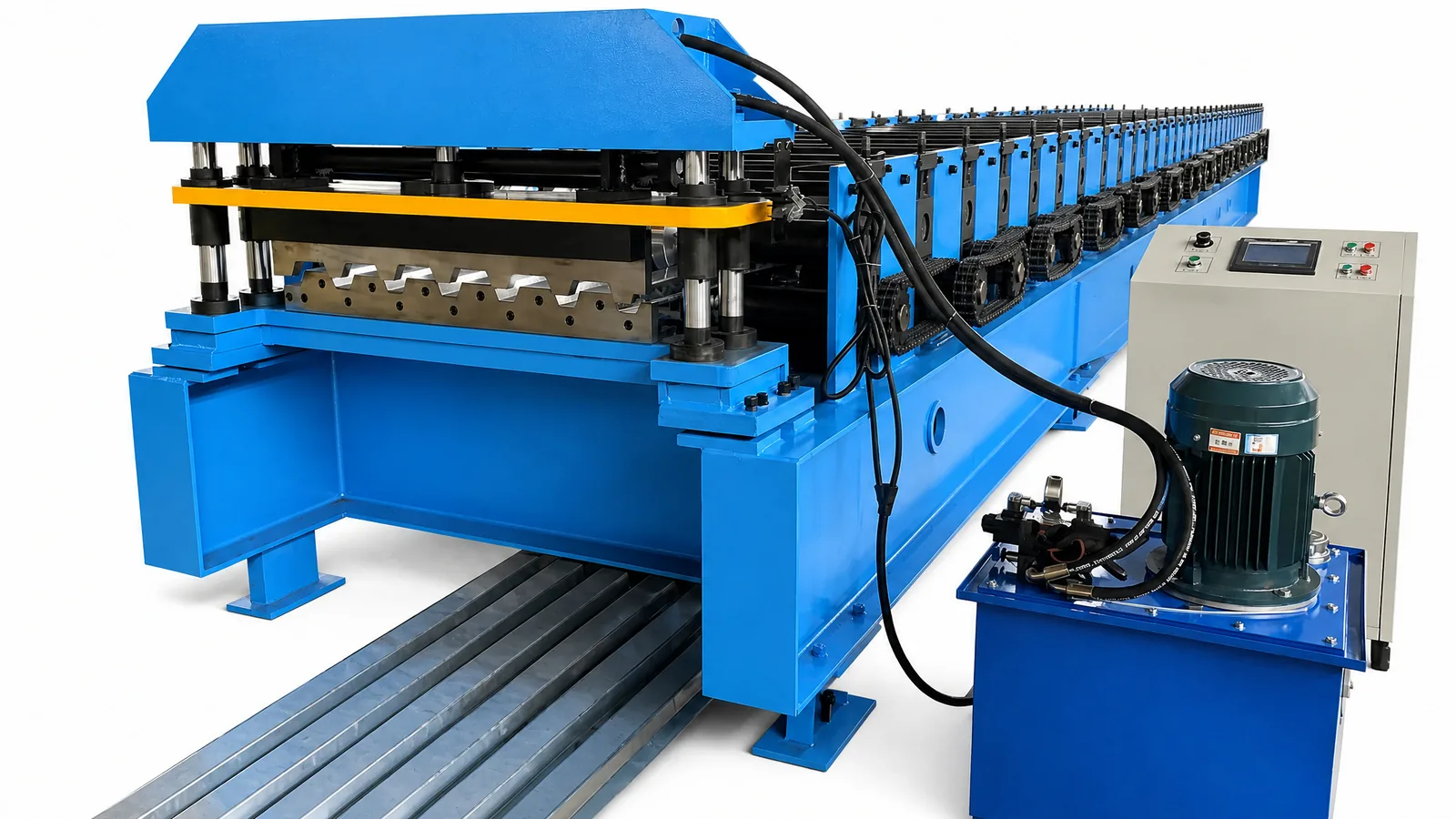
Typical Production Line Setup
| Component | Role | Necessity |
|---|---|---|
| Hydraulic decoiler | Uncoils 0.8–1.5 mm galvanized coil | Must-have |
| Leveling unit | Critical for flat deck panels | Must-have |
| Roll forming machine | 22–26 stations for deep ribs | Must-have |
| Embossing unit | Creates mechanical bond with concrete | For composite deck |
| Inline punch | Shear stud access holes | Optional |
| Hydraulic flying cut | Cuts without stopping the line | Must-have |
| Auto stacker | Stacks finished deck panels | Recommended |