Cut to Length Line
Uncoiler, leveler, feed, shear and stacker — the line that turns a coil into flat blanks cut to a measured length. Here is what decides its accuracy and its output.
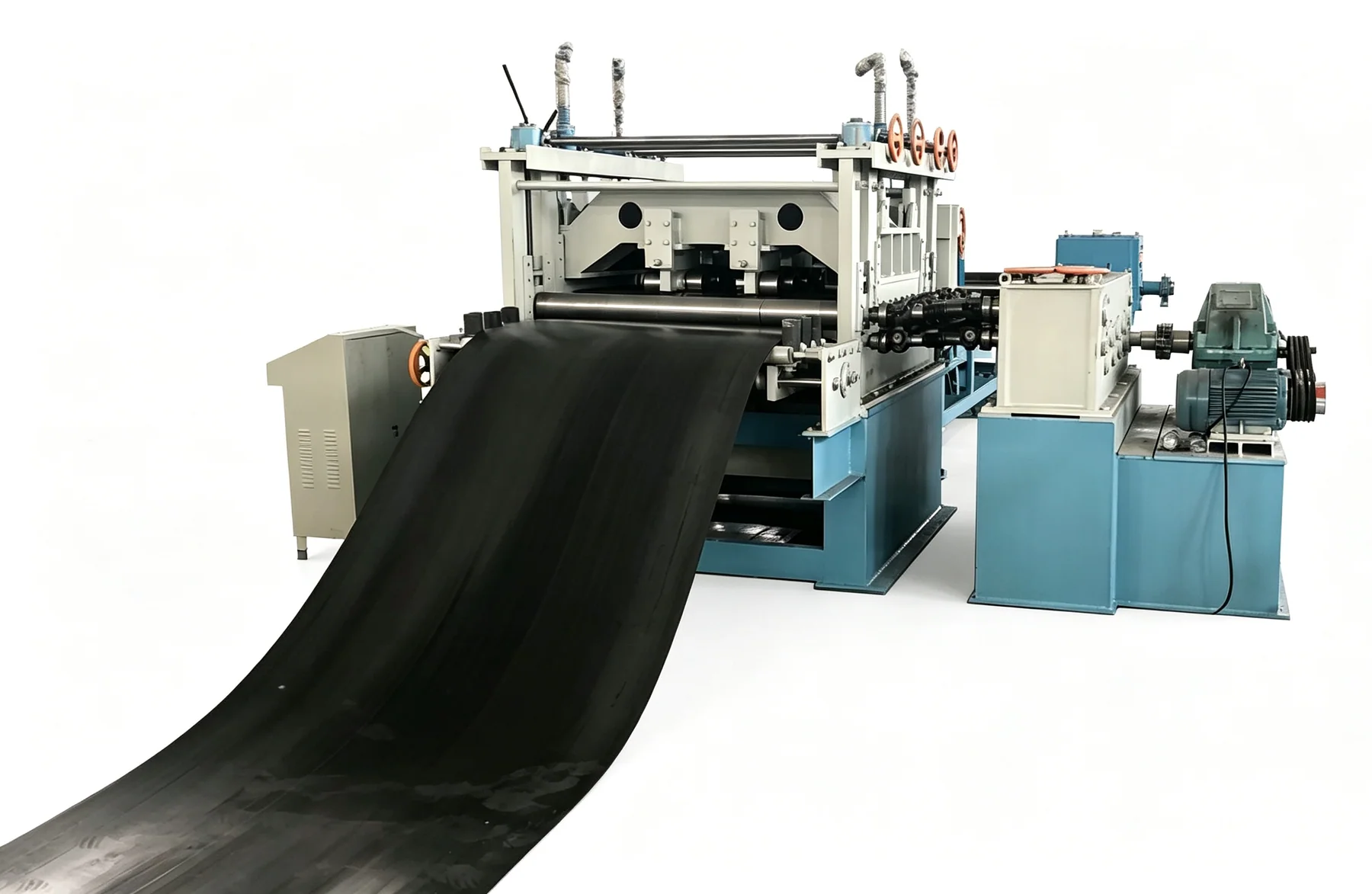
A cut-to-length line takes steel coil and delivers flat blanks cut to a measured length. It is the simplest way to stop buying cut sheet: instead of paying a service centre a margin on every tonne, you convert one master coil into the lengths your own production needs.
The line is short and the sequence is fixed, which is why most of the buying decisions happen before a supplier is even chosen. What people get wrong is not the shear — it is the front end and the tolerance. Below is what actually decides whether the blanks come off flat and in tolerance.
What a cut to length line is made of
- 01
Uncoiler
Holds the coil and pays it off under controlled back-tension, so the strip reaches the leveler at constant speed rather than in surges.
- 02
Leveler
Removes coil set and cross-bow before the strip is measured. This is the step that decides whether the cut blank lies flat.
- 03
Feed and measure
Measures the strip as it feeds, either with a measuring roll on an encoder or a servo feed. This is where the cut length is decided.
- 04
Shear
Cuts the strip to length. A flying shear cuts at line speed; a stop-start shear indexes the strip and cuts while it is stationary.
- 05
Stacker
Takes the cut blanks off the line and stacks them. On thin sheet the stacker is what stops the sheet being distorted at the end of the line.
How to choose a cut to length line
- Coil weight — what can your handling actually lift?
- A cut-to-length line starts at the uncoiler, and an undersized one stops the whole line. Standard coil is supplied at 3 – 5 tonnes, and our uncoilers cover 3 T, 5 T and 10 T. If you buy 5 tonne coil, a 3 T uncoiler is not a saving — it is a bottleneck that also rules out ever buying heavier coil.
- Material thickness and width range
- Decide this from the widest and thickest job you will actually quote, not from the average. Our decoiling and leveling units cover 0.3 – 4.0 mm and coil widths up to 1300 mm; the slitting line upstream takes input widths up to 1600 mm. Anything outside those ranges is a different machine, not a setting.
- How flat does the blank have to be?
- This is what sets the leveler, not the shear. Coil arrives wound under tension and keeps both coil set and cross-bow, and if those are not removed the cut blank is bowed before anything else happens to it. Seven rollers is the usual minimum for thin sheet; nine or eleven are used above about 2 mm and for higher-tensile material.
- Flying shear or stop-start shear?
- A flying shear cuts while the strip is moving, so the line never stops for a cut — that is what you want on high volume of short blanks. A stop-start shear indexes and cuts while the strip is stationary, which is simpler and typically more accurate, and is the normal choice on long blanks and lower volumes. The cut length and volume decide this, not the budget.
- How is the length measured?
- Either a measuring roll on an encoder, or a servo feed. The measuring roll runs against the strip and counts length directly; a servo feed controls position. Which is right depends on the length tolerance your part needs and how much slip you can tolerate on the surface — that is the single question to settle with the supplier before ordering.
- Do you need cut-to-length, slitting, or both?
- They solve different problems. Slitting divides a master coil into narrower widths; cut-to-length cuts to length. If you buy master coil and need several widths and cut lengths, a line that does both removes two separate service-centre margins. If you only need length, slitting capacity is money you do not have to spend.
What to fix before you order a cut to length line
Put a number on the length tolerance before you compare quotes
Cut-to-length lines are quoted on capacity, speed and price, and the tolerance is usually left vague. Your part either fits a tolerance or it does not, so state the tolerance you need and ask each supplier for the measured value their machine holds — not the design value.
Ask who pays for the stacker, and whether it is included
The stacker is the part of the line that gets omitted to reach a price. Without one, cut blanks come off the line and are handled twice at the end, which is where thin sheet gets distorted. Get its capacity and whether it is in the quoted scope in writing.
Settle the coil weight once, at the front
The uncoiler capacity is the hardest thing to change later. Match it to the heaviest coil you can realistically buy and handle, and add a coil car rather than relying on a forklift — a heavy coil loaded by fork onto the mandrel damages the mandrel and the coil edge.
Leveling is not the place to save
A cut blank that is bowed cannot be straightened after the fact. If you are running export coil — which commonly arrives with crushed edges on the outer wraps — plan the leveler into the specification from the start. It is not a straightforward field addition.
Write the cut-length list requirement into the order
Production runs are normally a list of lengths, not one length. The control has to take a programmed list and batch-count through it, otherwise an operator sets each length by hand and the real output of the machine is set by the setting time.
Ask for the wear-part list with the quotation
Shear blades, measuring rolls and leveling rolls are consumables. Knowing their part numbers and lead times before the line is installed is the difference between a scheduled change and an unplanned stop, particularly if the line runs material that is hard on blades.