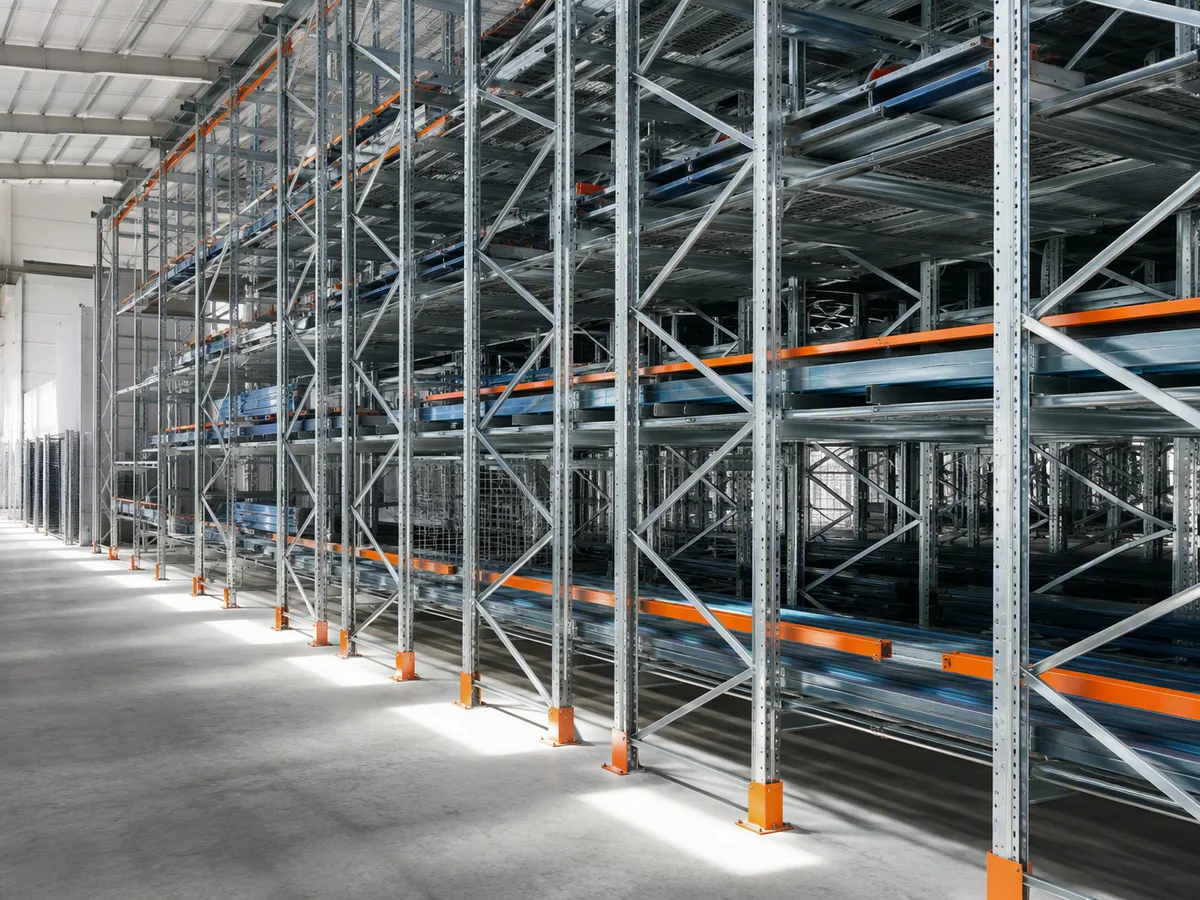
Storage Racking & Warehouse Systems
Perforated cold-formed sections for warehouse racking, shelving and mezzanine systems — run on the same platform as solar strut channel.
Warehouse storage racking is a mature and globally consistent product category built entirely from cold-formed steel sections.
The uprights, beams and bracing that make up a pallet racking system are all produced by roll forming, and the same machine platform that produces solar strut channel is well-suited to racking upright production with a change of roll cassette and punch tooling.
For a producer already serving the solar or industrial cable management market, racking is a natural adjacent market that uses existing capital and skills.
Storage Racking System Components
A standard selective pallet racking system consists of three main cold-formed components. Uprights (also called frames or columns) are the vertical elements that carry the load from loaded beams to the floor. They are perforated at regular intervals (typically 50 mm pitch) with a proprietary teardrop or square hole pattern into which the beam connectors lock. Upright depth ranges from 80 mm to 120 mm and thickness from 1.5 mm to 2.5 mm depending on the load rating. Beams are the horizontal elements that support the pallet load between two uprights, typically C or box sections with a 50 mm step at each end that allows the beam connector to hook into the upright perforations. Bracing connects pairs of uprights into a frame and provides the horizontal and diagonal rigidity that keeps the frame square under load. All three components are produced from Z275 galvanised steel coil in the as-rolled or powder-coated condition.
The Machine Platform: Shared with Solar Strut
The commercial appeal of racking upright production for an existing strut channel producer is that the machine platform is largely shared.0 mm range with inline punching.
The principal difference is the punch tooling: strut channel uses the 9 x 18 mm slot pattern at 25 or 50 mm pitch; racking uprights use a 50 mm pitch teardrop or square hole pattern specific to the racking system design.
Changing between the two products requires a roll cassette change and a punch die change — typically a half-day operation for an experienced setter.
Beams are a simpler profile and can often run on the same machine with a lighter cassette; bracing diagonals are typically simple angles bent on a press brake rather than roll formed.
Load Certification and Market Access
Racking is a safety-critical product in most markets. In Europe, racking systems are certified to EN 15512 and EN 15620; in North America to ANSI MH16.1; in Australia to AS 4084. These standards place obligations on the racking system designer and the end user.
For a new entrant, producing profiles under licence or as a second-source supplier to an established racking brand is a lower-risk path to market than attempting to develop a proprietary certified system from scratch: the brand provides the load tables, the certification, and the market pull while the producer provides precision-formed profiles at competitive cost.
Market Demand and Output
Warehouse storage demand is driven by e-commerce fulfilment, cold chain logistics and manufacturing inventory management.
Racking demand follows warehouse construction with a slight lag: new warehouses need full racking installations (high-density, long-duration orders) while existing warehouses generate ongoing replacement and expansion orders.
At 15 m/min with inline punching, one line produces roughly 600–800 m of upright per shift — enough for a medium-sized warehouse installation.
Large project orders provide volume and forward visibility, while replacement orders fill gaps in the production schedule, making racking a relatively stable market for a profile producer.
Machines for This Application
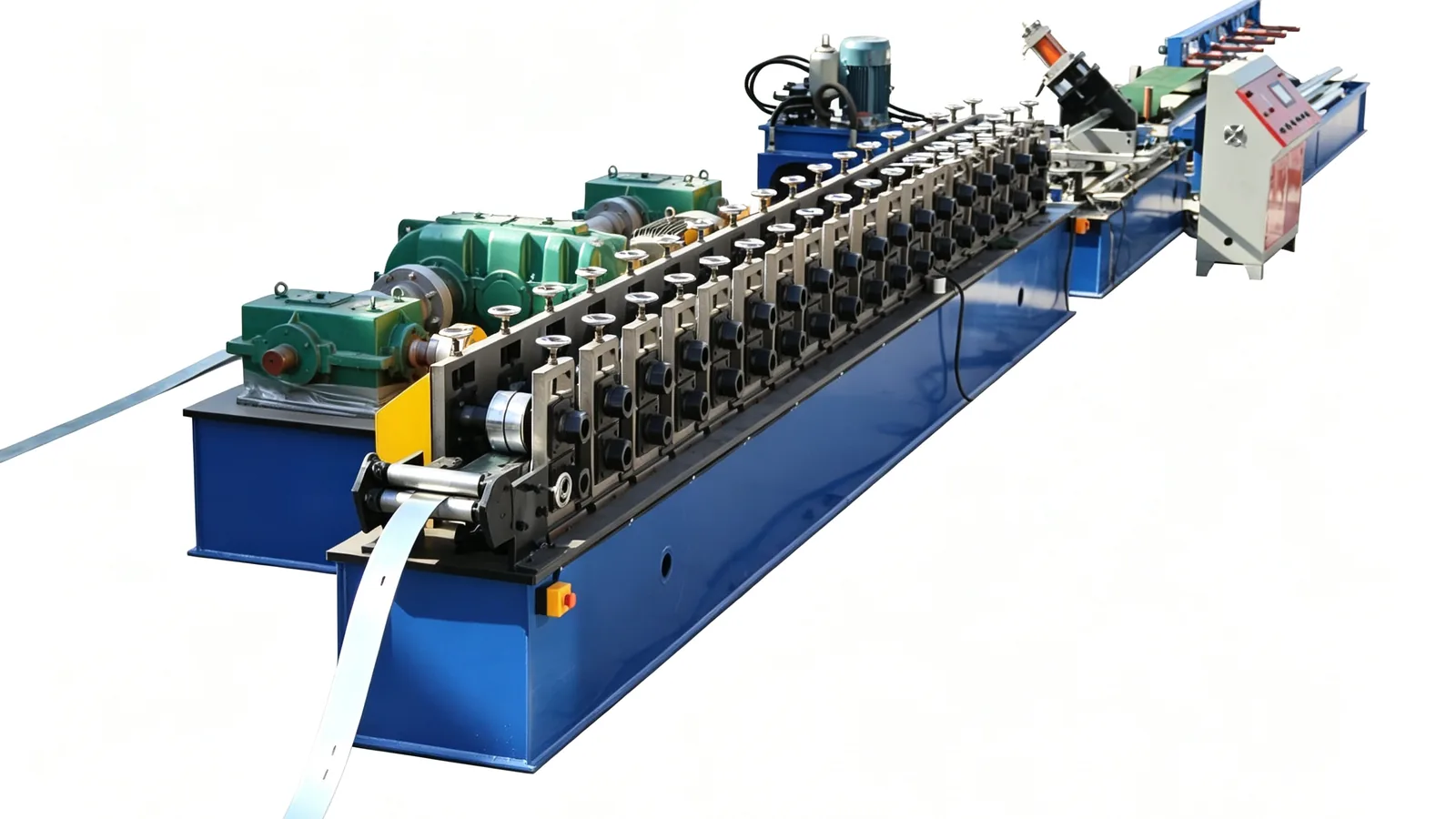
Solar Strut Channel Machine
Racking uprights and beams with inline slot punching
View specs & pricing →
Cable Tray Roll Forming Machine
Cable management for warehouse distribution systems
View specs & pricing →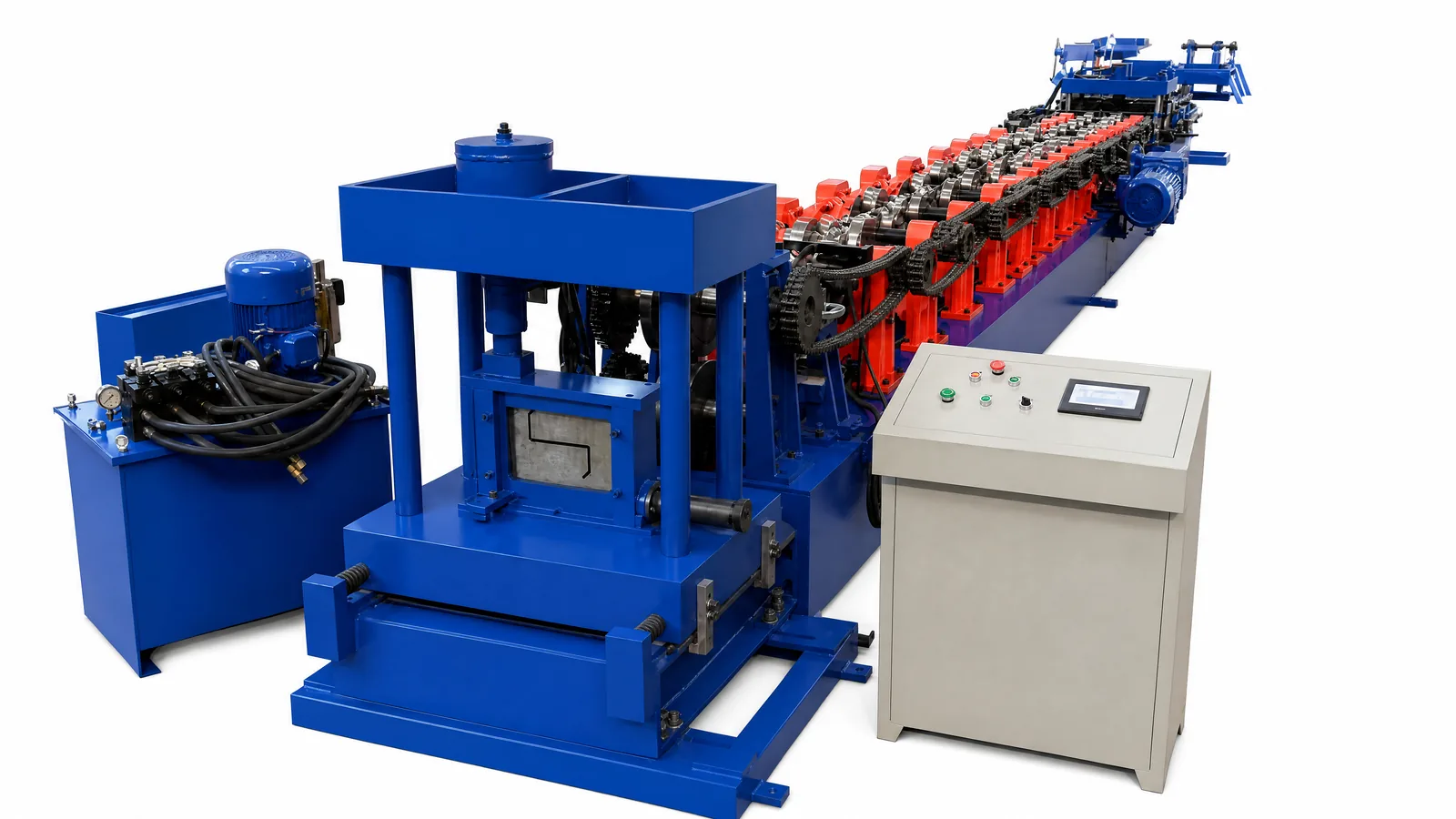
Truss & Roof Purlin Machine
Long-span mezzanine and roof structure sections
View specs & pricing →Typical Production Line Setup
| Component | Role | Necessity |
|---|---|---|
| Hydraulic decoiler | Uncoils 1.5–3.0 mm galvanised coil | Must-have |
| Leveling unit | Removes coil set before slotting | Standard inclusion |
| Strut / racking machine | Forms the perforated upright and beam sections | Must-have |
| Inline slot punch | Upright slots on a fixed pitch grid | Must-have |
| Hydraulic flying cut | Cuts to programmed upright heights | Must-have |
| Runout table | Receives finished uprights | Standard inclusion |