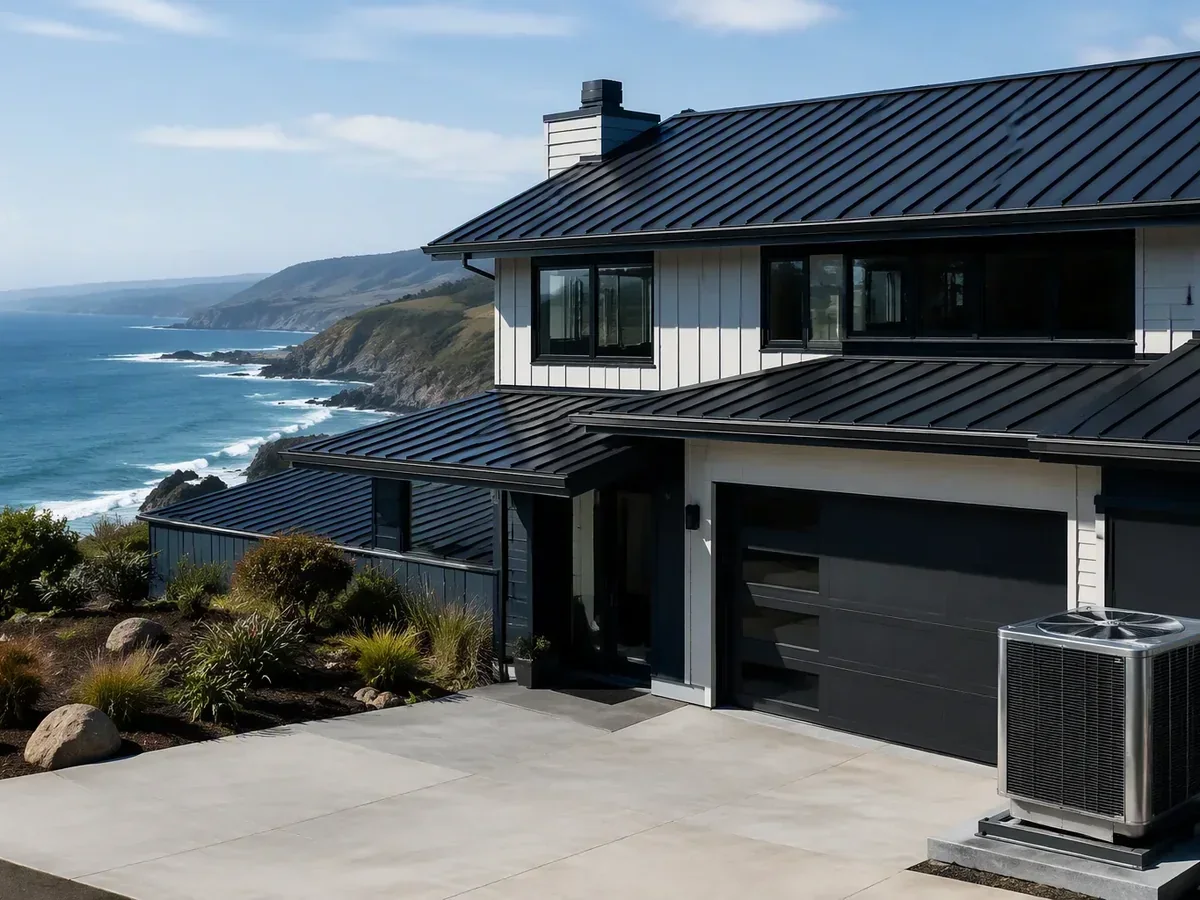
Metal Roofing & Cladding Machines
Complete production lines for IBR, corrugated, trapezoidal, standing seam and tile-effect roofing and wall cladding profiles.
Metal roofing is the dominant roofing choice across industrial, commercial and agricultural construction worldwide.
Cold roll forming is the manufacturing process that turns flat galvanised or pre-painted steel coil into the profiled sheets that cover millions of square metres of roof and wall every year.
Understanding how the process works — and what machine choices drive quality and cost — is the foundation of any profitable roofing sheet production business.
What Is Metal Roofing Roll Forming?
Roll forming passes a continuous strip of steel coil through a series of paired forming rolls, each set bending the strip a little further until the finished profile emerges from the last station.
Unlike press forming, which stamps one panel at a time, roll forming is a continuous process: coil goes in one end and finished sheets come out the other at speeds of 8–30 m/min depending on the profile.
A complete roofing sheet line consists of a hydraulic decoiler, a leveling unit, the roll forming machine itself, an optional inline punch, a hydraulic flying shear, and a runout table.
Each component matters: a decoiler that cannot maintain consistent back-tension will cause the strip to wander, producing sheets with wavy edges, while a leveling unit under-specified for the coil thickness allows coil-set to carry through as longitudinal bow in the finished sheet.
Common Metal Roofing Profiles
The global roofing sheet market uses a relatively small set of standard profiles, each associated with specific markets and construction traditions. Trapezoidal profiles (TR4, TR5, IBR) dominate the Middle East, Africa and South-East Asia, where their simple geometry, deep ribs and long-span capability make them the default industrial and agricultural choice. Corrugated profiles (762 mm and 900 mm) remain standard in the UK and parts of Africa. Standing seam profiles — including Klip-Lok and snap-lock — are the premium choice in Europe, North America and Australia, where concealed fixings and weather tightness justify a higher per-metre cost. Glazed tile and Spanish tile profiles serve residential markets where customers want the look of clay tiles at a fraction of the weight and cost. Choosing the right profile for your market is a commercial question rather than a technical one: the roll tooling for each profile is a significant capital investment and cannot be switched between profiles without a full cassette change.
Key Selection Criteria for a Roofing Roll Forming Machine
When specifying a roofing sheet machine, the following parameters define what the line can and cannot produce:
- Material thickness range: Most roofing sheet is 0.3–0.8 mm. Ensure the machine is designed for your target thickness, not just rated for it at the high end.
- Cover width: The effective cover width of the finished sheet determines how many sheets are needed per roof run. Narrower profiles mean more laps and more fixing time on site.
- Line speed: Quoted speeds are often for ideal conditions. Ask for the achievable speed at your target material and profile, including cutting cycle time.
- Cassette interchangeability: If you plan to run more than one profile on the same base frame, confirm that cassette change is genuinely practical and that re-alignment after each change is documented and reliable.
- PLC brand and functionality: The control cabinet should accept standard electrical specifications for your market (380 V / 415 V / 440 V) and provide batch counting, length tolerance control and fault diagnostics in a language the operator can read.
Material Selection
Roofing sheets are almost always made from galvanised steel (GI, Z275 coating minimum) or pre-painted galvanised steel (PPGI).
For corrosive environments such as coastal or industrial sites, Galvalume (AZ150 aluminium-zinc alloy coating) significantly outperforms standard galvanised.
Pre-painted coil adds a polymer topcoat — polyester, PVDF or SMP — that determines colour retention and surface hardness. The thickness you choose affects both the machine specification and end-product performance: for agricultural sheds 0.35–0.42 mm is common, while for permanent industrial and commercial buildings 0.5–0.7 mm is more typical.
Output and Business Model
A single roofing sheet line running one shift at 20 m/min on a simple trapezoidal profile can produce roughly 800–1,200 m of sheet per shift after accounting for coil changes and batch changeovers — enough to serve a radius of 200–400 km for a small regional producer.
As volume grows, producers typically add a second profile cassette, extend to two shifts, or invest in a second line.
The economics of roofing sheet production depend heavily on coil cost management: buying coil in the right widths to minimise trim waste, and sourcing in the right quantities to achieve mill pricing without tying up excessive working capital.
A slitting line becomes viable when you are consuming more than 300–500 tonnes per year across multiple widths.
Machines for This Application
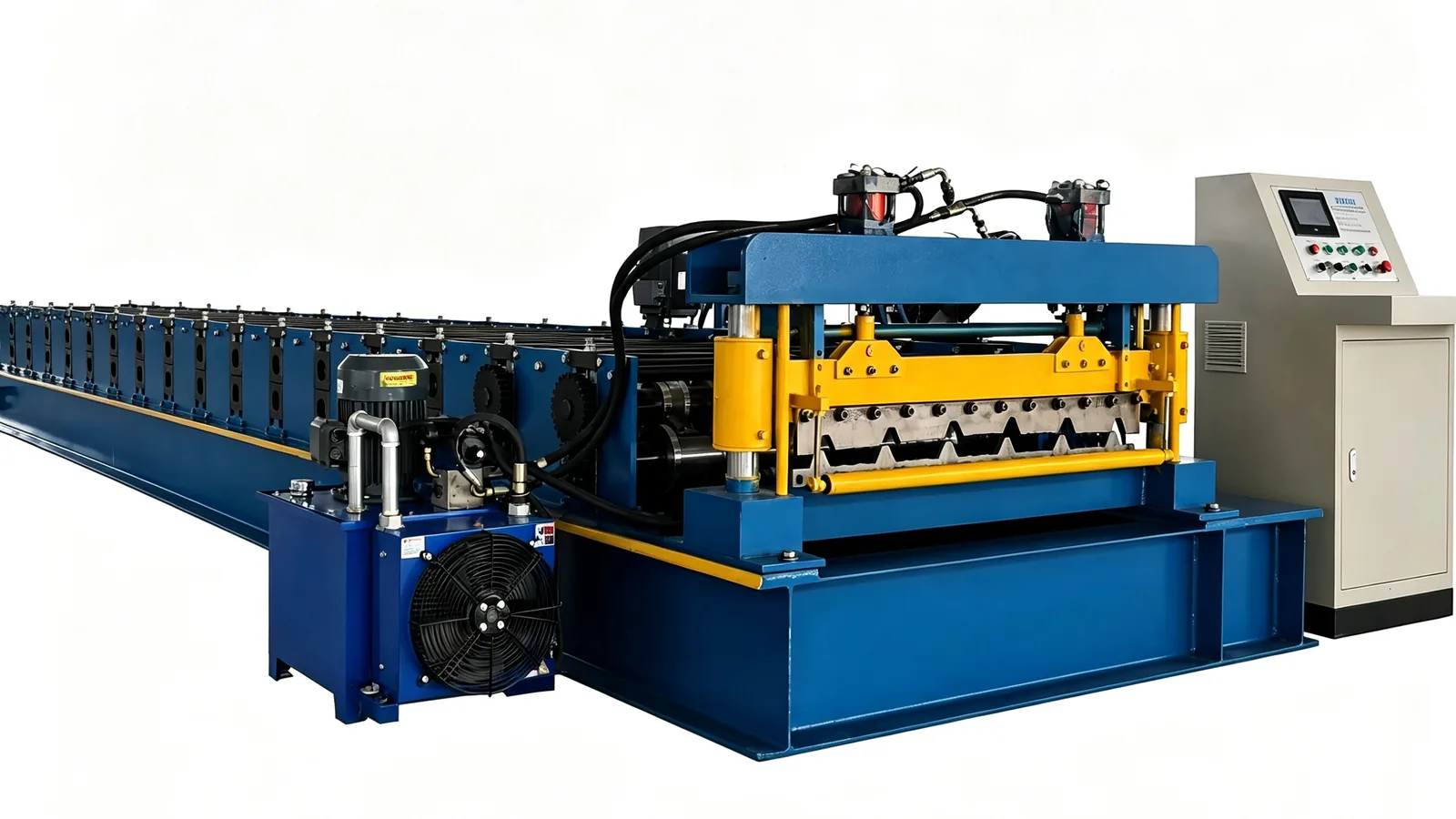
Roof Sheet Roll Forming Machine
IBR, TR4/TR5, C20/C35 — interchangeable tooling on one base frame
View specs & pricing →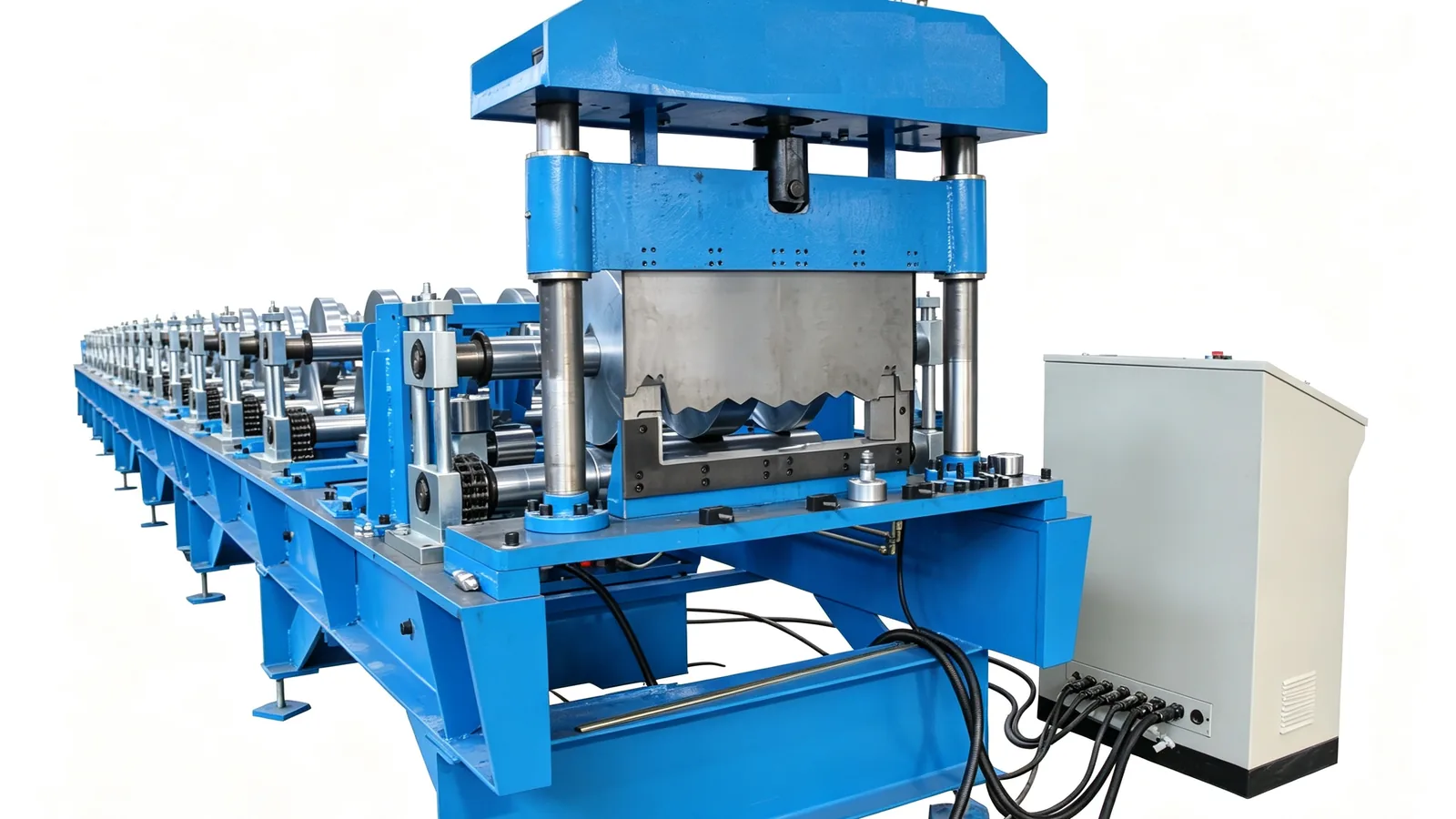
Standing Seam Roll Forming Machine
Concealed fastener Klip-Lok and snap-lock profiles
View specs & pricing →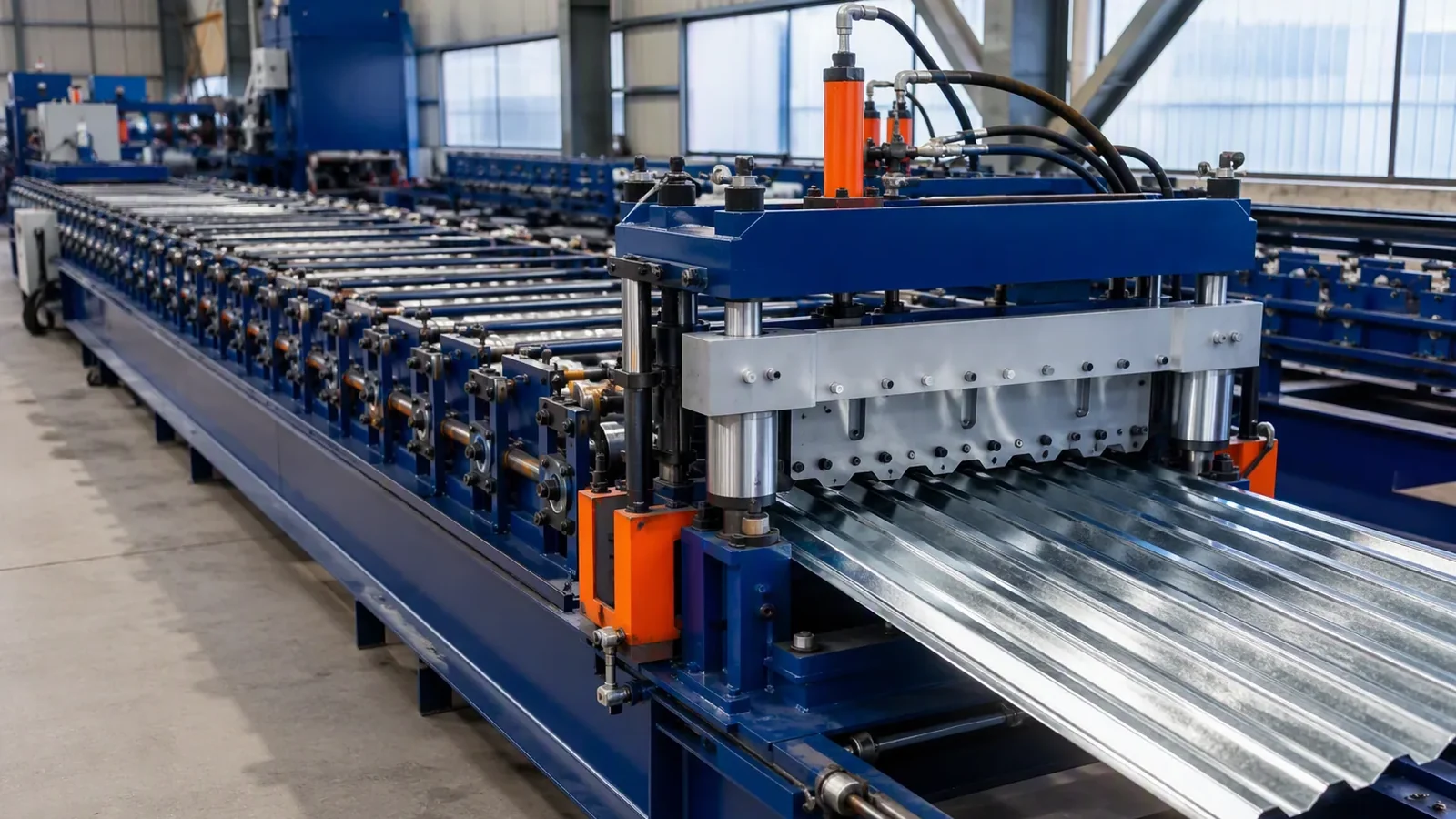
Corrugated Sheet Roll Forming Machine
762 / 900 / 1000 mm corrugated iron roofing sheet
View specs & pricing →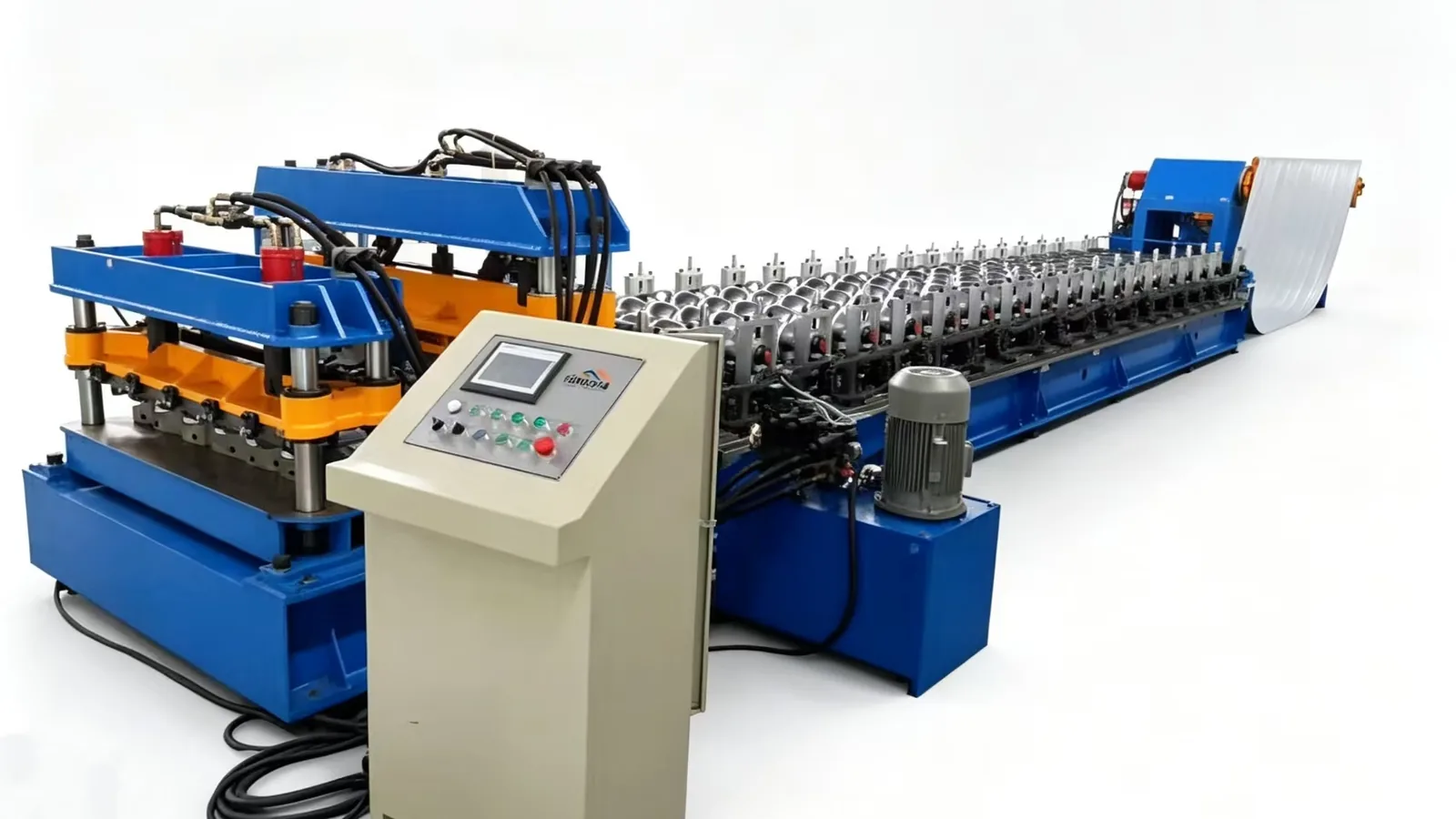
Glazed Tile Roll Forming Machine
Stone-chip coated Roman and Spanish tile profiles
View specs & pricing →Typical Production Line Setup
| Component | Role | Necessity |
|---|---|---|
| Hydraulic decoiler | Uncoils steel coil (3–5T) | Must-have |
| Coil car / loading | Loads coil onto decoiler mandrel | Recommended |
| Leveling unit | Removes coil set and cross-bow | Standard inclusion |
| Main roll forming machine | Forms the roofing profile | Must-have |
| Inline hydraulic punch | Service holes and fixing slots | Optional |
| Hydraulic cutting unit | Cuts to programmed length | Must-have |
| Runout table | Receives finished sheets | Standard inclusion |
| PLC control cabinet | Length, batch and speed control | Must-have |