CZ Purlin Roll Forming Machine
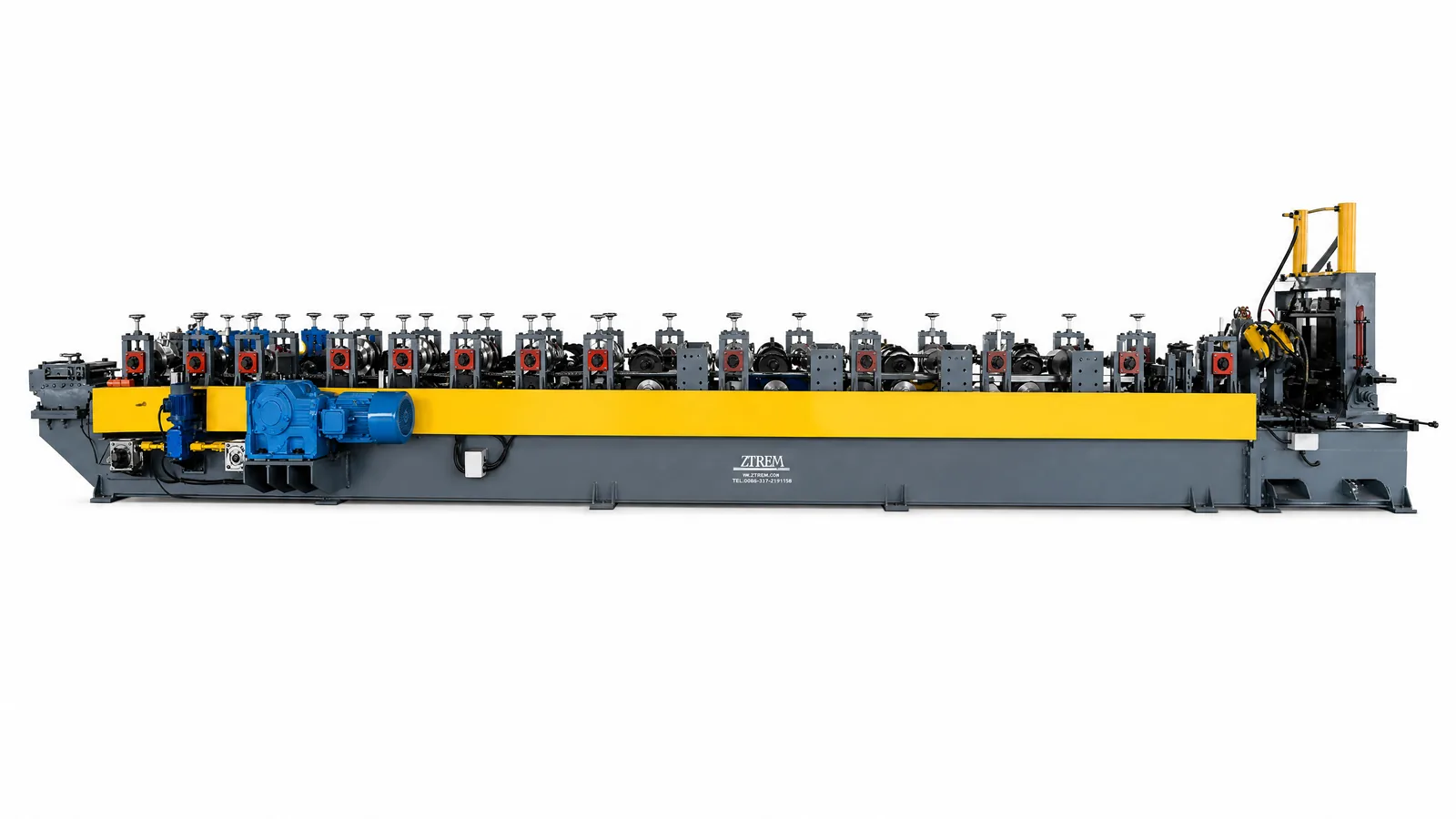
C and Z purlins from one machine with servo width adjustment — the C-to-Z change takes under 10 minutes rather than half a shift.
Technical Specifications
| Material | GI, galvanised, pre-painted steel |
| Thickness | 1.5 – 3.0 mm |
| Yield strength | ≤ 550 MPa (hardened rolls for higher) |
| Web height | C: 60 – 350 mm · Z: 60 – 300 mm |
| Flange | 45 – 90 mm, adjustable |
| Lip | 10 – 25 mm, adjustable |
| Forming speed | 8 – 25 m/min |
| Forming stations | 16 – 20 |
| Drive | Servo or gearbox, 15 – 22 kW |
| C → Z change | < 10 min (servo) · 30–45 min (manual) |
| Punching | Web holes 11 / 13 / 14 mm at auto pitch |
| Cutting | Hydraulic flying saw or post-cut |
| Control | PLC + 7″ touch-screen HMI |
| Certification | CE Declaration of Conformity |
| Lead time | 45 – 60 days |
Need a quote or a custom specification?
CZ Purlin Roll Forming Machine in Our Workshop
 0:43
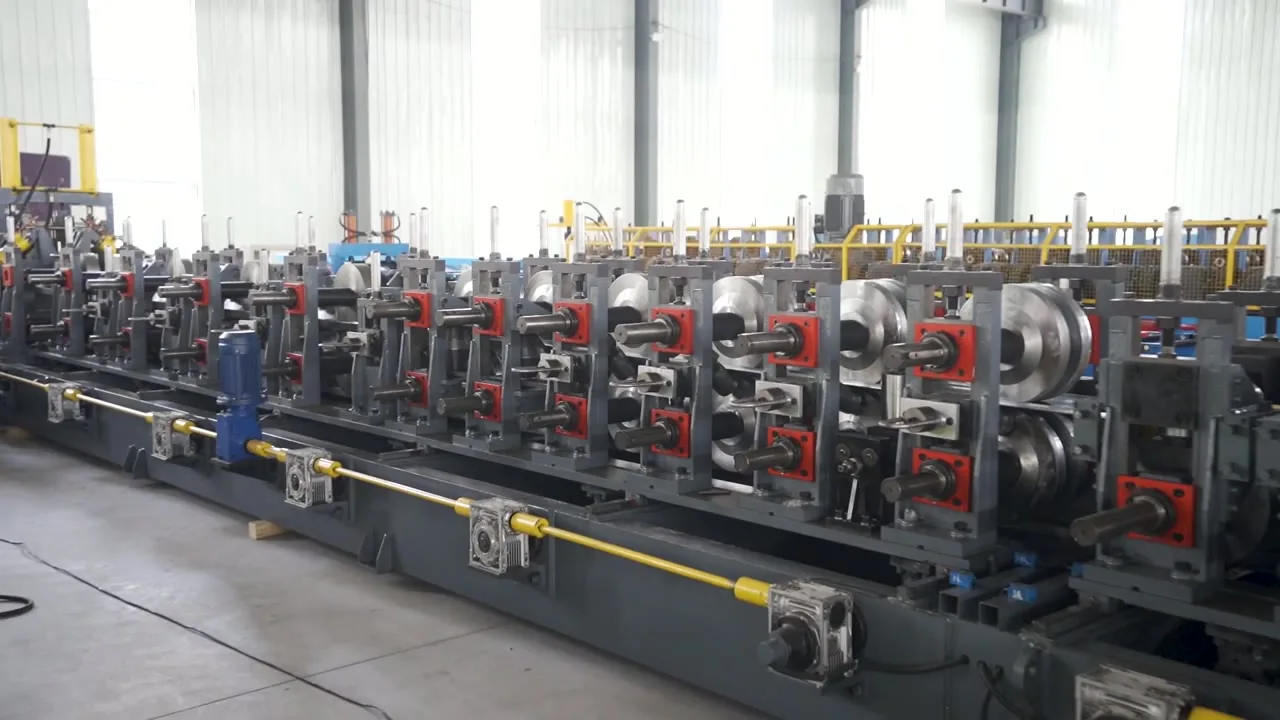
0:43 CZ Purlin Roll Forming Machine — Full Line Running | ZTRFM
the whole line from the entry end to the runout table, with the forming stations and hydraulic cutting unit visible.
Machine specifications →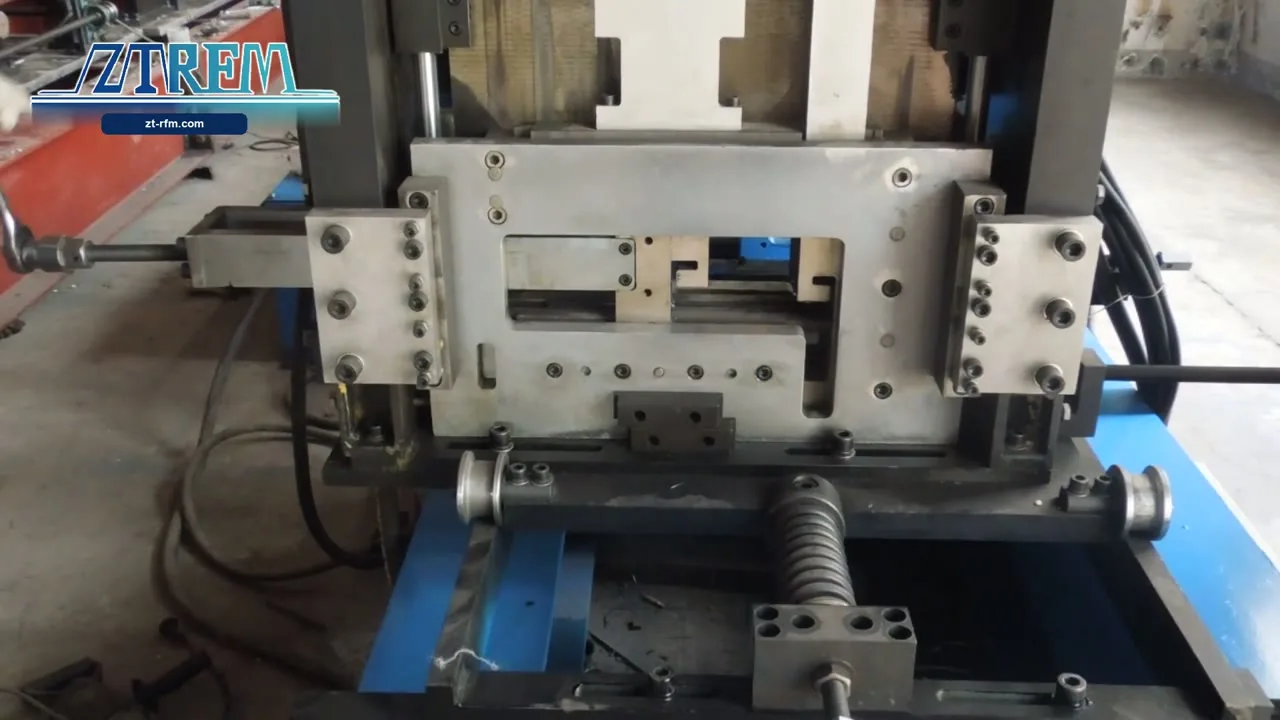 0:25
0:25 CZ Purlin Machine — Cutting Station Detail | ZTRFM
a close-up of the cutting station at the end of the forming section.
Machine specifications →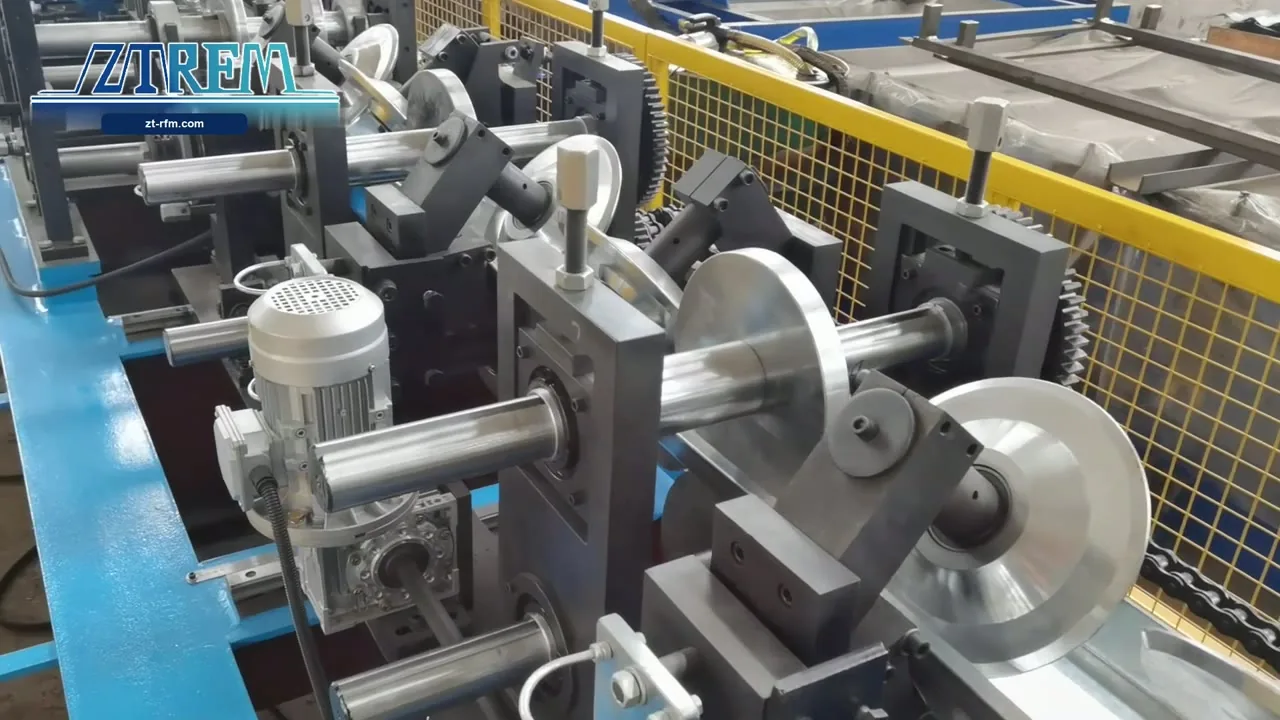 1:10
1:10 CZ Purlin Machine — Forming Rolls and Stations Up Close | ZTRFM
the forming section up close: the roller sets, the drive side and the hydraulic stations along the line. (Source clip replaced 2026-09-17 — the previous footage carried a third-party watermark.)
Machine specifications →What This Machine Produces
C purlins from 60 to 350 mm web height — the symmetric section normally used as a single-span roof or wall purlin, and for end bays, columns and floor joists.
Z purlins from 60 to 300 mm web height — the point-symmetric section that laps with its neighbour along a run.
Lapped Z runs — because a Z section nests with the next one, a row of single spans becomes a continuous beam. On a long roof this typically halves the bending moment compared with single spans, which is why Z purlins dominate long industrial roofs.
Flange 45–90 mm and lip 10–25 mm, both adjustable, so the section can be matched to the engineer’s span table rather than to a fixed catalogue size.
Punched purlins — 11 mm, 13 mm or 14 mm web holes at an automatically programmed pitch, preset per length run so a whole building set is produced without stopping the line.
Purlins in 1.5–3.0 mm galvanised, pre-painted or plain steel up to 550 MPa yield, formed at 8–25 m/min.
Recommended Configuration
A complete working line, not just the forming machine. Each item below is quoted as one package.
- 01
Hydraulic decoiler
purlin coil at 1.5–3.0 mm is heavy, so coil handling is the first thing to size correctly.
- 02
Strip straightener
a heavy purlin section will carry any coil set straight through the line, and a bowed purlin is scrap on site.
- 03
CZ purlin roll forming machine
16–20 stations on a servo or gearbox drive at 15–22 kW. The servo option is what makes the C-to-Z change take under 10 minutes instead of 30–45 minutes.
- 04
Inline web punch
punches 11, 13 or 14 mm holes at an automatically programmed pitch while the strip is flat, which is the only way to hold hole position on a 3 mm section.
- 05
Hydraulic flying saw or post-cut
purlin is cut after forming; a flying saw keeps the line running rather than stopping for every cut.
- 06
PLC with 7-inch touch-screen HMI
the width, lip and punch pattern for each purlin size are entered here, and on the servo machine they are recalled rather than re-set by hand.
- 07
Runout table sized to your longest purlin
purlins are long and heavy, and a short runout forces manual handling on every cut.
Production Workflow
- 01
Decoiler
Coil is loaded and uncoiled at controlled tension. At 1.5–3.0 mm the coil is stiff, so the decoiler brake setting has a direct effect on whether the finished purlin is straight.
- 02
Straightening
The strip is levelled before forming. Heavy-gauge coil set cannot be corrected by roll adjustment later, so this step decides the straightness of the final member.
- 03
Web punching
11 mm, 13 mm or 14 mm bolt holes are punched at the automatically programmed pitch while the strip is flat. Punching flat is what allows a 3 mm section to be punched accurately; punching a formed section at this thickness distorts it.
- 04
Roll forming
16–20 stations form the C or Z section, with flange at 45–90 mm and lip at 10–25 mm. Line speed is 8–25 m/min, and the actual figure depends mainly on the web height and thickness being run.
- 05
C-to-Z change
On a servo machine the change is entered on the HMI and takes under 10 minutes for full width and lip adjustment. On a manual gearbox machine every station has to be reset by hand, which takes 30–45 minutes.
- 06
Cutting and output
A hydraulic flying saw or post-cut cuts to length, and members leave on the runout table. Lapped Z runs are normally cut as matched sets, so the batch counter is set accordingly.
Key Components
- Forming stations
- 16–20, on a servo or gearbox drive
- Drive
- Servo or gearbox, 15–22 kW
- Web punching
- 11 / 13 / 14 mm holes at automatically programmed pitch
- C-to-Z adjustment
- Under 10 min servo · 30–45 min manual
- Cutting
- Hydraulic flying saw or post-cut
- Control
- PLC + 7-inch touch-screen HMI
- Working ranges
- C web 60–350 mm · Z web 60–300 mm · flange 45–90 mm · lip 10–25 mm
Customization Options
Every line is built to order. These are the points buyers most often change.
| Item | What can be changed |
|---|---|
| Section type | C only, Z only, or both on one machine |
| Web height | C 60–350 mm · Z 60–300 mm; custom tooling up to 400 mm web can be designed |
| Flange and lip | 45–90 mm and 10–25 mm, both adjustable |
| Punch pattern | 11 / 13 / 14 mm holes at your pitch, preset per length run |
| Drive type | Servo for quick width changes, gearbox where the size range is fixed |
| Steel grade and thickness | 1.5–3.0 mm, up to 550 MPa yield; hardened rolls at HRC 60–62 for higher grades |
| Power supply | 380 V / 50 Hz / 3-phase standard; other voltages to your site |
C purlin vs Z purlin — when each is the right choice
| Section | Best loaded as | Typical use | Why |
|---|---|---|---|
| C purlin | Single-span or simple beam | Purlins on small buildings, end bays, columns, floor joists | Symmetric flange geometry suits simple supports; easiest to nest and transport |
| Z purlin | Continuous multi-span | Long roof and wall runs with overlapping spans | Lapping Z sections creates a continuous beam, cutting bending moment by roughly half versus single spans |
Applications
FAQ — CZ Purlin Roll Forming Machine
How fast can the machine switch from C to Z?
What is the maximum web height?
Does it punch the web holes automatically?
Can it handle 3.0 mm G550?
What is the difference between C and Z purlin?
Why does purlin thickness matter so much?
What is the typical production output?
Does the machine include straightening and a decoiler?
Can the machine be built for our own profile?
How do we get a price for this line?
Which coil materials can the line run?
How many forming stations does it use?
You May Also Need
Send us your profile and output target
Tell us the profile and the numbers that matter to you. We confirm the configuration against the specification table above and quote FOB Tianjin within 24 hours.
- MaterialGI, galvanised, pre-painted steel
- Thickness1.5 – 3.0 mm
- Yield strength≤ 550 MPa (hardened rolls for higher)
- Web heightC: 60 – 350 mm · Z: 60 – 300 mm