Floor Deck Roll Forming Machine
Composite and deep-rib profiled steel decking for multi-storey construction — one machine covering both 50 mm composite deck and 75 mm deep-rib deck.
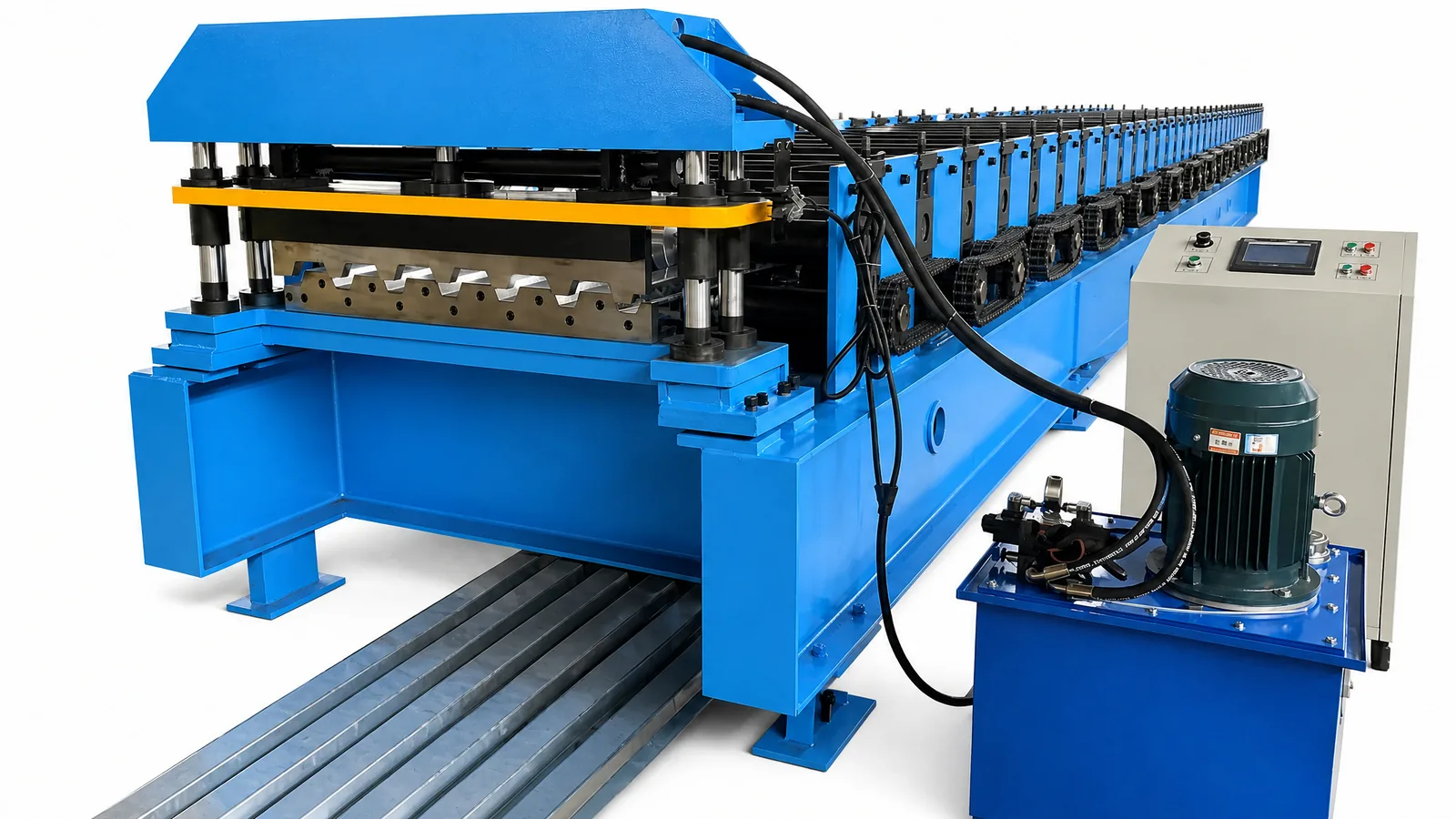
Technical Specifications
| Material | GI, galvanised, aluminium, pre-painted steel |
| Thickness | 0.8 – 1.5 mm |
| Effective cover width | 600 / 750 / 900 mm |
| Rib height | 50 – 80 mm (variant dependent) |
| Forming speed | 10 – 20 m/min |
| Forming stations | 22 – 26 |
| Drive | Gearbox chain drive, 11 – 18.5 kW |
| Embossing | Inline embossing unit for composite bond |
| Punching | Shear stud access holes, optional inline |
| Cutting | Hydraulic flying cut |
| Control | PLC + HMI, auto length + batch |
| Certification | CE Declaration of Conformity |
| Lead time | 45 – 60 days |
| Profile tolerance | ±0.5 mm on rib height · ±1 mm on cover width |
Need a quote or a custom specification?
Floor Deck Roll Forming Machine in Our Workshop
 0:43
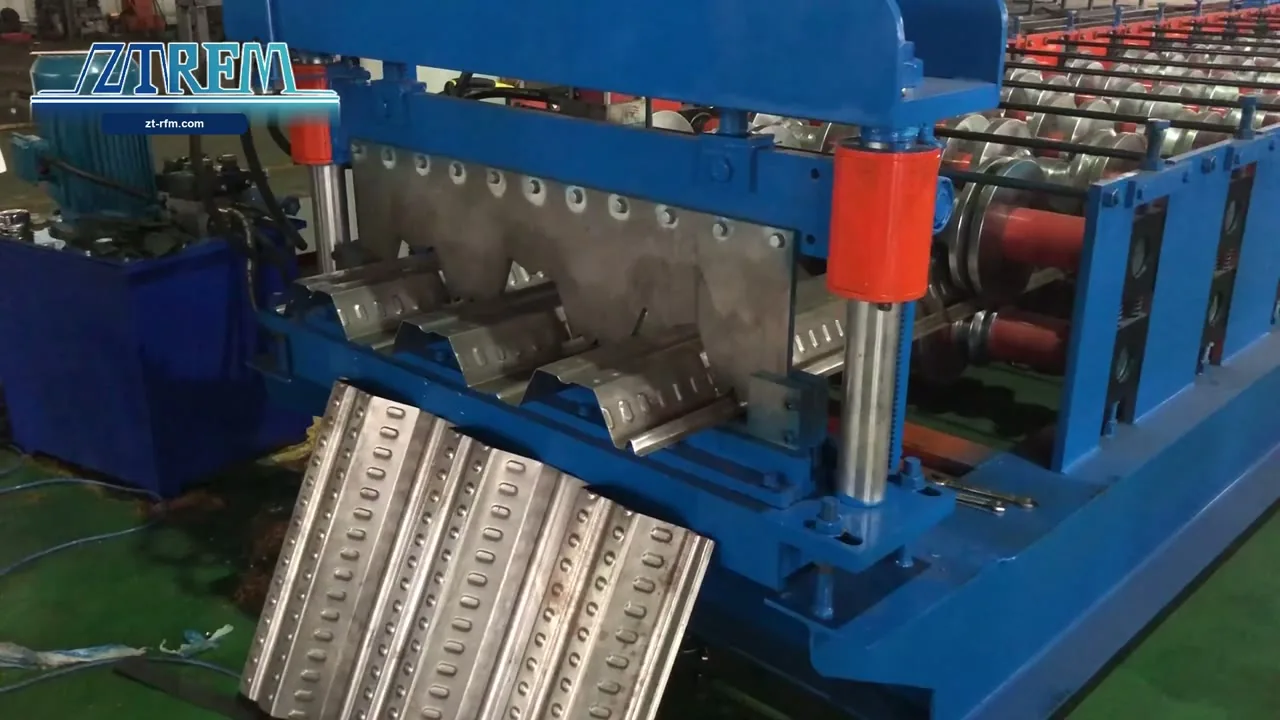
0:43 Floor Deck Roll Forming Machine — Forming and Cutting Station | ZTRFM
the forming and cutting station, with the deck profile visible at the output end.
Machine specifications →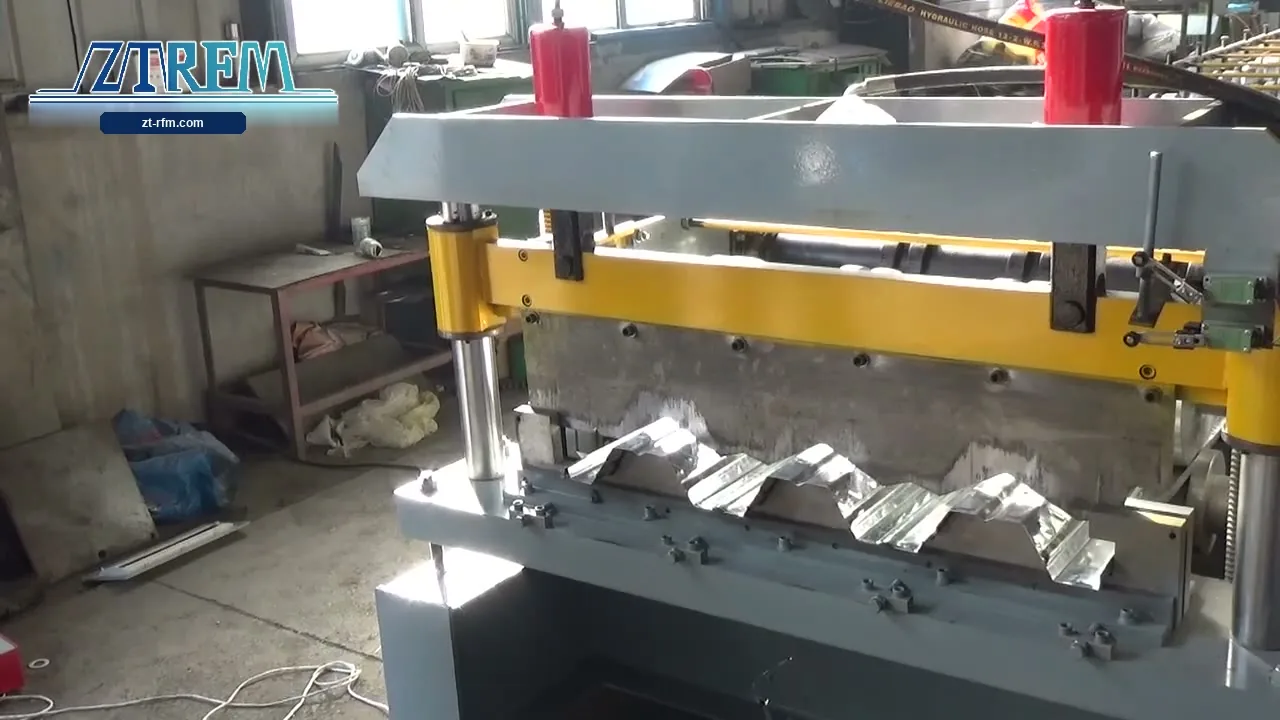 0:52
0:52 Floor Deck Roll Forming Machine — Roller Bank | ZTRFM
a close-up of the roller bank that forms the deck ribs.
Machine specifications →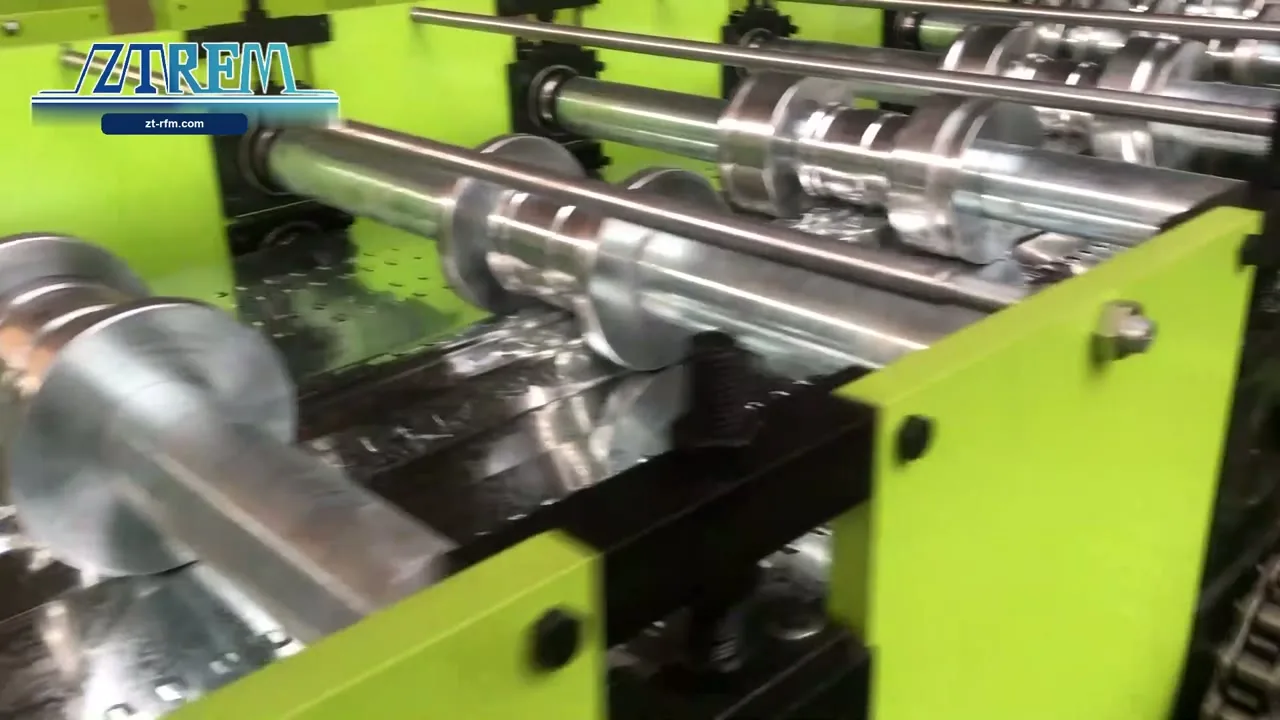 1:10
1:10 Floor Deck Roll Forming Machine — Forming Rolls in Operation | ZTRFM
the forming rolls running, viewed along the line.
Machine specifications →What This Machine Produces
Composite deck at around 50 mm rib — embossed ribs bond mechanically to the concrete and shear studs tie the slab to the beam, so the deck acts as tensile reinforcement. In many designs that removes the need for mesh reinforcement.
Deep-rib deck at 60–75 mm — the deeper rib carries the load by itself, which suits long spans, thinner overall floor depths, and cases where propping during construction is undesirable.
Re-entrant deck at 50–60 mm — a narrow top flange closes the rib, giving better fire performance on the deck itself.
Cover widths of 600, 750 and 900 mm; the required strip width is calculated from the profile drawing rather than assumed from a standard.
Embossed decking — the inline embossing unit forms the pattern that creates the mechanical steel-to-concrete bond. Without it the deck is plain formwork and the composite design assumption is invalid.
Decking with shear stud access holes — optional inline punching to your stud diameter and pitch, typically 13 mm, 16 mm or 19 mm.
Deck in 0.8–1.5 mm galvanised, pre-painted or aluminium sheet, formed through 22–26 stations at 10–20 m/min.
Recommended Configuration
A complete working line, not just the forming machine. Each item below is quoted as one package.
- 01
Hydraulic decoiler and straightener
deck is a wide, shallow section, so coil set is visible across the full cover width. Straightening before forming is the only place it can be removed.
- 02
Inline embossing unit
this is not an optional extra on a composite deck line. The embossment is what makes the steel and concrete act together, so the embossing rolls must be fitted, correctly set and maintained.
- 03
Floor deck roll forming machine
22–26 stations on a gearbox chain drive at 11–18.5 kW, forming at 10–20 m/min. The high station count is what holds a deep rib to ±0.5 mm without distorting the wide pan.
- 04
Shear stud punch (optional)
punches access holes at your stud diameter and pitch while the strip is flat.
- 05
Hydraulic flying cut
deck panels are long, and stopping the line at every cut would make the line uneconomic.
- 06
PLC with auto length and batch
lengths are set from the slab layout rather than measured off the line.
- 07
Runout table and stacking
deck panels are wide and awkward; a long runout keeps them flat instead of kinked.
Production Workflow
- 01
Decoiler
Coil is loaded and uncoiled at controlled tension. Deck runs across a wide cover width, so any tension variation becomes a visible wave across the pan.
- 02
Straightening
The strip is levelled before forming. Because deck is shallow and wide, residual coil set cannot be removed after the section is closed.
- 03
Punching
Where shear stud access holes are specified — typically 13, 16 or 19 mm, at your pitch — they are punched while the strip is flat.
- 04
Roll forming
22–26 stations form the ribs progressively. The station count is high because a deep rib in 0.8–1.5 mm material has to be built up gradually: pulling the full rib depth in one or two passes would thin the material at the bend radii.
- 05
Embossing
The embossing unit forms the pattern that keys the concrete to the steel. On a composite deck this step carries the structural assumption of the design, so it is checked with the rest of the profile at setup.
- 06
Cutting and output
A hydraulic flying cut cuts to the slab length set on the HMI, and panels leave on the runout table for stacking.
Key Components
- Forming stations
- 22–26
- Drive
- Gearbox chain drive, 11–18.5 kW
- Embossing unit
- Inline; forms the mechanical bond pattern for composite action
- Shear stud punch
- Optional inline; typically 13 / 16 / 19 mm
- Cutting
- Hydraulic flying cut
- Control
- PLC + HMI, auto length and batch
- Working range
- 0.8–1.5 mm · cover width 600 / 750 / 900 mm · rib height 50–80 mm
Customization Options
Every line is built to order. These are the points buyers most often change.
| Item | What can be changed |
|---|---|
| Deck variant | Composite 50 mm, deep-rib 60–75 mm, or re-entrant 50–60 mm |
| Cover width | 600 / 750 / 900 mm; strip width is calculated from your profile drawing |
| Shear stud holes | Optional inline punching at your diameter and pitch |
| Material | Galvanised, pre-painted, or aluminium 1.0–1.5 mm with adjusted roll pressure |
| Tolerance | ±0.5 mm on rib height and ±1 mm on cover width are typical, checked with a profile gauge |
| Power supply | 380 V / 50 Hz / 3-phase standard; other voltages to your site |
Composite deck vs deep-rib deck — which variant do you need?
| Variant | Rib height | Typical span | How it works | Use when |
|---|---|---|---|---|
| Composite deck | 50 mm | 2.5 – 3.6 m | Embossed ribs bond mechanically to the concrete; shear studs give composite action | Normal multi-storey slabs where mesh reinforcement can be omitted |
| Deep-rib deck | 60 – 75 mm | 3.6 – 6.0 m | Deeper rib carries load by itself; often used without composite action | Long spans, lower storey depths, or where propping is undesirable |
| Re-entrant deck | 50 – 60 mm | 3.0 – 4.5 m | Narrow top flange closes the rib for better fire performance | Projects with a fire-rating requirement on the deck itself |
Applications
FAQ — Floor Deck Roll Forming Machine
What is composite floor deck and how does it work?
Composite deck or deep-rib deck — which do I need?
What effective cover width is standard?
Does the line include shear stud holes?
Why is inline embossing important?
Can the machine run aluminium deck?
What is the tolerance on rib height?
How long does installation take versus a traditional slab?
Can the machine be built for our own profile?
How do we get a price for this line?
What material thickness can this machine form?
What is the production speed?
You May Also Need
Send us your profile and output target
Tell us the profile and the numbers that matter to you. We confirm the configuration against the specification table above and quote FOB Tianjin within 24 hours.
- MaterialGI, galvanised, aluminium, pre-painted steel
- Thickness0.8 – 1.5 mm
- Effective cover width600 / 750 / 900 mm
- Rib height50 – 80 mm (variant dependent)