ASTM M180 Guardrail Roll Forming Machine
North American W-beam guardrail line. ASTM M180 Class A and Class B, 3,810 mm (12'6") sections, inline bolt hole punching -- the specification US, Canadian and Latin American road authorities require.
ASTM M180 / AASHTO You are viewing the ASTM M180 / AASHTO build of this machine. See the standard version →
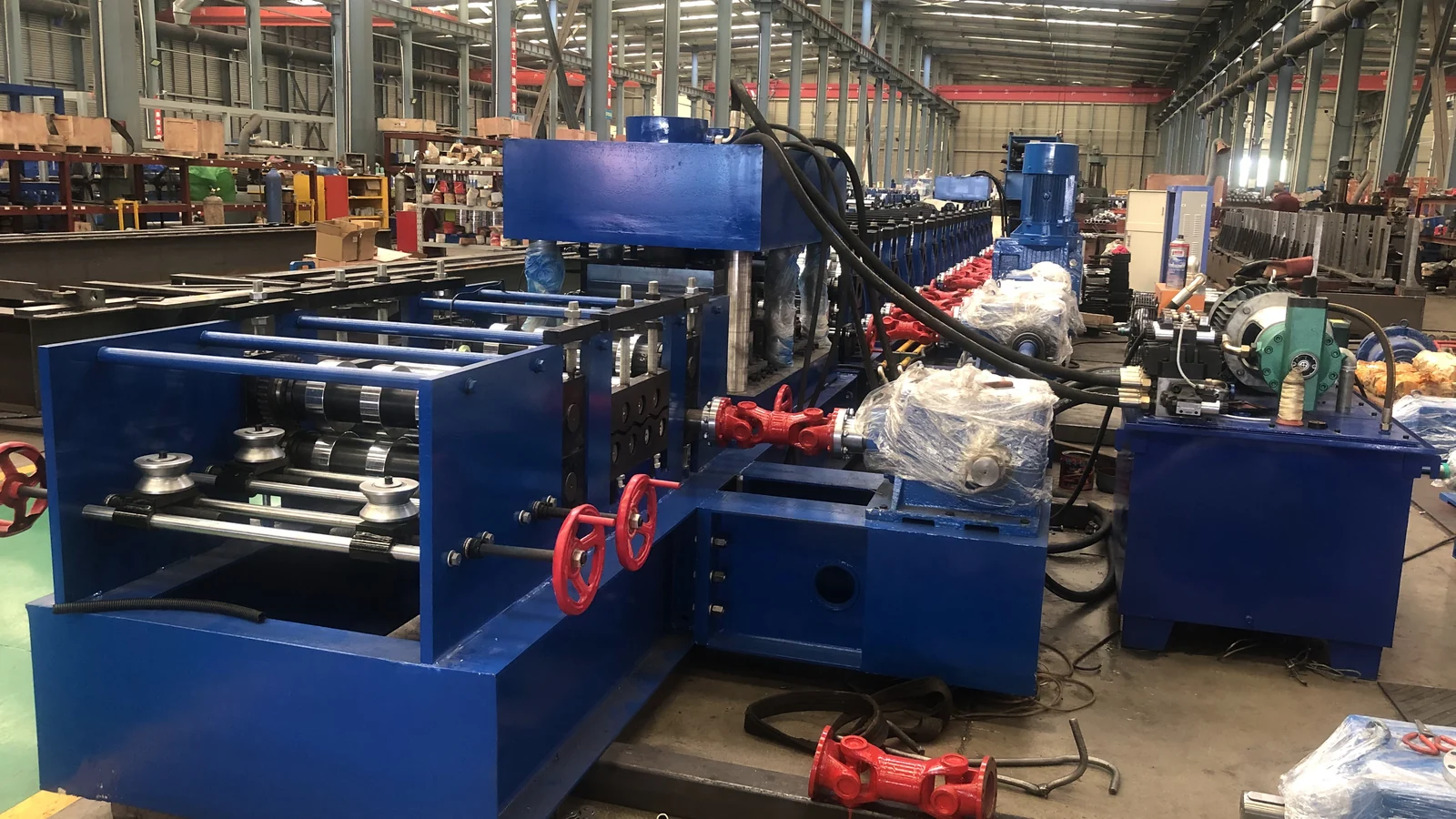
Technical Specifications
| Profile | ASTM M180 W-beam -- Class A or Class B |
| Section length | 3,810 mm (12 ft 6 in) standard |
| Beam width | 310-312 mm |
| Wave depth | 83 mm |
| Flange width | approx. 55 mm |
| Material thickness | Class A: 2.67 mm (0.105 in, 12 ga); Class B: 3.43 mm (0.135 in, 10 ga) |
| Steel grade | ASTM A1011 / A1011M Grade 50 (345 MPa min yield) |
| Galvanising | Hot-dip to ASTM A123 / A525; min avg 610 g/m2 (2 oz/ft2) |
| Bolt hole punch | Inline -- 9/16 in (14.3 mm) dia, 400 mm pitch along beam |
| Forming speed | 8-15 m/min |
| Forming stations | 18-24 |
| Drive | Heavy-duty gearbox; min 37 kW |
| Cutting | Flying die-cut press -- cuts to 3,810 mm without stopping |
| Control | PLC + HMI, auto length, batch, hole-punch synchronisation |
| Lead time | 45-60 days ex-works |
Need a quote or a custom specification?
Configuration Options
W-beam guardrail standards by market
| Standard | Market | Section length | Thickness (Class A) | Test method |
|---|---|---|---|---|
| ASTM M180 / AASHTO M180 | United States, Canada, Latin America | 3,810 mm (12'6in) | 2.67 mm (0.105 in) | NCHRP / AASHTO crash test |
| EN 1317-2 | Europe, Middle East, Africa, Asia | 4,320 mm | 3.0 mm typical | EN 1317 containment class N2, H1... |
| AS/NZS 3845 | Australia, New Zealand | 4,320 mm | 3.0 mm | EN 1317 protocols |
| BS EN 1317 | UK | 4,320 mm | 3.0 mm | EN 1317 |
Where This Machine Is Used
Applications
Common Questions
FAQ — ASTM M180 Guardrail Roll Forming Machine
What is ASTM M180 guardrail?
ASTM M180 (equivalent to AASHTO M180) is the North American standard specifying the geometry and mechanical properties of W-beam highway guardrail. Class A is 2.67 mm (12 ga) nominal; Class B is 3.43 mm (10 ga). Standard section length is 3,810 mm (12 ft 6 in). It is used extensively across the United States, Canada and Latin America.
What is the difference between Class A and Class B?
Class A (2.67 mm / 0.105 in) is the standard residential and rural road specification. Class B (3.43 mm / 0.135 in) is used on high-speed expressways and in higher-risk applications where greater energy absorption is required. The machine runs both classes; only the coil material changes.
Is the bolt hole punching inline?
Yes. The inline punch press produces 9/16 in (14.3 mm) diameter holes at 400 mm pitch along the beam, synchronised with the forming line speed. The hole pattern aligns with standard MASH and NCHRP post spacings of 1,905 mm (6 ft 3 in).
Does your machine produce EN 1317 sections as well as ASTM M180?
The ASTM M180 machine is configured for 3,810 mm section length and the US beam geometry. The EN 1317 machine produces 4,320 mm sections with the European W-beam geometry. The two profiles are not identical, so the tooling is specific to the standard. We supply both configurations.
What galvanising specification applies to ASTM M180 guardrail?
ASTM M180 requires hot-dip galvanising to ASTM A123 or A525, with a minimum average coating weight of 610 g/m2 (2 oz/ft2). This is heavier than the European minimum and reflects the longer service-interval philosophy in North American road maintenance.
What steel grade does the machine process?
ASTM A1011 Grade 50 (345 MPa minimum yield) is the standard. The machine is designed for 2.67-3.43 mm thick high-strength steel and includes a heavy-duty gearbox drive rated for the forming load. Processing thinner or weaker material simply requires no modification.
Can the machine be built for our own profile?
Yes. Send the profile drawing with the section dimensions, the material and thickness, and the coil width you intend to run. We confirm the roll design, forming stations and line layout against that drawing before quoting, so the machine matches the section you actually sell.
How do we get a price for this line?
Send the profile drawing or section dimensions, the material and thickness, the coil width, and your target output per shift. Price depends on the profile, the coil and the level of automation, so we quote against your actual job rather than a catalogue figure.
What material thickness can this machine form?
Material thickness runs Class A: 2.67 mm (0.105 in, 12 ga); Class B: 3.43 mm (0.135 in, 10 ga). The roll gap, drive and cutting unit are set for this range, so staying inside it is what keeps the section geometry repeatable run after run.
What is the production speed?
Forming speed is 8-15 m/min. Treat this as the line speed: real shift output also depends on cut length, coil reloading and how often the profile is changed.
How many forming stations does it use?
The line uses 18-24 forming stations. Station count follows the section — more bends and tighter tolerances need more forming steps, which is why two profiles rarely share one roll set.
What is the drive and installed power?
Drive: Heavy-duty gearbox; min 37 kW. Final drive sizing is confirmed against your profile and coil, because a wider or thicker section needs more torque to hold the same line speed.
Related Machines
You May Also Need
Send us your profile and output target
Tell us the profile and the numbers that matter to you. We confirm the configuration against the specification table above and quote FOB Tianjin within 24 hours.
- ProfileASTM M180 W-beam -- Class A or Class B
- Section length3,810 mm (12 ft 6 in) standard
- Beam width310-312 mm
- Wave depth83 mm