Highway W-Beam Guardrail Roll Forming Machine
A heavy-duty line that forms W-beam and thrie-beam highway guardrail with in-line punching and cutting. Two production-tested models — the GR2 two-wave line and the GR3 three-wave line — each tooled to your national standard.
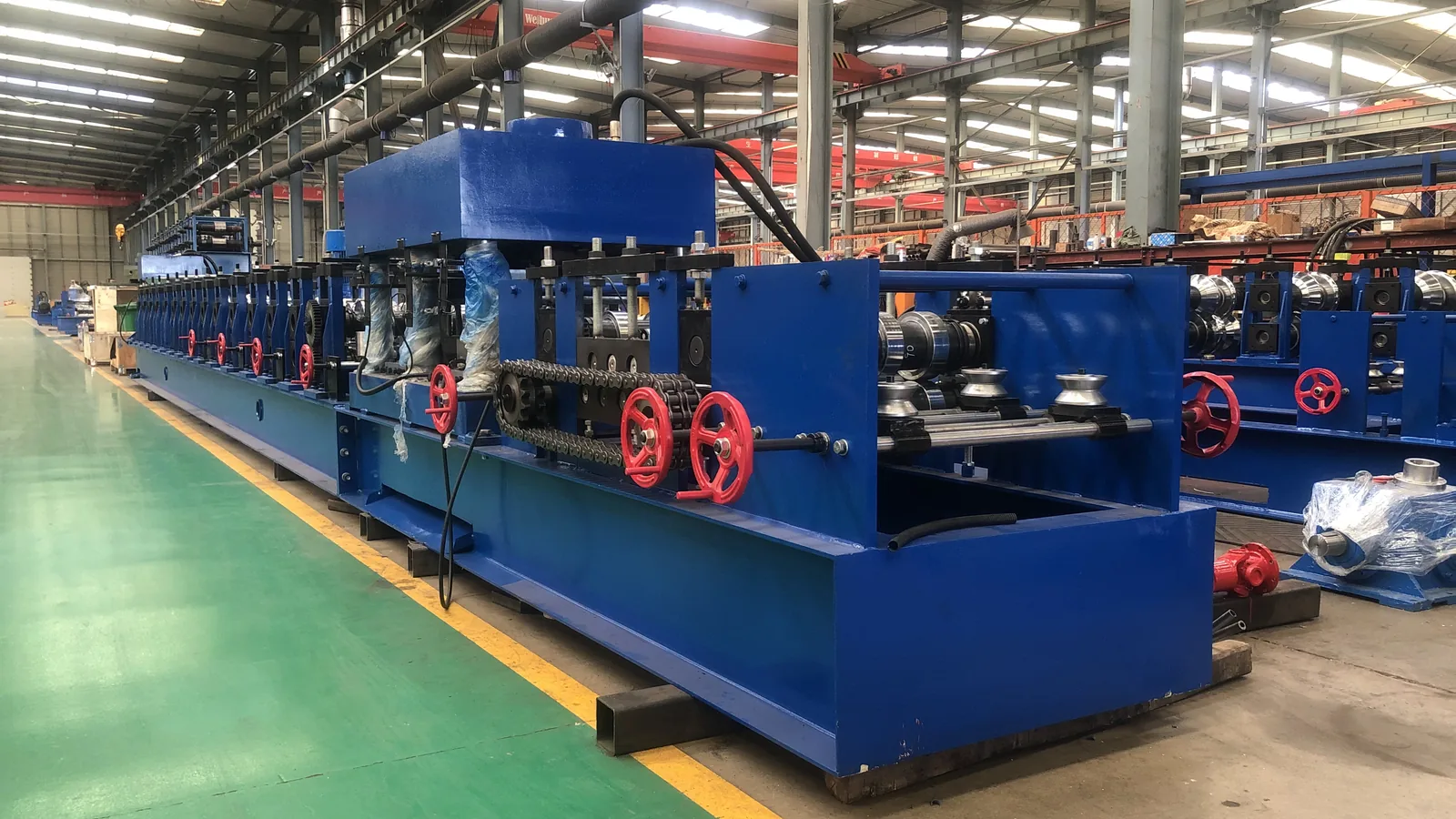
Technical Specifications
| Formed profile | W-beam (two-wave) and thrie-beam (three-wave) highway guardrail |
| Feeding width | 490 mm |
| Finished cover width | 312 mm (W-beam) |
| Finished profile height | 90 mm |
| Material | Galvanised steel, cold-rolled steel, carbon steel, PPGI, Q235 |
| Material thickness | 2.5 – 4.0 mm |
| Yield strength | ≤ 345 MPa (Q235 / Q345 / S235 / S275) |
| Output length | 4320 mm ± 2 mm (EN 1317-2) · 3810 mm (ASTM M180) |
| Forming speed | 15 – 20 m/min (GR2) · 25 m/min (GR3) |
| Forming stations | 15 fixed driven stations (GR2) · 16 stations (GR3) |
| Main motor power | 22 kW × 2 (GR2) · 30 kW Siemens (GR3) |
| Roller material | GCr15 bearing steel, HRC 55–60 (GR2) · 45# tempered, φ95 mm shafts (GR3) |
| Punching | In-line hydraulic punching — bolt slots and fixing holes before cutting |
| Cutting | Automatic, Cr12 quenched cutter HRC 60–62, length and quantity presets |
| Decoiler | Hydraulic, 10 t capacity, coil ID 508 mm |
| Control system | Siemens PLC + Siemens frequency inverter, touch screen (EN / CN) |
| Standards | EN 1317 · ASTM M180 · AS/NZS 3845 |
| Certification | CE Declaration of Conformity |
| Lead time | 55 – 70 days |
Need a quote or a custom specification?
Which configuration fits your project
ZTRFM-GR2 — Two-Wave W-Beam Guardrail Line
The standard highway barrier line. The two-wave and automatic two-wave machines in our range share the same core parameters and are supplied as this one model.
| Formed profile | W-beam, two-wave highway guardrail |
| Applicable materials | Galvanised steel, cold-rolled steel, carbon steel, Q235 |
| Material thickness | 2.5 – 4.0 mm (per specification table above) |
| Feeding width | 490 mm |
| Finished cover width | 312 mm |
| Finished profile height | 90 mm |
| Forming stations | 15 fixed driven stations |
| Main motor power | 22 kW × 2 |
| Forming speed | 15 – 20 m/min |
| Length accuracy | 4320 mm ± 2 mm |
| Roller material | GCr15 bearing steel, HRC 55–60 |
| Punching & cutting | Hydraulic in-line punching and cut; length / quantity presets |
| Decoiler | Hydraulic type, 10 t loading capacity, coil ID 508 mm |
| Control system | Siemens PLC + Siemens frequency inverter, touch screen (EN / CN) |
| Certification | CE Declaration of Conformity |
ZTRFM-GR3 — Three-Wave Thrie-Beam Guardrail Line
The heavy-duty line for bridges, medians and other high-impact locations. Heavier frame, higher tonnage, larger cutting knife.
| Formed profile | Thrie-beam, three-wave guardrail |
| Formed material | PPGI / GI / aluminium (customised) |
| Forming stations | 16 stations |
| Shaft diameter | φ95 mm |
| Roller material | 45# steel with tempering |
| Machine frame | 400 H steel; gearbox transmission drive |
| Cutting | Automatic, Cr12 quenched cutter (HRC 60–62) |
| Motor power | 30 kW, Siemens |
| Forming speed | 25 m/min (depends on profile and thickness) |
| Voltage | 380 V / 50 Hz / 3-phase (as required) |
| Machine dimension (L × W × H) | 18,500 × 1,200 × 1,500 mm |
| Weight | 15 t |
| Control | PLC automatic — batch, length and quantity presets; multi-language screen |
| Decoiler | Hydraulic automatic decoiler (manual decoiler included) |
| Certification | CE Declaration of Conformity |
What This Machine Produces
W-beam (two-wave) highway guardrail panels — the standard roadside barrier profile, 490 mm strip in, 312 mm cover out, 90 mm profile height.
Thrie-beam (three-wave) guardrail panels — a deeper, higher-impact profile for bridges, central reserves and other high-risk locations.
Bolted connection details formed in the same pass: bolt slots and fixing holes are punched in-line, so the panel arrives ready to install — no secondary drilling on site.
Panels cut to the length your standard calls for. EN 1317-2 uses 4320 mm; ASTM M180 uses 3810 mm; other lengths are tooled to your drawing. Length accuracy is ±2 mm.
Guardrail-to-post hardware positions — hole pitch and slot geometry are set to your national standard drawing, not to a generic pattern.
Matching end terminals can be produced on the same platform with an additional tooling set, so a single line covers the full barrier sight.
Recommended Configuration
A complete working line, not just the forming machine. Each item below is quoted as one package.
- 01
Hydraulic decoiler, 10 t
holds the coil and feeds strip at controlled tension. 508 mm coil ID is standard for guardrail; the GR3 line also includes a manual decoiler.
- 02
Strip leveling unit
guardrail is run from thicker, higher-strength coil than most profiles, so the strip is straightened before it enters the first station. Without this, residual coil set shows up as twist in the finished panel.
- 03
In-line hydraulic punching press
punches bolt slots and fixing holes before forming. Doing it here, rather than on the finished section, is what makes the ±2 mm hole-to-hole accuracy achievable.
- 04
Roll forming machine
15 stations (GR2) or 16 (GR3) on a 400 H steel frame, gearbox transmission drive, 22 kW × 2 (GR2) or 30 kW Siemens (GR3).
- 05
Automatic cutter with Cr12 quenched knife (HRC 60–62)
cuts to preset length and batch quantity. Guardrail is thick material, so this is a die-cut press rather than a light shear.
- 06
PLC control cabinet
Siemens PLC and frequency inverter, touch screen in English and Chinese, with batch, length and quantity presets.
- 07
Runout table and stacking
panels are 4320 mm and heavy; a powered runout and stacking arrangement keeps the line running without manual handling between cuts.
Production Workflow
- 01
Decoiler
The steel coil is loaded on the hydraulic mandrel (10 t capacity, 508 mm coil ID) and uncoiled at controlled tension.
- 02
Leveling
The strip passes through a leveling unit that removes coil set and cross-bow before forming. This step matters more on guardrail than on thin roofing profiles, because 2.5–4.0 mm high-strength strip holds its deformation.
- 03
In-line hydraulic punching
Bolt slots and fixing holes are punched at the standard pitch while the strip is still flat. Punching flat is what delivers the ±2 mm length accuracy on the finished panel.
- 04
Roll forming
15 driven stations (GR2) or 16 stations (GR3) form the W-beam or thrie-beam section progressively. Rolls are GCr15 bearing steel at HRC 55–60 on the GR2, and 45# tempered steel on φ95 mm shafts on the GR3.
- 05
Automatic cutting
The Cr12 quenched cutter (HRC 60–62) cuts at the preset length and batch quantity — for example 4320 mm ± 2 mm, 100 panels.
- 06
Output and stacking
Finished panels leave on the runout table, stacked and ready for galvanising inspection and packing.
Key Components
- Hydraulic decoiler
- 10 t capacity, coil ID 508 mm; manual decoiler included with the GR3 line
- Leveling unit
- Straightens high-strength strip before the first forming station
- Hydraulic punching press
- In-line bolt slots and fixing holes, punched on the flat strip
- Forming stations
- GCr15 rollers HRC 55–60 (GR2); 45# tempered rollers on φ95 mm shafts (GR3)
- Machine frame
- 400 H steel with gearbox transmission drive
- Automatic cutter
- Cr12 quenched knife, HRC 60–62, for 2.5–4.0 mm material
- Drive motor
- 22 kW × 2 (GR2) · 30 kW Siemens (GR3)
- Control system
- Siemens PLC + frequency inverter, touch screen, EN / CN
Customization Options
Every line is built to order. These are the points buyers most often change.
| Item | What can be changed |
|---|---|
| Profile and standard | W-beam or thrie-beam, tooled to your national standard drawing: EN 1317-2, ASTM M180, AS/NZS 3845 or a local specification |
| Panel length | 4320 mm, 3810 mm or a custom cut length — this sets the punching program and the cut-to-length arrangement |
| Bolt pitch and hole pattern | Punched to your drawing rather than a fixed pattern; the punch dies are made to your slot geometry |
| Material and thickness | Galvanised, pre-galvanised, cold-rolled carbon steel, PPGI. Confirm minimum and maximum thickness at order stage, because roll loads and press tonnage are set to the range you specify |
| Forming speed | 15–20 m/min (GR2) or 25 m/min (GR3), depending on section and thickness |
| Power supply | 380 V / 50 Hz / 3-phase standard; other voltages and frequencies to your site |
| Control language | Touch screen language and units on request |
| Output arrangement | Runout and stacking length sized to your panel length and factory layout |
Guardrail profile standards compared
| Standard | Profile | Output length | Main markets | Typical use |
|---|---|---|---|---|
| EN 1317-2 | W-beam (two-wave) | 4320 mm | Europe, Middle East, Africa | Mainline highway verges and medians |
| ASTM M180 | W-beam (two-wave) | 3810 mm | North America | US state DOT and provincial highway work |
| AS/NZS 3845 | W-beam (two-wave) | 4320 mm | Australia, New Zealand | Highway and roadside barrier |
| Thrie-beam | Three-wave | 4320 mm | Bridges, median barriers, high-risk locations | Carries a higher impact load than W-beam |
Applications
FAQ — Highway W-Beam Guardrail Roll Forming Machine
What is a guardrail roll forming machine?
What profiles can this line produce?
What material thickness does it process?
How fast is the line?
Does the machine punch the bolt holes automatically?
What is the difference between W-beam and thrie-beam?
Can I run both profiles on one machine?
Is CE certification included?
What is the lead time and minimum order quantity?
Can the machine be built for our own profile?
How do we get a price for this line?
How many forming stations does it use?
You May Also Need
Send us your profile and output target
Tell us the profile and the numbers that matter to you. We confirm the configuration against the specification table above and quote FOB Tianjin within 24 hours.
- Formed profileW-beam (two-wave) and thrie-beam (three-wave) highway guardrail
- Feeding width490 mm
- Finished cover width312 mm (W-beam)
- Finished profile height90 mm