Guardrail Roll Forming Machine Manufacturers
Two-wave W-beam and three-wave thrie-beam highway guardrail lines — 2.5 – 4.0 mm strip, in-line bolt-slot punching, cut to 4320 mm ± 2 mm for EN 1317-2 or 3810 mm for ASTM M180.
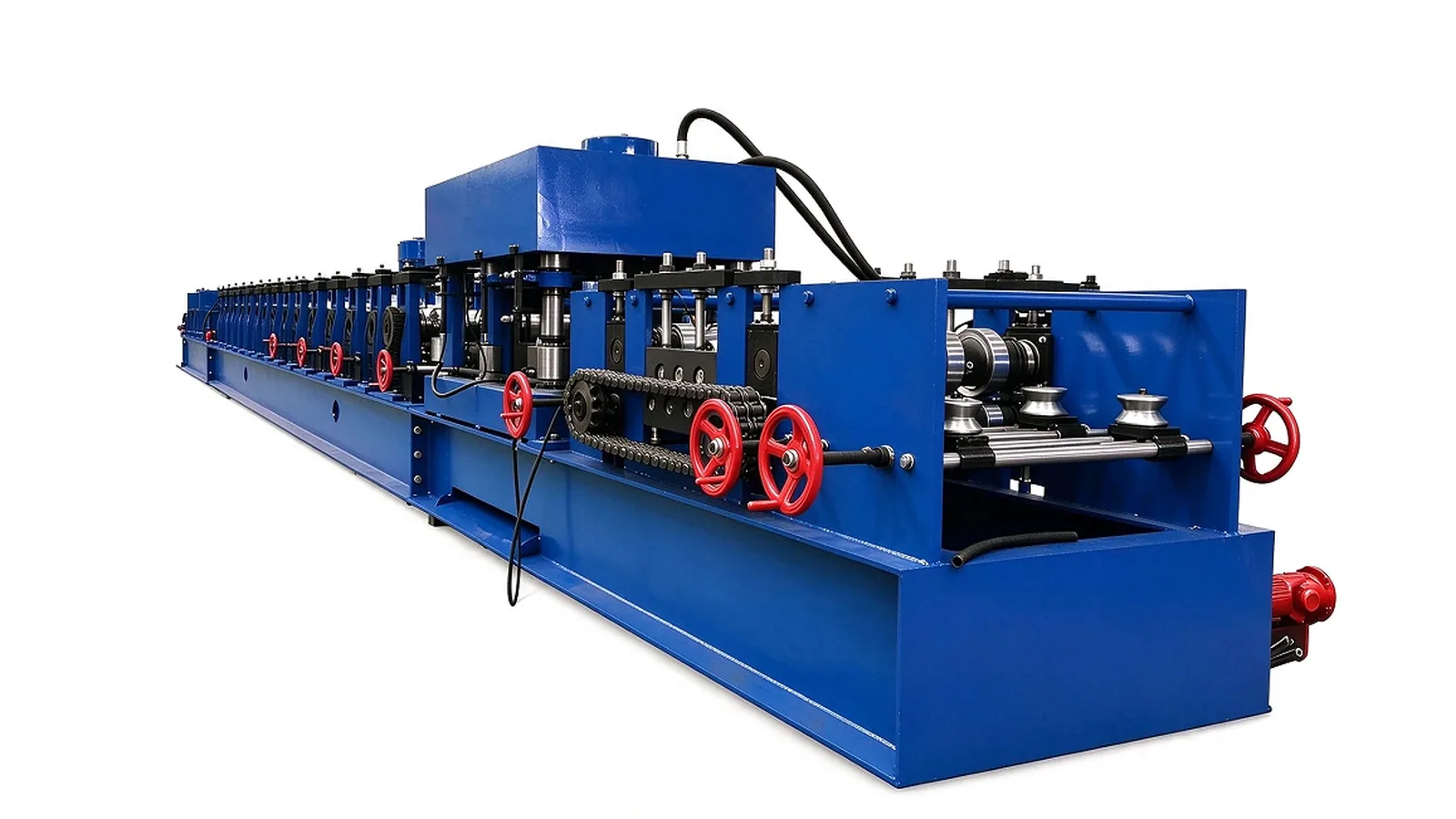
A guardrail roll forming machine turns steel coil into the beam that runs along the edge of a highway. It is a demanding line to buy: the section is heavy, the holes have to line up with posts poured months apart, and the contract is usually thousands of identical beams rather than a mix of lengths.
ZTRFM builds the line in two configurations — the two-wave W-beam line and the three-wave thrie-beam line — and both are assembled, wired and run on our own shop floor before they ship. Everything below is the specification we quote from; if your project runs to a different standard, tell us the standard and we will quote against it.
Which guardrail line fits your market
ZTRFM-GR2 — two-wave W-beam line
W-beam section, 15 fixed driven stations, 22 kW × 2, 15 – 20 m/min, GCr15 bearing-steel rolls at HRC 55–60. The standard highway barrier line.
ZTRFM-GR3 — three-wave thrie-beam line
Thrie-beam section, 16 stations, 30 kW Siemens motor, 25 m/min, 45# tempered rolls on φ95 mm shafts. For markets that specify the three-wave section or run both.
Machine specifications
| Formed profile | W-beam (two-wave) and thrie-beam (three-wave) highway guardrail |
|---|---|
| Feeding width | 490 mm |
| Finished cover width | 312 mm (W-beam) |
| Finished profile height | 90 mm |
| Material | Galvanised steel, cold-rolled steel, carbon steel, PPGI, Q235 |
| Material thickness | 2.5 – 4.0 mm |
| Yield strength | ≤ 345 MPa (Q235 / Q345 / S235 / S275) |
| Output length | 4320 mm ± 2 mm (EN 1317-2) · 3810 mm (ASTM M180) |
| Forming speed | 15 – 20 m/min (GR2) · 25 m/min (GR3) |
| Forming stations | 15 fixed driven stations (GR2) · 16 stations (GR3) |
| Main motor power | 22 kW × 2 (GR2) · 30 kW Siemens (GR3) |
| Roller material | GCr15 bearing steel, HRC 55–60 (GR2) · 45# tempered, φ95 mm shafts (GR3) |
| Punching | In-line hydraulic punching — bolt slots and fixing holes cut before the part is cut off |
| Cutting | Automatic, Cr12 quenched cutter HRC 60–62, length and quantity presets |
| Decoiler | Hydraulic, 10 t capacity, coil ID 508 mm |
| Control system | Siemens PLC + Siemens frequency inverter, touch screen (EN / CN) |
| Standards | EN 1317 · ASTM M180 · AS/NZS 3845 |
| Certification | CE Declaration of Conformity |
| Lead time | 55 – 70 days |
Values are given per model where the two lines differ (GR2 = two-wave, GR3 = three-wave); where a value is common to both it is stated once. A machine is quoted against one of these configurations — there is no single list price.
How to choose a guardrail machine manufacturer
Does the line punch the bolt slots in-line, before the cut?
Guardrail is bolted through slotted holes along the beam, and those slots have to line up with the posts on site. If punching happens after cutting, every hole position depends on a second setup. In-line hydraulic punching keeps the slots registered to the formed section, which is what makes the beam assemble on site without rework.
Which standard is the machine actually built to?
EN 1317 and ASTM M180 are not the same product. A line set up for EN 1317-2 produces 4320 mm beams; an ASTM M180 setup runs 3810 mm. Both are available on the same machine family, but the rolls, cut length list and hole pattern have to be specified at order stage — not changed afterwards.
Can it hold the length tolerance on every beam?
A guardrail run is hundreds of identical beams bolted end to end, so a length drift shows up as a joint that will not close. The tolerance to hold is ± 2 mm over 4320 mm, and it comes from the cut unit and the control, not from the forming speed.
W-beam only, or thrie-beam as well?
The two-wave W-beam is the default product. If you also quote three-wave thrie-beam, that is a different roll set and a longer line — 16 stations against 15. Deciding this at order stage is far cheaper than adding it later.
What thickness and coil width does your market use?
The line covers 2.5 – 4.0 mm strip at 490 mm feeding width, which is what highway barrier specifications call for. Thinner decorative panel work belongs on a different machine — a guardrail line is built for the heavier section, not for thin sheet.
Will they run your profile before it ships?
Ask for the acceptance test: the machine should be assembled, wired and run on the maker own shop floor, producing your section, before it is packed. Photo and video of that run is the cheapest possible insurance on a line of this size.
ASTM M180 and other guardrail standards
- ASTM M180
- The US highway guardrail standard. Beams are cut to 3810 mm, and the section and hole pattern follow the M180 drawings rather than a European profile.
- EN 1317-2
- The European standard for vehicle restraint systems. Beam length is 4320 mm ± 2 mm, and the containment class tells you which section and post spacing the project needs.
- AS/NZS 3845
- The Australian and New Zealand road safety barrier standard. Same machine family, different section and hole details again — which is why the standard is settled before the rolls are cut.
The standard is not a label on the datasheet — it decides the cut length, the hole pattern and therefore the rolls. Tell us which standard the project is tendered under and the line is built to that, not adapted to it later.
Line configuration and options
Standard line
- Hydraulic decoiler, 10 t capacity, coil ID 508 mm
- Strip leveling unit
- In-line hydraulic punching press — bolt slots and fixing holes
- Roll forming machine — 15 stations (GR2) or 16 stations (GR3)
- Automatic cutter, Cr12 quenched knife at HRC 60–62
- Siemens PLC control cabinet with touch screen (EN / CN)
- Runout table and stacking
Specified at order stage
- Profile set — two-wave W-beam, three-wave thrie-beam, or both
- Cut length list per standard — 4320 mm for EN 1317-2, 3810 mm for ASTM M180
- Roll material and hardening for the volume you expect to run
- Coil handling matched to your coil supply and decoiler capacity
- Hole pattern and slot geometry from the project drawings
Guardrail machine price — what drives it
- How many profiles the line has to make
- A W-beam-only line is the base case. Adding three-wave thrie-beam means a second roll set and a longer line, and on many projects that is the single largest step in price.
- Stations and motor power
- Forming a 2.5 – 4.0 mm section without marking the surface takes stations and drive power: 15 stations on the two-wave line, 16 on the three-wave line, with 22 kW × 2 and 30 kW respectively.
- Whether punching is in-line or offline
- The in-line hydraulic press is a real cost item, and it is also the reason the finished beam assembles without rework. It is a productivity decision before it is a price decision.
- Decoiler capacity and coil handling
- The line ships with a hydraulic 10 t decoiler at 508 mm coil ID. If your coil supply is heavier or larger, the handling equipment changes with it.
- Control system and length accuracy
- Siemens PLC and inverter with a fault-tolerant touch screen, and a cut list that runs from a programmed schedule with batch counting. The accuracy you buy here is what holds the ± 2 mm on every beam.
- Roll material and hardening
- GCr15 bearing steel at HRC 55–60 on the two-wave line, 45# tempered rolls on φ95 mm shafts on the three-wave line. Roll specification follows the section and the volume you expect to run.
We quote the configuration rather than publish a number, because two guardrail lines built for different standards and different profile mixes are not the same machine.
Factory, certification and lead time
ZTRFM builds cold roll forming lines for the highway barrier, roofing, framing, floor deck and solar markets, and the guardrail line is assembled, wired and run on our own shop floor before it is packed. The line carries a CE Declaration of Conformity and is built to EN 1317, ASTM M180 or AS/NZS 3845 depending on the market it is going to. Lead time is 55 – 70 days, machines ship FOB Tianjin, and enquiries are answered within 24 hours.