Truss & Roof Purlin Roll Forming Machine
Truss and lattice purlin sections for long-span roofs where a single purlin cannot carry the span.
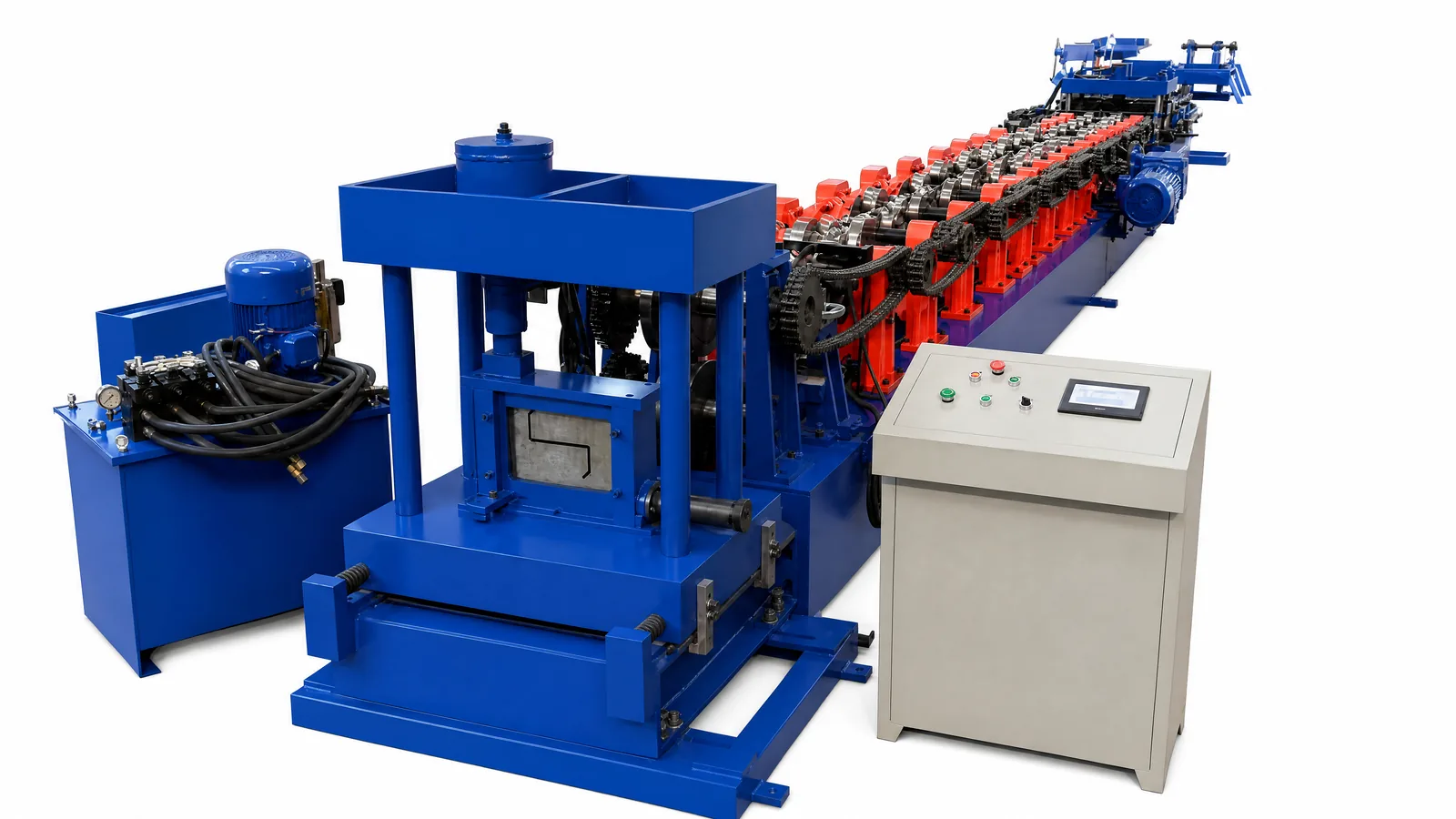
Technical Specifications
| Material | GI, galvanised, pre-painted steel |
| Thickness | 1.5 – 3.5 mm |
| Profiles | Truss purlin chord, web member, lattice section |
| Section depth | 100 – 400 mm |
| Forming speed | 8 – 18 m/min |
| Forming stations | 18 – 24 |
| Drive | Gearbox chain drive, 15 – 22 kW |
| Punching | Inline chord punch, optional |
| Cutting | Hydraulic flying cut |
| Control | PLC + HMI, batch counter |
| Certification | CE Declaration of Conformity |
| Lead time | 50 – 65 days |
Need a quote or a custom specification?
What This Machine Produces
Truss purlin chords — the top and bottom members of a triangulated purlin, roll formed on this line.
Web members — the separate short lengths that zig-zag between the chords, produced on a smaller machine or bought in.
Lattice sections — the assembled truss purlin, made by welding or connecting the web pieces between the two chords.
Section depths of 100–400 mm — deeper than a single cold-formed purlin can sensibly reach.
Distributed depth rather than a deep thin web: because the two chords sit apart, the section gets its bending capacity from geometry rather than from web depth alone, which avoids the local buckling limit that governs a very deep single C or Z.
Chords in 1.5–3.5 mm galvanised or pre-painted steel, formed through 18–24 stations at 8–18 m/min.
Recommended Configuration
A complete working line, not just the forming machine. Each item below is quoted as one package.
- 01
Decoiler and leveling unit
chords carry the bending in the assembled section, so chord straightness has a direct effect on how the truss purlin performs.
- 02
Truss purlin roll forming machine
18–24 stations on a gearbox chain drive at 15–22 kW, forming chords at 8–18 m/min.
- 03
Inline chord punch (optional)
punches connection positions in the chord while the strip is flat, which is what allows the webs to be located accurately at assembly.
- 04
Assembly arrangement (separate from this line)
the chords come off this machine; the truss is built by welding or connecting the web members between them. This line does not produce a finished truss in a single pass, and no machine does.
- 05
Hydraulic flying cut
chords are cut to the purlin length.
- 06
PLC with HMI and batch counter
chord lengths are cut per truss, so the batch counter is what keeps a set together.
Production Workflow
- 01
Decoiler
Coil is loaded and uncoiled at controlled tension. At 1.5–3.5 mm the chord is a structural member, so tension consistency shows directly in the straightness of the assembled truss.
- 02
Leveling
The strip is straightened before forming. A truss purlin is assembled from two chords; if one is bowed, the truss cannot be closed squarely in the jig.
- 03
Chord punching (optional)
Connection positions are punched while the strip is flat, so the web members can be located accurately at assembly.
- 04
Roll forming
18–24 stations form the chord section in 1.5–3.5 mm steel at 8–18 m/min.
- 05
Cutting
A hydraulic flying cut cuts chords to the truss length, with a batch counter keeping a set together.
- 06
Assembly (separate step)
The two chords are jigged apart and the web members are welded or connected between them. This is a fabrication step, not part of the roll forming line.
Key Components
- Forming stations
- 18–24
- Drive
- Gearbox chain drive, 15–22 kW
- Chord punch
- Inline, optional
- Cutting
- Hydraulic flying cut with batch counter
- Control
- PLC + HMI
- Working range
- 1.5–3.5 mm · section depth 100–400 mm
- Note on scope
- Produces the chords; assembly of the truss is a separate fabrication step
Customization Options
Every line is built to order. These are the points buyers most often change.
| Item | What can be changed |
|---|---|
| Profiles | Truss purlin chord, web member, lattice section — tell us which members you intend to produce on this line and which you will buy in |
| Section depth | 100–400 mm |
| Thickness | 1.5–3.5 mm. Chords take the bending and are usually thicker; webs carry mainly shear and can be thinner — getting that combination right is a structural design decision |
| Chord punching | Inline punch for connection positions, optional |
| Power supply | 380 V / 50 Hz / 3-phase standard; other voltages to your site |
Applications
FAQ — Truss & Roof Purlin Roll Forming Machine
What is a truss purlin and when is it used?
Why not just use a deeper C purlin?
Can one machine make both chords and webs?
What thickness is used?
Is this line suitable for a start-up producer?
How does the truss purlin compare on cost?
Can the machine be built for our own profile?
Which coil materials can the line run?
What is the production speed?
How many forming stations does it use?
What is the drive and installed power?
How is the finished profile cut to length?
You May Also Need
Send us your profile and output target
Tell us the profile and the numbers that matter to you. We confirm the configuration against the specification table above and quote FOB Tianjin within 24 hours.
- MaterialGI, galvanised, pre-painted steel
- Thickness1.5 – 3.5 mm
- ProfilesTruss purlin chord, web member, lattice section
- Section depth100 – 400 mm