Sigma Purlin Roll Forming Machine
Sigma and Omega sections that carry more load than a C purlin of the same depth — the right answer where depth is constrained.
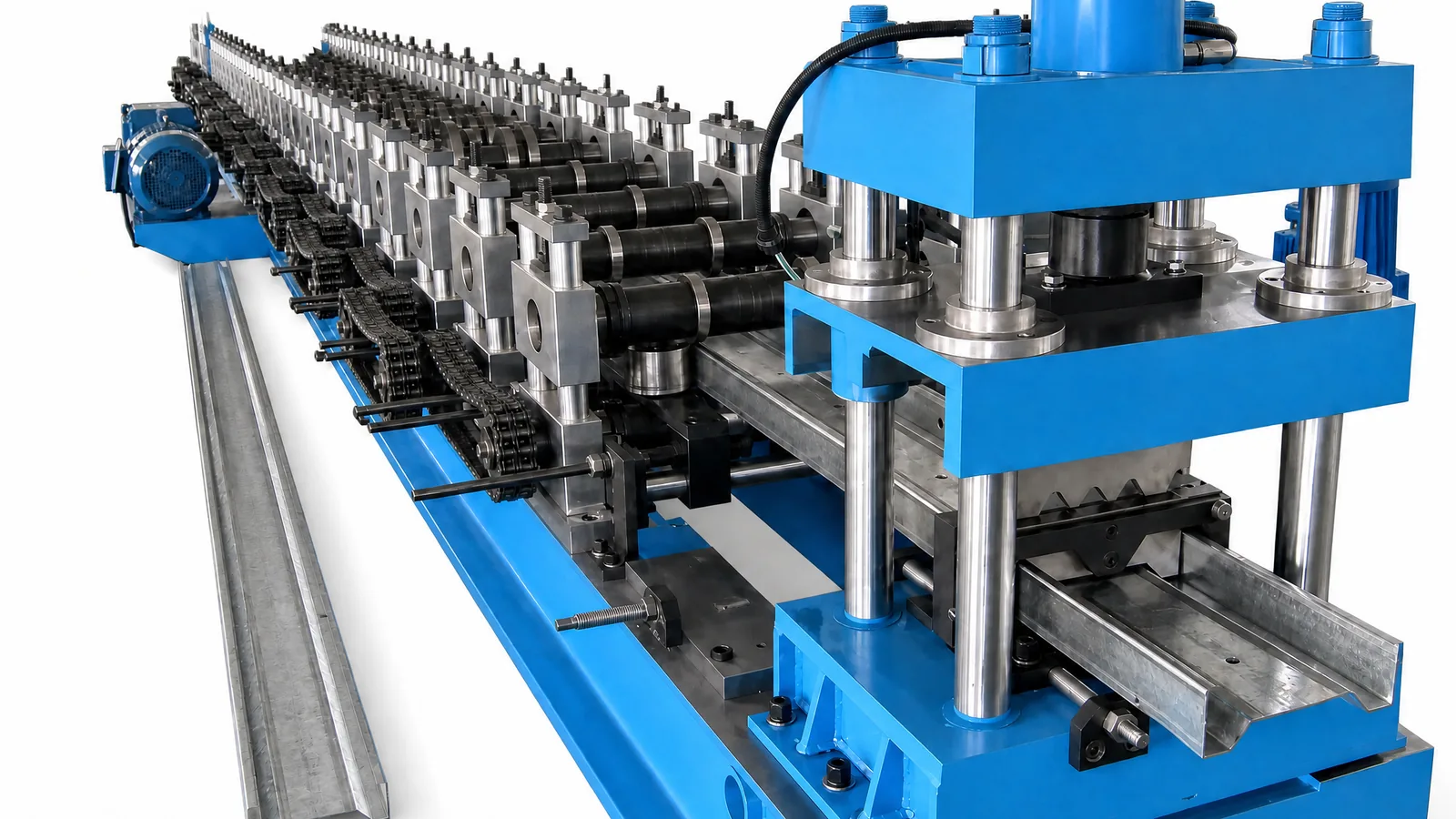
Technical Specifications
| Material | GI, galvanised, pre-painted steel |
| Thickness | 1.5 – 3.0 mm |
| Web height | 100 – 250 mm |
| Section types | Sigma (Σ), Omega (Ω), M-section |
| Forming speed | 8 – 20 m/min |
| Forming stations | 18 – 22 |
| Drive | Gearbox chain drive, 11 – 15 kW |
| Punching | Inline web punch, optional |
| Cutting | Hydraulic flying cut |
| Control | PLC + touch-screen HMI |
| Certification | CE Declaration of Conformity |
| Lead time | 45 – 60 days |
Need a quote or a custom specification?
Sigma Purlin Roll Forming Machine in Our Workshop
 1:10
1:10 Sigma Purlin Roll Forming Machine — Forming Station Detail | ZTRFM
a forming station of the sigma purlin machine, shown close up.
Machine specifications →What This Machine Produces
Sigma (Σ) sections from 100 to 250 mm web height — the section that carries more load than a C purlin of the same depth.
Omega (Ω) sections — the same stiffening principle with a different fold pattern, common on cladding rails and standing-seam roof support.
M-sections — effectively two purlins joined back to back in one strip, used as a heavier beam or rail where a single section would need extra bracing.
Sections with stiffening folds rather than a plain web — the folds put more material away from the neutral axis, which is where the extra capacity over a C purlin comes from.
Section depths of 100–250 mm in 1.5–3.0 mm galvanised or pre-painted steel, formed through 18–22 stations at 8–20 m/min.
Truly flat-bottomed stiffer sections for applications where a C purlin would need additional bracing to stop the web from buckling.
Recommended Configuration
A complete working line, not just the forming machine. Each item below is quoted as one package.
- 01
Decoiler and leveling unit
sigma sections are used where depth is constrained, so the section has to be exactly to depth. Strip straightness is the first thing that decides whether it is.
- 02
Sigma purlin roll forming machine
18–22 stations on a gearbox chain drive at 11–15 kW, forming at 8–20 m/min over a 100–250 mm depth range.
- 03
Hardened rolls for high-yield steel
the roll load difference between G300 and G550 at 3.0 mm is substantial, so confirm the grade at order stage and specify the roll hardness to match.
- 04
Inline web punch (optional)
available, though many sigma users do not punch on the line, because connections are made with clips and brackets rather than through the purlin web.
- 05
Hydraulic flying cut
sections are produced in long runs, so a flying cut keeps the line moving.
- 06
PLC with touch-screen HMI
depth and section type are selected rather than set by hand across every station.
Production Workflow
- 01
Decoiler
Coil is loaded and uncoiled at controlled tension. Sigma sections are specified where the depth envelope is tight, so tension variation that would be tolerable on a C purlin is not tolerable here.
- 02
Leveling
The strip is straightened before forming. Because the section relies on stiffening folds for its capacity, those folds must be formed from flat, consistent strip — a wavy strip produces folds of varying depth.
- 03
Roll forming
18–22 stations form the sigma, omega or M section progressively in 1.5–3.0 mm material at 8–20 m/min. The station count is higher than a CZ purlin line because forming the stiffening folds without thinning the material takes more passes.
- 04
Punching (optional)
Where an inline web punch is fitted, it cuts while the strip is flat.
- 05
Cutting
A hydraulic flying cut cuts to length.
- 06
Output
Sections leave on the runout table.
Key Components
- Forming stations
- 18–22 — higher than a CZ line because of the stiffening folds
- Drive
- Gearbox chain drive, 11–15 kW
- Web punch
- Inline, optional; often not specified because connections use clips
- Cutting
- Hydraulic flying cut
- Control
- PLC + touch-screen HMI
- Working range
- 1.5–3.0 mm · web height 100–250 mm
- Sections
- Sigma (Σ), Omega (Ω), M-section
Customization Options
Every line is built to order. These are the points buyers most often change.
| Item | What can be changed |
|---|---|
| Section type | Sigma, Omega or M-section — different tooling on the same frame |
| Web height | 100–250 mm |
| Steel grade and thickness | 1.5–3.0 mm. Below 1.5 mm the stiffening folds do not form reliably; above 3.0 mm you move into a heavier machine class and we quote a custom drive configuration |
| Roll hardness | Hardened rolls for high-yield steel — G550 at 3.0 mm needs a different roll specification from G300 |
| Punching | Inline web punch available as an option |
| Power supply | 380 V / 50 Hz / 3-phase standard; other voltages to your site |
Applications
FAQ — Sigma Purlin Roll Forming Machine
Sigma versus Z purlin — which is stronger?
Why choose sigma instead of a deeper C purlin?
Can it handle 3.0 mm G550?
What is an M-section purlin used for?
Does the machine punch holes?
What thickness range is practical?
Can the machine be built for our own profile?
How do we get a price for this line?
Which coil materials can the line run?
What is the production speed?
How many forming stations does it use?
What is the drive and installed power?
You May Also Need
Send us your profile and output target
Tell us the profile and the numbers that matter to you. We confirm the configuration against the specification table above and quote FOB Tianjin within 24 hours.
- MaterialGI, galvanised, pre-painted steel
- Thickness1.5 – 3.0 mm
- Web height100 – 250 mm
- Section typesSigma (Σ), Omega (Ω), M-section