Key takeaways
- A thrie-beam section is 508 mm in its vertical dimension with three waves; a W-beam section is 312 mm with two waves.
- AASHTO M180 names both shapes in one specification and orders the shape separately from the two base-metal thickness classes, 2.67 mm and 3.43 mm.
- M180 is geometry and material only. The crash rating comes from MASH test levels or EN 1317-2 containment classes, tested on the complete barrier system.
- Thrie-beam needs its own roll tooling and a wider strip than the 490 mm W-beam feed, so a dual-shape line is quoted with two tooling sets.
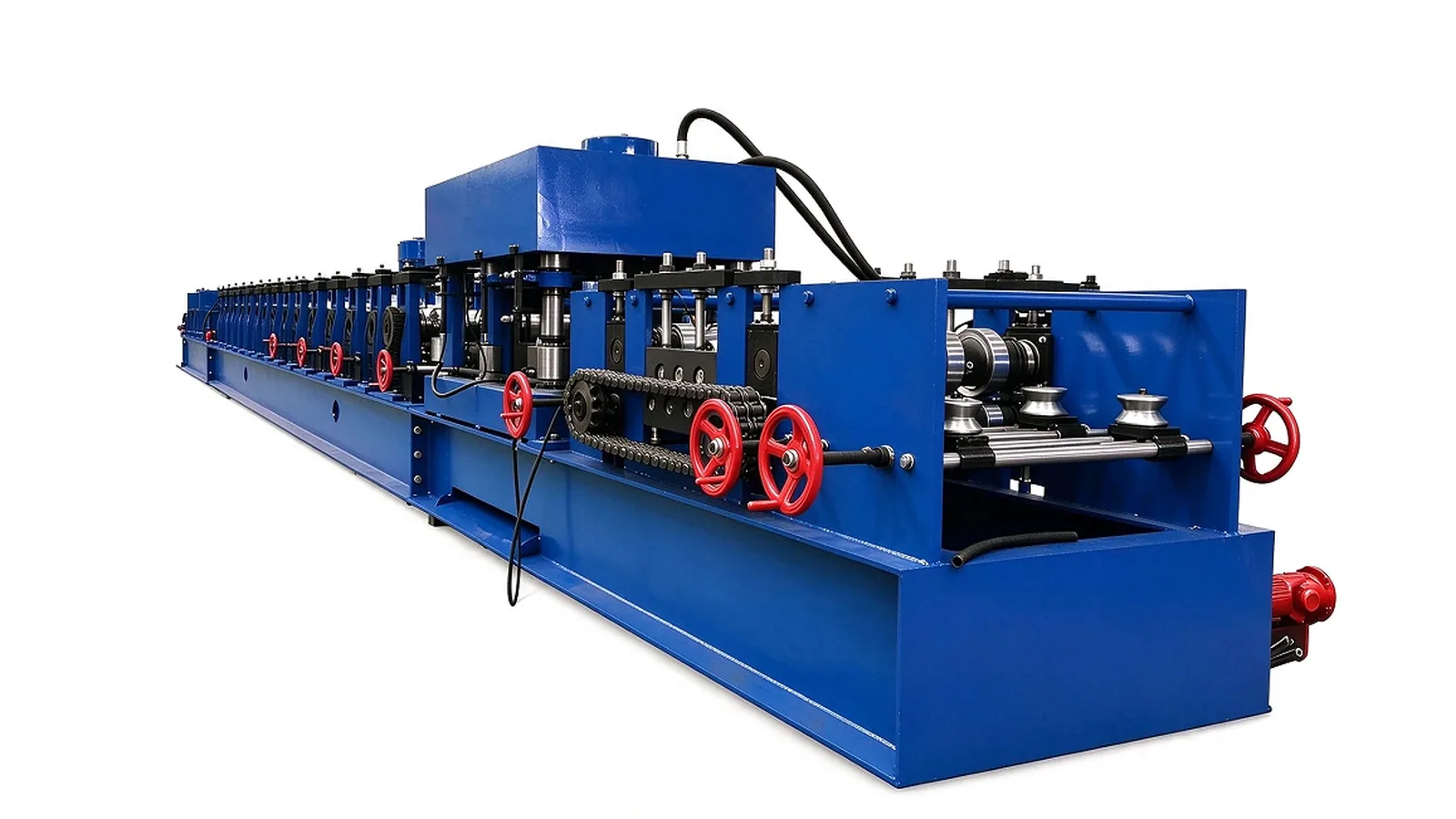
Short answer: a thrie-beam guardrail section is 508 mm high with three waves. A W-beam section is 312 mm high with two waves. AASHTO M180 fixes both geometries; MASH, not the beam, sets the crash rating.
Introduction
Thrie-beam enquiries arrive from two directions. One is an engineer who has been told to use a deeper barrier on a bridge approach or a median and needs to know what the section actually is. The other is a producer asked to quote a line for a shape the enquiry describes as "custom", where the drawing exists but nobody has said which clauses of the standard the drawing has to satisfy.
Both land on the same confusion: what is fixed by the standard, and what is a manufacturing decision. Those are different lists, and mixing them is how a machine gets ordered for a section that will not be accepted at handover. This article separates the two — the section geometry, the clauses that govern it, the crash-test framework that sits on top, and the tooling consequences for the line that forms the part. If you are new to the product itself, start with what W-beam guardrail is; the site-side requirements are collected in the guardrail installation and specification guide.
What a thrie-beam section actually is
A thrie beam is a corrugated steel beam with three waves instead of two. In the North American specification it is not a separate product category. AASHTO M180-18 asks the purchaser to state the "shape (W-beam or thrie beam)" in the same ordering clause that fixes the effective length of the beam section at 3.8 m or 7.6 m (12.5 ft or 25.0 ft). One specification, two shapes, one set of material and coating rules.
What separates them in service is depth. A comparative study of thrie-beam treatments gives the thrie-beam depth, measured vertically, as 508 mm (20 in.), and records a typical installed ground clearance of 304.8 mm (12 in.). A W-beam section presents 312 mm across the same vertical dimension on our guardrail lines. The extra 196 mm of section depth raises bending resistance and gives a taller contact face for large vehicles, which is why the shape appears where the impact duty is heavier than an ordinary verge can absorb.
It also changes the manufacturing problem. More developed width in the strip, more forming stations, a heavier frame and a bigger cutting press. That is the part of the topic that costs money, and it is the part most enquiries leave out.
Thrie-beam dimensions and what AASHTO M180 fixes
M180 fixes less than buyers expect and more than machine builders would like. It provides six types and two classes. The types are coating designations — Type I and Type II are zinc-coated at different coating weights, Type III is supplied for painting, Type IV is corrosion-resistant steel, and Types V and VI are zinc-aluminium-magnesium coated. The classes are base metal thickness: Class A at 2.67 mm (0.105 in.) and Class B at 3.43 mm (0.135 in.).
The shape is ordered independently of both. A thrie-beam contract and a W-beam contract can each be Class A or Class B, in any coating type the project allows, which is exactly why the purchase order has to spell out all three rather than the shape alone.
| Property | W-beam | Thrie-beam | Where it comes from |
|---|---|---|---|
| Waves in section | Two | Three | Shape designation, AASHTO M180-18 |
| Vertical section dimension | 312 mm | 508 mm (20 in.) | W-beam line specification; thrie-beam depth from the USDOT comparative study |
| Typical ground clearance | Set by the post schedule | 304.8 mm (12 in.) | Installed detail, thrie-beam treatment study |
| Base metal thickness | Class A 2.67 mm or Class B 3.43 mm | Class A 2.67 mm or Class B 3.43 mm | AASHTO M180-18, Class A and Class B |
| Effective section length | 3.8 m or 7.6 m per M180; 4,320 mm per EN 1317-2 | 4,320 mm is the common European length | AASHTO M180-18 ordering clause; EN 1317-2 |
| Typical location | Mainline verges, embankments, rural road | Bridges, median barriers, transitions, high-risk locations | Barrier layout practice |
| Tooling | 490 mm strip feed, 15 stations on our two-wave line | Wider strip feed, 16 stations on our three-wave line | Guardrail line specifications |
Two consequences follow. First, the thickness class is a purchasing decision, not a shape decision — specifying "thrie-beam" without a class leaves the mill free to supply either. Second, M180 contains no crash test at all. Its basis of acceptance is inspection and sampling of the material at the fabricating plant, at a warehouse, or after delivery to site. Nothing in it tells you how a barrier made from compliant steel will behave when a vehicle hits it.
Where thrie-beam is specified instead of W-beam
The shape is specified where a W-beam would be asked to do more than it was designed for. Bridge railings and bridge approaches are the classic case: the deck edge has no room for a barrier to deflect, so a deeper, stiffer section is used to hold the vehicle with less movement. Median barriers on divided highways are the second case, because a median strike can arrive from either side and often involves a heavier vehicle than the design car.
Transitions are the third. Where a flexible guardrail run meets a rigid concrete barrier or a bridge parapet, the stiffness step has to be managed over a length, and thrie-beam is used inside that transition because it can be bolted to both systems. Short-radius treatments at intersections and tight interchanges appear in the same literature for the same reason: a deeper section keeps the barrier line continuous without a rigid post arrangement.
In all of these the beam is only one line of the schedule. The 508 mm section stands higher than a W-beam, and the installed ground clearance is a separate figure, so the post height, the blockout and the bolt positions have to be specified together with the beam. A barrier specified as a section alone is an incomplete specification. The guardrail and road barrier application page collects the layouts we build lines for.
MASH and EN 1317: the rating belongs to the system
Crash performance in North America is assessed under MASH, the AASHTO Manual for Assessing Safety Hardware, which replaced the earlier NCHRP Report 350 procedures. MASH defines test levels by the vehicle fleet and impact severity, not by the beam section. The passenger-vehicle tests use a small car and a pickup at a 25 degree impact angle, and the levels step up in speed.
| MASH test level | Passenger-vehicle impact speed | Heavy vehicle added | Where it is normally used |
|---|---|---|---|
| TL-1 | 31 mph (50 km/h) at 25 degrees | None | Low-speed and work-zone applications |
| TL-2 | 44 mph (70 km/h) at 25 degrees | None | Collector roads, lower-speed arterial work |
| TL-3 | 62 mph (100 km/h) at 25 degrees | None | The common highway specification |
| TL-4 | Passenger-vehicle tests retained | 10,000 kg single-unit truck | Higher-risk locations, some median and bridge work |
| TL-5 | Passenger-vehicle tests retained | Tractor-trailer test | Heavy-truck routes, critical bridge barriers |
Outside North America the equivalent framework is EN 1317. Under EN 1317-2 a vehicle restraint system is classified by containment level (N1, N2, H1, H2, H3, H4a, H4b) and by working width class (W1 to W8). A thrie-beam barrier specified for a bridge in Europe is therefore described by a containment level and a working width, not by a section drawing alone — the section is the means, the class is the requirement.
The consequence for anyone buying a machine is blunt: certification of the line and certification of the barrier are two different documents. A CE Declaration of Conformity covers the machine as supplied. A MASH or EN 1317 rating belongs to a tested system — beam, post, blockout, bolt and terminal together — and is obtained by the barrier producer through full-scale impact testing of an installed installation. No roll forming line can supply that rating, and any supplier who implies otherwise is describing something they do not have.
What the roll forming line has to do differently
A W-beam line is already a heavy machine by cold roll forming standards. Our two-wave line takes a 490 mm strip and delivers a 312 mm cover at 90 mm profile height, with 15 driven stations, two 22 kW motors, GCr15 rolls at HRC 55 to 60 and a forming speed of 15 to 20 m/min. Coil arrives on a hydraulic decoiler rated 10 t with a 508 mm coil ID, which is the standard guardrail coil. The full specification sits on the W-beam guardrail roll forming machine page.
A thrie-beam line changes four things at once. The strip is wider, because the finished section is 508 mm across and the developed width has to cover three waves plus flanges. The station count rises — 16 on our three-wave line — and the shafts go to 95 mm in 45# tempered steel to carry the forming load. The frame moves to 400 H steel with gearbox transmission and a 30 kW Siemens motor, and the whole machine grows to roughly 18,500 mm long and 15 t. Cutting is the fourth change: 2.5 to 4.0 mm material is cut with a Cr12 quenched knife at HRC 60 to 62 on a die-cut press, not a light shear.
The North American configuration adds its own constraints. The ASTM M180 guardrail machine is specified around 3,810 mm sections, 9/16 in (14.3 mm) bolt holes on a 400 mm pitch and ASTM A1011 Grade 50 steel at 345 MPa minimum yield, with 18 to 24 stations and at least 37 kW of drive. Put that next to the European detail and the differences are not cosmetic: different section length, different hole pattern, different steel grade, different tooling.
One feature is common to both and worth insisting on. Punching is done on the flat strip before forming, not on the finished section. That is what makes a length tolerance of plus or minus 2 mm achievable on a 4,320 mm panel — the hole-to-hole dimension is set while the material is still a plane, and forming afterwards does not move it.
Writing the purchase order: six lines that decide the machine
Most specification arguments are settled by six lines on the order. Write them and the machine definition follows; leave any of them to the supplier and you inherit their assumption.
- Shape and standard. Thrie beam to AASHTO M180, or a three-wave section to a national drawing. Name the standard number, not the trade name.
- Base metal class and grade. Class A at 2.67 mm or Class B at 3.43 mm, and the steel grade behind it — A1011 Grade 50 at 345 MPa minimum yield for North America, Q235, Q345, S235 or S275 elsewhere.
- Section length and tolerance. 4,320 mm for EN 1317-2 and AS/NZS 3845 work, 3,810 mm for M180, and the tolerance you will accept, typically plus or minus 2 mm.
- Hole pattern. Pitch, hole diameter and slot geometry, taken from the project drawing. On the North American detail that is 9/16 in holes at 400 mm pitch; the European pattern is different and is not interchangeable.
- Coating type and who applies it. M180 Type I to Type VI if the barrier is North American, ISO 1461 galvanising if it is European, and a clear statement of whether the line or a separate galvaniser does the coating.
- Output and coil. Target metres per minute and panels per shift, plus the coil you actually buy — 10 t on a 508 mm ID is the guardrail norm, and the decoiler is sized from it.
The custom enquiry: what changes and what does not
Most "custom thrie-beam" requests are not new machines. They are the standard three-wave architecture with a different length, a different hole pattern, a different steel grade or a section that sits a few millimetres away from a published drawing. What changes is the roll tooling drawing, the punch dies, the cut-length program and the length of the runout and stacker, because a 4,320 mm panel needs a longer output table than a 3,810 mm one.
What does not change is the machine architecture: decoiler, leveling unit, in-line hydraulic punch, forming stations, automatic cut, runout and PLC control. That is why a custom enquiry can be quoted with confidence and still carry the standard lead time of 55 to 70 days — the long end of that range belongs to tooling made to a new section drawing, not to the frame.
Leveling deserves a note here. Guardrail is run from thick, high-strength coil, and residual coil set that would be invisible on a 0.5 mm roofing profile becomes visible twist in a 4.0 mm barrier panel that has to bolt to its neighbour. A leveling unit before the first station is not an accessory on this product.
Four specification errors that show up on site
- Confusing cover width with strip width. A 312 mm W-beam is formed from a 490 mm strip. Order coil at 312 mm and the line cannot make the section; the extra 178 mm is the material taken up in the waves and flanges.
- Naming M180 and EN 1317 in the same line of the bill of quantities. They imply different section lengths, different hole patterns and different steel grades. One barrier cannot satisfy both, and the tooling is specific to each.
- Ordering Class A and designing the post spacing from a Class B section. The class changes the beam's stiffness; the post schedule that was tested with 3.43 mm material is not automatically valid with 2.67 mm.
- Treating the machine certificate as the barrier certificate. The CE Declaration covers the line. The MASH or EN 1317 rating covers a tested system, and it is the producer's document, obtained by impact testing.
What to send with a thrie-beam enquiry
Four things make a quotation definitive rather than indicative: the section drawing with the wave geometry and overall vertical dimension, the standard the finished barrier must satisfy including its class or containment level, the steel grade and thickness class with the coil size you will buy, and the hole pattern with its pitch and slot geometry. Add your target output and the destination market, because voltage and control-language details follow from it.
With those in hand the open questions are narrow — station count, strip width, punch setup and cut length — and each one can be answered in writing before a purchase order exists. That is a far cheaper conversation than discovering the hole pitch is wrong after the tooling is cut. The guardrail and barrier machine range shows the two lines side by side, and the W-beam and thrie-beam guardrail line carries the full specification table for both models.