Cable Tray Roll Forming Machine
Perforated, solid and ladder cable tray from 100 to 600 mm wide — the electrical containment product that sits alongside solar and industrial work.
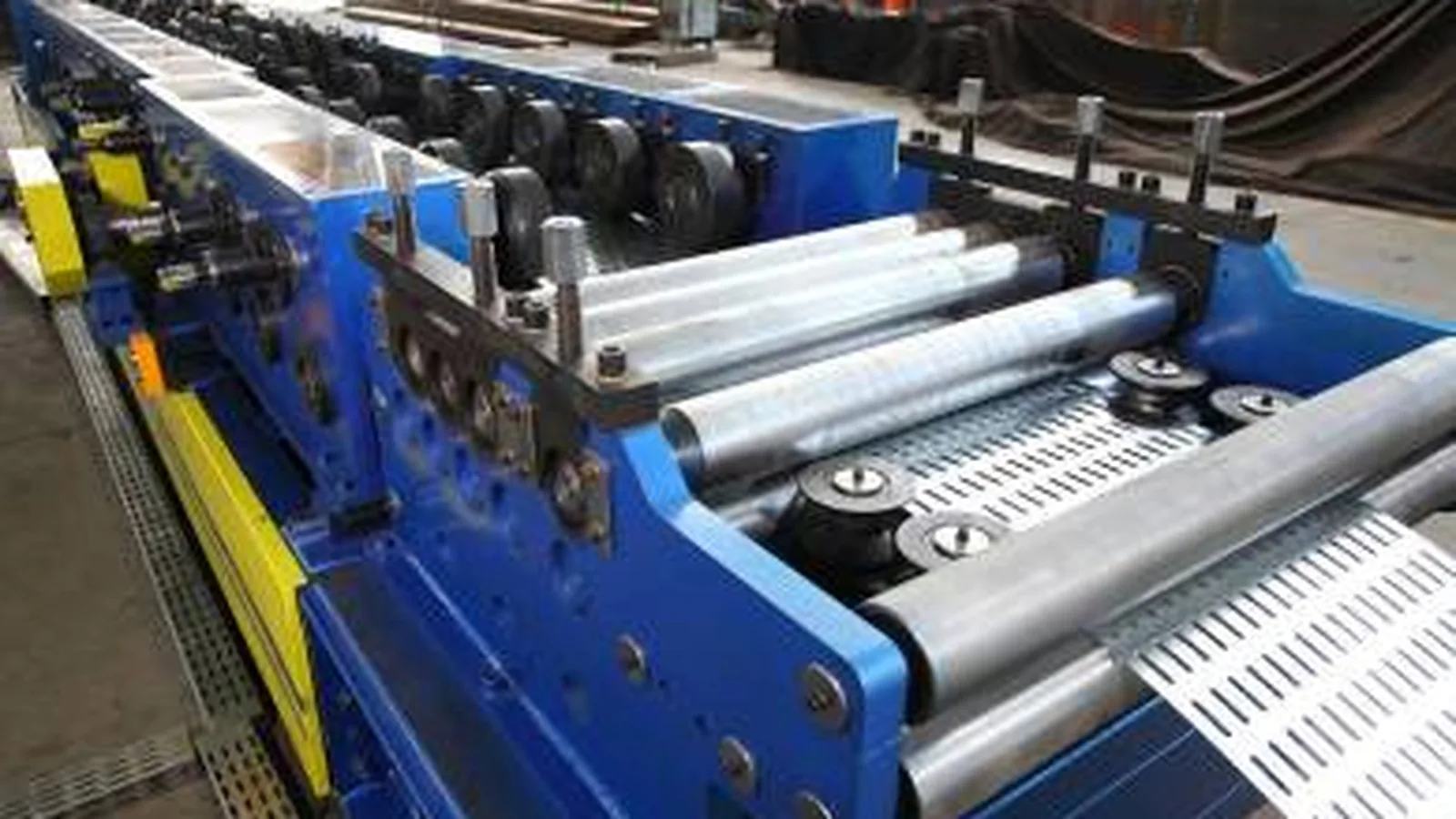
Technical Specifications
| Material | GI, pre-galvanised, stainless 304 / 316 |
| Thickness | 1.0 – 2.0 mm |
| Tray width | 100 / 150 / 200 / 300 / 400 / 600 mm |
| Tray height | 50 / 60 / 75 / 100 mm |
| Tray types | Solid, perforated, ladder, ventilated |
| Forming speed | 10 – 20 m/min |
| Forming stations | 14 – 18 |
| Punching | Inline perforating unit, optional |
| Cutting | Hydraulic flying cut |
| Control | PLC + HMI, width presets |
| Certification | CE Declaration of Conformity |
| Lead time | 45 – 60 days |
Need a quote or a custom specification?
What This Machine Produces
Perforated cable tray — solid base with punched holes, the standard specification for general power and data containment, with good ventilation.
Ladder tray — two side rails with rungs and no base, giving maximum airflow around heavy power cables where heat dissipation matters most.
Solid tray — closed base with no perforations, for areas needing protection from dust, water or electromagnetic interference, normally supplied with a lid.
Ventilated tray — slotted base and sides, sitting between perforated and ladder tray where cable density is medium.
Tray widths of 100, 150, 200, 300, 400 and 600 mm, with depths of 50, 60, 75 and 100 mm.
Sections in 1.0–2.0 mm galvanised, pre-galvanised or stainless 304 / 316 steel at 10–20 m/min.
Matching covers — a separate simple profile that runs on the same frame with an additional cassette.
Recommended Configuration
A complete working line, not just the forming machine. Each item below is quoted as one package.
- 01
Hydraulic decoiler and straightener
tray is a wide, shallow section, so any coil set shows immediately as a twisted sidewall.
- 02
Inline perforating unit (optional but strongly recommended)
perforation drives cable tray cost, because roughly half the material is punched out. Doing it inline while the strip is flat avoids a separate handling operation and a second machine, and it keeps the hole pattern aligned with the tray section.
- 03
Cable tray roll forming machine
14–18 stations, width-adjustable, forming at 10–20 m/min.
- 04
Width adjustment
manual screws take 15–30 minutes to change between 100 mm and 300 mm tray; the servo option recalls presets from the HMI in about 5 minutes.
- 05
Hydraulic flying cut
cuts at line speed so a multi-width schedule does not mean stopping for every length.
- 06
PLC with width presets
the tray width and cut length are recalled rather than re-set.
- 07
Runtime table and stacking
tray is bulky and light, and stacks badly if it is not guided off the line.
Production Workflow
- 01
Decoiler
Coil is loaded and uncoiled at controlled tension. Tray is a wide section, so uneven tension shows up as a wave along the sidewall rather than as a thickness variation.
- 02
Straightening
The strip is levelled before forming. On tray, residual coil set becomes a twist between the two sidewalls, which is why straightening matters more here than the section thickness suggests.
- 03
Perforating
When the inline perforating unit is fitted, the base and side perforations are punched while the strip is flat. This is the step that removes a whole secondary operation and keeps the hole pattern registered to the section.
- 04
Roll forming
14–18 stations form the tray — base, two sidewalls and the returns — at 10–20 m/min. Width adjustment is made at the stations rather than by changing rolls, which is what allows one machine to cover 100–600 mm.
- 05
Cutting
A hydraulic flying cut cuts to length at line speed.
- 06
Output
Tray leaves on the runout table and is stacked for packing. Covers, where produced, run as a separate simpler pass on the same frame.
Key Components
- Forming stations
- 14–18, width-adjustable
- Drive
- Gearbox chain drive
- Perforating
- Inline unit, optional; keeps the hole pattern registered to the section
- Width adjustment
- Manual 15–30 min · servo presets about 5 min
- Cutting
- Hydraulic flying cut
- Control
- PLC + HMI with width presets
- Working range
- 1.0–2.0 mm · width 100–600 mm · depth 50–100 mm
Customization Options
Every line is built to order. These are the points buyers most often change.
| Item | What can be changed |
|---|---|
| Tray type | Perforated, ladder, solid or ventilated |
| Tray width | 100 / 150 / 200 / 300 / 400 / 600 mm |
| Tray depth | 50 / 60 / 75 / 100 mm |
| Material | Pre-galvanised steel is standard; stainless 304 or 316 for food factories, chemical plants and coastal sites |
| Width adjustment | Manual screws or servo presets from the HMI |
| Covers | Runs on the same frame with an additional cassette |
| Power supply | 380 V / 50 Hz / 3-phase standard; other voltages to your site |
Cable tray types and where each is specified
| Type | Construction | Ventilation | Typical use |
|---|---|---|---|
| Perforated | Solid base with punched holes | Good | General power and data containment; the standard specification |
| Ladder | Two side rails with rungs | Maximum | Heavy power cables that need maximum heat dissipation |
| Solid | Closed base, no perforations | None | Areas needing protection from dust, water or EMI; often with a lid |
| Ventilated | Slotted base and sides | High | Compromise between perforated and ladder where cable density is medium |
Applications
FAQ — Cable Tray Roll Forming Machine
How do you change between 100 mm and 300 mm wide tray?
What is the difference between perforated and ladder tray?
What material is used for cable tray?
Does the machine produce the covers as well?
Why is inline perforating worth having?
What is the load capacity of a cable tray?
Can the machine be built for our own profile?
How do we get a price for this line?
What material thickness can this machine form?
What is the production speed?
How many forming stations does it use?
How is the finished profile cut to length?
You May Also Need
Send us your profile and output target
Tell us the profile and the numbers that matter to you. We confirm the configuration against the specification table above and quote FOB Tianjin within 24 hours.
- MaterialGI, pre-galvanised, stainless 304 / 316
- Thickness1.0 – 2.0 mm
- Tray width100 / 150 / 200 / 300 / 400 / 600 mm
- Tray height50 / 60 / 75 / 100 mm