Steel Coil Slitting Line
Cut master coil into the exact widths your roll forming lines need — and stop paying a service centre margin on every tonne.
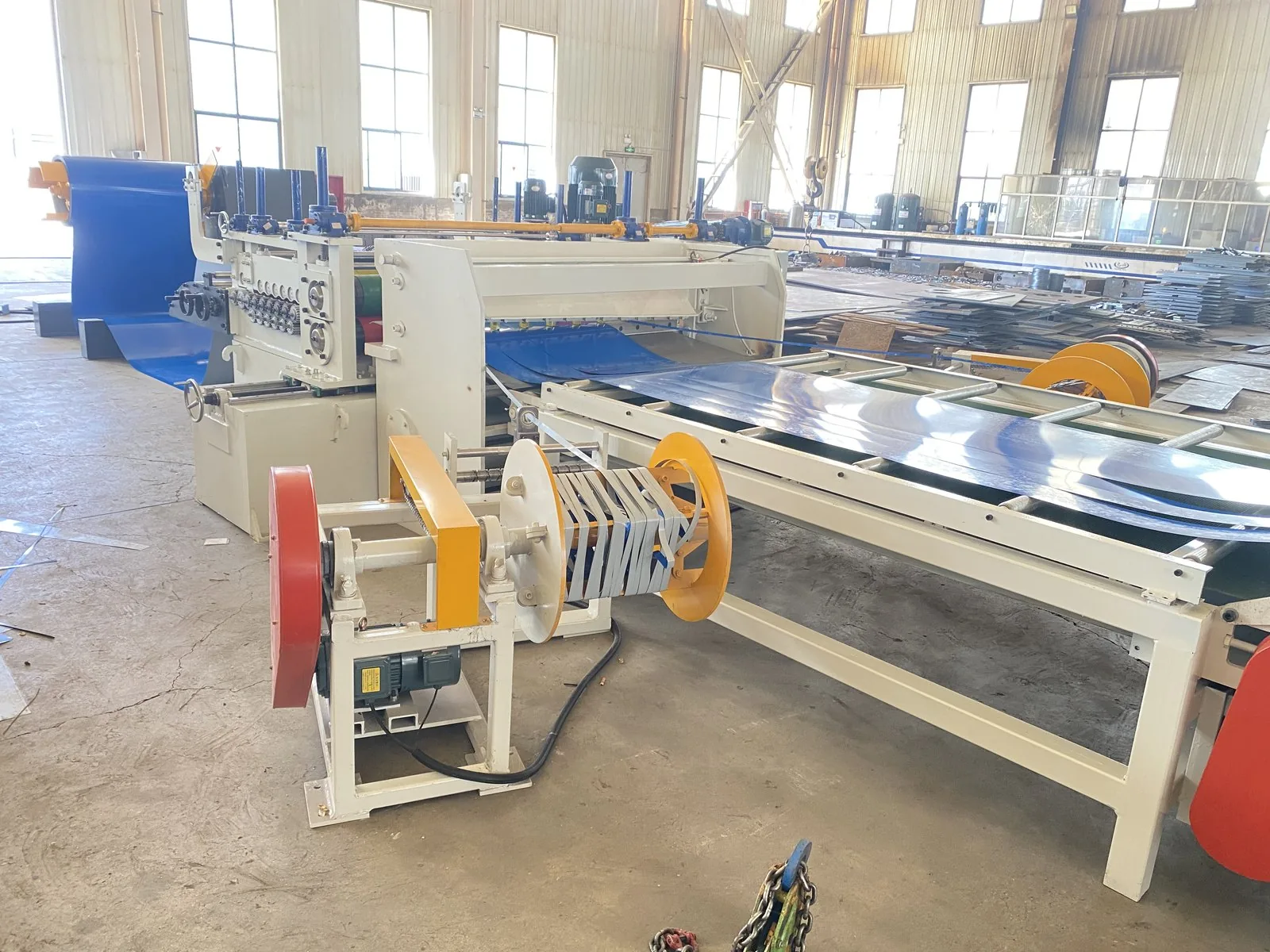
Technical Specifications
| Strip material | Cold-rolled, galvanised and hot-rolled coil |
| Thickness range | 0.3–3.2 mm (SL-1250) · 0.35–4.0 mm (SL-1600) |
| Incoming coil width | 600–1250 mm (SL-1250) · up to 1600 mm (SL-1600) |
| Slit strip width | from 20 mm (SL-1250) · 30 mm in secondary slitting (SL-1600) |
| Width tolerance | ±0.05 mm on slit width |
| Incoming coil camber | ≤2 mm/m |
| Leveller | 17 rolls, 7 over / 8 under plus one guide shaft, Ø100 mm over 1250 mm face, 40Cr, HF hardened and hard-chrome plated |
| Support rolls | Ø90 mm, wedge-adjusted, to stop the levelling rolls deflecting under load |
| Slitting head | Arbor type with interchangeable spacers — up to 11 strips (SL-1250), 11 knife sets / 22 blades (SL-1600) |
| Knife shaft | Ø220 mm (SL-1250) · Ø191 mm (SL-1600), 40Cr |
| Line speed | max 25 m/min (SL-1250) · threading 10 m/min, 10–20 m/min (SL-1600) |
| Coil weight | max 12 t (SL-1250) · max 15 t (SL-1600) |
| Coil inner diameter | Ø508 mm (SL-1250) · Ø508 / 610 / 750 mm (SL-1600) |
| Mandrel expansion | 475–525 mm |
| Power supply | AC 380 V ±10%, 50 Hz ±5%, 3-phase 5-wire |
| Air supply | 0.4–0.6 MPa |
| Control | PLC + HMI, full-digital AC drives, parameters preset and monitored with alarms |
| Certification | CE Declaration of Conformity |
Need a quote or a custom specification?
Which configuration fits your project
SL-1250 — 0.3–3.2 mm × 1250 mm
Hydraulic expanding-mandrel decoiler feeding a combined levelling, cut-to-length and slitting unit, with a tension-controlled recoiler.
| Strip material | Cold-rolled, galvanised sheet |
| Strip thickness | 0.3–3.2 mm |
| Coil width | 600–1250 mm |
| Coil inner diameter | Ø508 mm |
| Coil outer diameter | max 1600 mm |
| Coil weight | max 12 t |
| Slit strip width | from 20 mm |
| Strips per coil | up to 11 |
| Width tolerance | ±0.05 mm |
| Line speed | max 25 m/min |
| Mandrel expansion | 475–525 mm; mandrel ground to Ø508 mm |
| Main shaft | Ø194 mm |
| Mandrel effective length | 1250 mm |
| Decoiler drive | 7.5 kW centre drive; expanding cylinder Ø125 mm at 12 MPa |
| Leveller | 17 rolls, 7 over / 8 under + one guide shaft, Ø100 mm × 1250 mm face, 40Cr, HF hardened, hard-chrome plated |
| Leveller support rolls | one upper + one lower row, Ø90 mm, 45# steel, wedge-adjusted |
| Knife shaft | Ø220 mm, 40Cr |
| Knife blades | Ø220 × Ø330 mm, Cr12MoV; thickness to suit the widths ordered |
| Main drive motor | AC 22 kW |
| Power supply | AC 380 V +10%, 50 Hz +5%, 3-phase 5-wire |
| Air supply | 0.4–0.6 MPa |
SL-1600 — 0.35–4.0 mm × 1600 mm
Single-head cantilever decoiler with an anti-loosening hold-down arm and a support arm, feeding a levelling and cut-to-length unit plus slitter.
| Strip material | Galvanised, cold-rolled, hot-rolled coil |
| Strip thickness | 0.35–4.0 mm |
| Coil width | max 1600 mm |
| Coil inner diameter | Ø508 / 610 / 750 mm |
| Coil outer diameter | max 1600 mm |
| Coil weight | max 15 t (coil car rated 2–15 t) |
| Incoming coil camber | ≤2 mm/m |
| Width tolerance | ±0.05 mm |
| Threading speed | 10 m/min |
| Line speed | 10–20 m/min |
| Decoiler max working speed | 30 m/min |
| Decoiler drive | 7.5 kW; hydraulic power unit 4 kW |
| Decoiler arms | one anti-loosening hold-down arm + one support arm |
| Leveller | 17 rolls, 7 over / 8 under + one guide shaft, Ø100 mm × 1650 mm face, 40Cr, HF hardened, hard-chrome plated |
| Leveller support rolls | two upper + two lower rows, Ø90 mm, 40Cr, wedge-adjusted |
| Knife shaft | Ø191 mm, 40Cr |
| Knife blade material | D2 (Cr12MoV) |
| Knife sets | 11 sets (22 blades) |
| Strips per coil | typically 2–5 from a 1600 mm coil; a second pass takes it to 30 mm in up to 20 strips |
| Line footprint | 20 m × 8 m (L × W) |
What This Machine Produces
Slit coil in the exact widths your roll forming lines need, produced from one master coil rather than bought in cut-to-width.
Slit strip from 20 mm on the SL-1250, cut from incoming coil 600–1250 mm wide in 0.3–3.2 mm material. The SL-1600 takes coil up to 1600 mm wide and 0.35–4.0 mm thick, and a second slitting pass reduces the strip to 30 mm.
Up to 11 strips from one master coil on the SL-1250. The SL-1600 normally cuts a 1600 mm coil into 2–5 strips and carries 11 knife sets (22 blades); replacing spacer combinations sets the finished widths, so a width change is a setup rather than a re-tooling job.
Recoiled output under tension on a Ø508 mm bore, with coil weights up to 12 t on the SL-1250 and 15 t on the SL-1600.
Cold-rolled, galvanised and hot-rolled coil as documented; aluminium, pre-painted and stainless quoted with their own knife clearance rather than a single generic setting.
Slit width held to ±0.05 mm and verified on the finished strip before the line is packed, with burr height checked against thickness in the same inspection.
Line speed matched to the coil weight handled: max 25 m/min on the SL-1250, and 10–20 m/min on the SL-1600 with 10 m/min threading.
Recommended Configuration
A complete working line, not just the forming machine. Each item below is quoted as one package.
- 01
Decoiler section sized to the master coil
12 t on the SL-1250, 15 t on the SL-1600 with a coil car rated 2–15 t. This is the heaviest handling on the line, so coil car and mandrel specification matter more here than anywhere else in the machine.
- 02
Levelling ahead of the slitter
both configurations use 17 rolls in a 7-over / 8-under arrangement plus one guide shaft, Ø100 mm rolls in 40Cr with wedge-adjusted Ø90 mm support rolls underneath. Slitting strip that is not flat builds camber into the slit coil, and camber is far harder to remove after cutting than before.
- 03
Arbor-type slitting head with interchangeable spacers
up to 11 strips per pass on the SL-1250; 11 knife sets (22 blades) on the SL-1600, which normally cuts a 1600 mm coil into 2–5 strips. Set the knife count against the width mix you actually run, not against the theoretical maximum.
- 04
Tensioned recoiler on a Ø508 mm bore
recoiling under controlled tension is what produces a slit coil that can be fed into a forming line without telescoping. The SL-1600 additionally accepts Ø610 and Ø750 mm bores through its cantilever mandrel.
- 05
Edge burr control
knife clearance and knife sharpness decide slit quality. Burr height is checked against thickness on the finished strip, and slit width is verified to ±0.05 mm before the line is packed.
- 06
PLC control with full-digital AC drives
overload, circuit-breaker and emergency-stop protection, line interlocks and fault alarms, process parameters preset, and key machine parameters monitored with alarms. Shearing speed, coiling tension, length setting, single-machine adjustment and full-line automatic running all come off the main console.
- 07
A note on whether you need this line at all: it normally makes sense where you run several widths that a service centre cannot supply reliably, or where the slitting margin on your annual tonnage outweighs the capital cost. Give us your annual tonnage and width mix and we will tell you honestly which way it goes.
Production Workflow
- 01
Decoiling
The master coil is loaded on the expanding mandrel — Ø508 mm bore expanding over 475–525 mm up to 12 t on the SL-1250. The SL-1600 uses a cantilever mandrel for Ø508 / 610 / 750 mm bores up to 15 t, held by a hold-down arm and a support arm.
- 02
Levelling
The strip passes through 17 levelling rolls in a 7-over / 8-under arrangement plus one guide shaft — Ø100 mm rolls over a 1250 mm face on the SL-1250 and 1650 mm on the SL-1600, 40Cr, HF hardened and hard-chrome plated, with Ø90 mm wedge-adjusted support rolls. Incoming camber is specified at ≤2 mm/m and the leveller is what keeps it out of the finished strip.
- 03
Slitting
The strip passes through the arbor-type head where circular knives cut it to width. The SL-1250 runs up to 11 strips; the SL-1600 carries 11 knife sets (22 blades) and normally produces 2–5 strips from a 1600 mm coil, with a second pass taking strip down to 30 mm. Finished widths are set with interchangeable spacer combinations, and edge trim scrap is collected by the edge-trimmer unit.
- 04
Tensioning and recoiling
The slit strips are separated and recoiled under controlled tension on a Ø508 mm bore — the SL-1600 also accepts Ø610 and Ø750 mm. Tension control here is what stops the slit coil telescoping in handling.
- 05
Width and edge check
Slit width is held to ±0.05 mm and verified on the finished strip, with burr height checked against thickness. Body colour and the control-system operating language follow your requirement.
- 06
Output
Finished slit coils come off the recoiler for banding and dispatch. The practical gain for a plant running several forming lines is that one master coil inventory replaces a separate cut-to-width stock holding for every width used.
Key Components
- Decoiler (SL-1250)
- Hydraulic expanding mandrel — Ø508 mm bore expanding over 475–525 mm, Ø194 mm main shaft, 1250 mm effective mandrel length, 7.5 kW centre drive, Ø125 mm expanding cylinder at 12 MPa
- Decoiler (SL-1600)
- Single-head cantilever mandrel for Ø508 / 610 / 750 mm bores, hold-down arm and support arm, 2–15 t, 7.5 kW drive, 4 kW hydraulic power unit, 30 m/min max working speed
- Leveller
- 17 rolls, 7 over / 8 under plus one guide shaft. Ø100 mm rolls, 40Cr, HF hardened and hard-chrome plated — 1250 mm face width on the SL-1250, 1650 mm on the SL-1600
- Leveller support rolls
- Ø90 mm, wedge-adjusted so the levelling rolls do not deflect under load — one upper and one lower row on the SL-1250, two of each on the SL-1600
- Slitting head
- Arbor type — fixed frame, a movable frame on a rail base for knife changes, lifting unit and knife shafts. Depth of cut is fine-adjusted by hand; interchangeable spacers set the finished widths
- Knives
- SL-1250: Ø220 × Ø330 mm blades in Cr12MoV on a Ø220 mm 40Cr shaft. SL-1600: D2 (Cr12MoV) blades, 11 sets (22 blades) on a Ø191 mm 40Cr shaft
- Recoiler
- Hydraulic or pneumatic with tension control, Ø508 mm bore as standard and Ø610 / Ø750 mm available on the SL-1600; coil weights to 12 t (SL-1250) and 15 t (SL-1600)
- Line speed
- Max 25 m/min on the SL-1250; the SL-1600 threads at 10 m/min and runs at 10–20 m/min
- Control
- PLC + HMI with full-digital AC drives on decoiler, leveller, shear and recoiler; overload, circuit-breaker and emergency-stop protection; interlocks and fault alarms; parameter preset and monitoring
- Utilities
- AC 380 V ±10%, 50 Hz ±5%, 3-phase 5-wire; air supply 0.4–0.6 MPa
- Quality check
- Slit width verified to ±0.05 mm and slit edges inspected before the line is packed
Customization Options
Every line is built to order. These are the points buyers most often change.
| Item | What can be changed |
|---|---|
| Configuration | SL-1250 (0.3–3.2 mm × 600–1250 mm, up to 12 t) or SL-1600 (0.35–4.0 mm, up to 1600 mm wide, up to 15 t). Other thickness and width ranges are built to order |
| Strips per coil | Up to 11 strips on the SL-1250; typically 2–5 strips on the SL-1600, with a second pass down to 30 mm in up to 20 strips |
| Minimum slit width | from 20 mm on the SL-1250. Below that the strip cannot be tensioned reliably and edge camber becomes a problem, so narrow strip is normally run on a dedicated line |
| Coil bore | Ø508 mm standard on the SL-1250; Ø508 / 610 / 750 mm on the SL-1600 cantilever mandrel |
| Materials | Cold-rolled, galvanised and hot-rolled as documented; aluminium, pre-painted and stainless quoted with their own knife clearance — stainless work-hardens at the slit edge and needs tighter clearance, aluminium burrs more readily |
| Tension system | Hydraulic for the heavier coils, pneumatic for lighter work |
| Information we need to quote | Strip material and grade, thickness range, incoming coil width, coil inner and outer diameter, coil weight, the strip widths you need to produce, and your supply voltage and frequency |
Applications
FAQ — Steel Coil Slitting Line
Why install a slitting line instead of buying cut-to-width coil?
What width tolerance does slitting achieve?
What is the minimum slit width?
How many strips can one coil be cut into?
What coil weight and inner diameter does the line take?
How often do slitting knives need sharpening?
Can the line cut aluminium and stainless?
Is a slitting line worth it for a small producer?
Can the machine be built for our own profile?
How do we get a price for this line?
What material thickness can this machine form?
What is the production speed?
You May Also Need
Send us your profile and output target
Tell us the profile and the numbers that matter to you. We confirm the configuration against the specification table above and quote FOB Tianjin within 24 hours.
- Strip materialCold-rolled, galvanised and hot-rolled coil
- Thickness range0.3–3.2 mm (SL-1250) · 0.35–4.0 mm (SL-1600)
- Incoming coil width600–1250 mm (SL-1250) · up to 1600 mm (SL-1600)
- Slit strip widthfrom 20 mm (SL-1250) · 30 mm in secondary slitting (SL-1600)