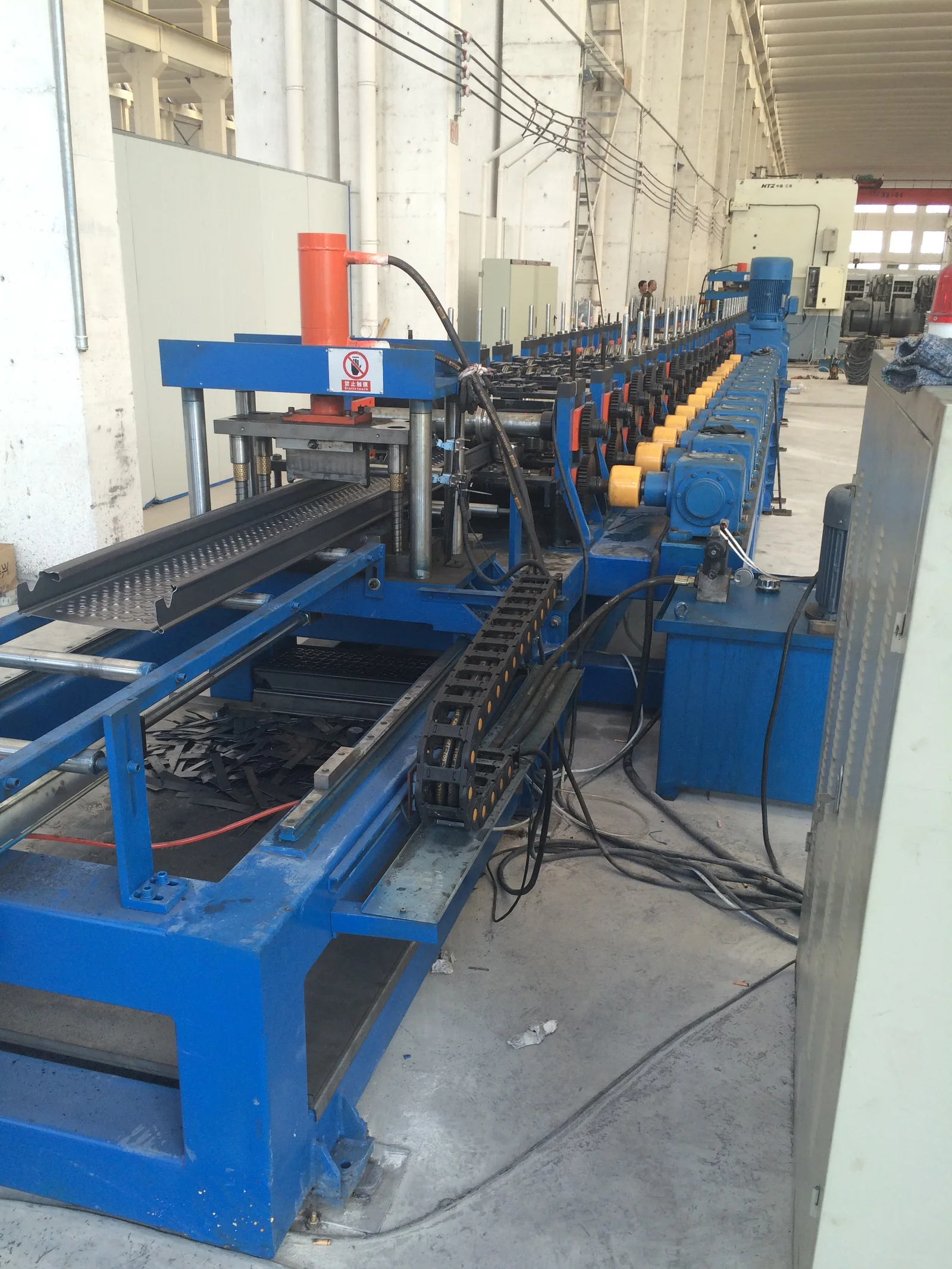
Scaffold Plank Roll Forming & Perforating Line
Anti-slip steel scaffold planks formed and perforated on one line — the walkway product that pairs with any access or barrier system.
Technical Specifications
| Material | GI, pre-galvanised, hot-rolled steel |
| Thickness | 1.2 – 2.5 mm |
| Plank width | 210 / 230 / 250 / 320 mm |
| Plank length | 1.0 – 4.0 m |
| Anti-slip | Raised dimples, perforated holes, or both |
| Forming speed | 10 – 18 m/min |
| Forming stations | 14 – 18 |
| Punching | Inline perforating + dimpling unit |
| Drive | Gearbox chain drive, 11 – 15 kW |
| Cutting | Hydraulic flying cut |
| Control | PLC + HMI, batch counter |
| Certification | CE Declaration of Conformity |
| Lead time | 50 – 65 days |
Need a quote or a custom specification?
What This Machine Produces
Perforated and dimpled steel scaffold planks in widths of 210, 230, 250 and 320 mm.
Load-bearing walkway platforms for scaffolding systems, replacing timber boards. The plank is roll formed from steel with a raised or perforated anti-slip surface, and hooks at each end engage the scaffold transoms.
Planks in lengths from 1.0 to 4.0 m, cut to the bay length required, in 1.2–2.5 mm galvanised, pre-galvanised or hot-rolled steel.
Two anti-slip variants: raised dimples formed into the walking surface, or perforations that drain and grip. Perforated-and-dimpled planks combine both and are the usual specification for outdoor work, because dimples alone grip less well when wet.
Plain dimpled walkway planks — disabling the perforating unit and running the dimpling unit alone produces a plank without perforation, which is common for indoor and dry-duty access.
Planks produced on one pass: the perforating and dimpling unit sits inline ahead of the forming stations, so the flat strip is pierced and dimpled before the section is closed and both features stay accurately positioned relative to the plank edges.
A note on the load rating: scaffold planks are normally rated to a uniformly distributed load specified by the scaffolding standard in force, commonly in the region of 2–3 kN per plank for standard duty. The plank has to be tested and certified to that rating, so the machine specification follows the product approval rather than setting it. Confirming the standard you intend to certify against is part of the enquiry.
Recommended Configuration
A complete working line, not just the forming machine. Each item below is quoted as one package.
- 01
Decoiler and leveling unit
planks carry people, so the section geometry has to be consistent along the whole length. Coil set that is not removed first will show as a rise or dip in the walking surface.
- 02
Inline perforating and dimpling unit
this is the unit that makes the machine a scaffold plank line rather than a generic box-section line. It sits ahead of the forming stations and works on the flat strip.
- 03
Scaffold plank roll forming machine
14–18 stations on a gearbox chain drive at 11–15 kW, forming at 10–18 m/min.
- 04
Hydraulic flying cut with batch counter
planks are cut to the bay length, and a scaffold set mixes lengths, so the batch counter is what keeps a set together.
- 05
PLC + HMI
perforating on/off, dimpling, length and batch are selected on the control. Switching from perforated-and-dimpled to plain dimpled is a control action, not a tooling change.
- 06
A note on the process sequence: perforating and dimpling both happen on the flat strip before forming. Doing either after the section is closed would be inaccurate, because the punch has no clean access line into a formed box.
Production Workflow
- 01
Decoiler
Coil is loaded and uncoiled at controlled tension. The plank is a walkway, so tension consistency shows directly in whether the finished surface is flat along its length.
- 02
Leveling
The strip is straightened before forming. Cross-bow that is not removed here becomes a twist along the plank, and a twisted plank will not sit flat on the transoms.
- 03
Perforating and dimpling
The flat strip is pierced and dimpled in one pass. Both features are positioned relative to the plank edges here, which is only possible while the strip is flat.
- 04
Roll forming
14–18 stations form the plank section in 1.2–2.5 mm material at 10–18 m/min, closing the section around the anti-slip surface.
- 05
Cutting
A hydraulic flying cut cuts to the bay length with a batch counter.
- 06
End preparation
Hooks or end pieces for engaging the transoms are added at assembly. Those are fabricated separately from this line.
Key Components
- Forming stations
- 14–18
- Drive
- Gearbox chain drive, 11–15 kW
- Perforating and dimpling unit
- Inline, ahead of the forming stations — the defining unit of this line
- Cutting
- Hydraulic flying cut, batch counter
- Control
- PLC + HMI with perforating and dimpling on/off
- Working range
- 1.2–2.5 mm · plank width 210 / 230 / 250 / 320 mm · length 1.0–4.0 m
- Duty reference
- commonly rated around 2–3 kN per plank for standard duty; confirm the standard you will certify against
Customization Options
Every line is built to order. These are the points buyers most often change.
| Item | What can be changed |
|---|---|
| Anti-slip surface | Dimpled, perforated, or both — perforated-and-dimpled is the usual choice for outdoor work because dimples alone grip less well when wet |
| Plank width | 210 / 230 / 250 / 320 mm |
| Plank length | 1.0–4.0 m, cut to the bay length |
| Material and thickness | 1.2–2.5 mm galvanised, pre-galvanised or hot-rolled. Hot-dip galvanised is common where the plank is used on refineries and chemical plants, because steel planks are fire resistant where timber is not |
| Perforation pattern | Hole size and pitch to your own design |
| Duty rating | Tell us which scaffolding standard you intend to certify the plank to — the machine specification follows the product approval |
| Power supply | 380 V / 50 Hz / 3-phase standard; other voltages to your site |
Applications
FAQ — Scaffold Plank Roll Forming & Perforating Line
What is a steel scaffold plank?
Why replace timber scaffold boards with steel planks?
How is the anti-slip surface made?
What load must a scaffold plank carry?
Does the line do perforating and dimpling in one pass?
Can the same line make plain walkway planks without perforation?
Can the machine be built for our own profile?
How do we get a price for this line?
What material thickness can this machine form?
What is the production speed?
How many forming stations does it use?
What is the drive and installed power?
You May Also Need
Send us your profile and output target
Tell us the profile and the numbers that matter to you. We confirm the configuration against the specification table above and quote FOB Tianjin within 24 hours.
- MaterialGI, pre-galvanised, hot-rolled steel
- Thickness1.2 – 2.5 mm
- Plank width210 / 230 / 250 / 320 mm
- Plank length1.0 – 4.0 m