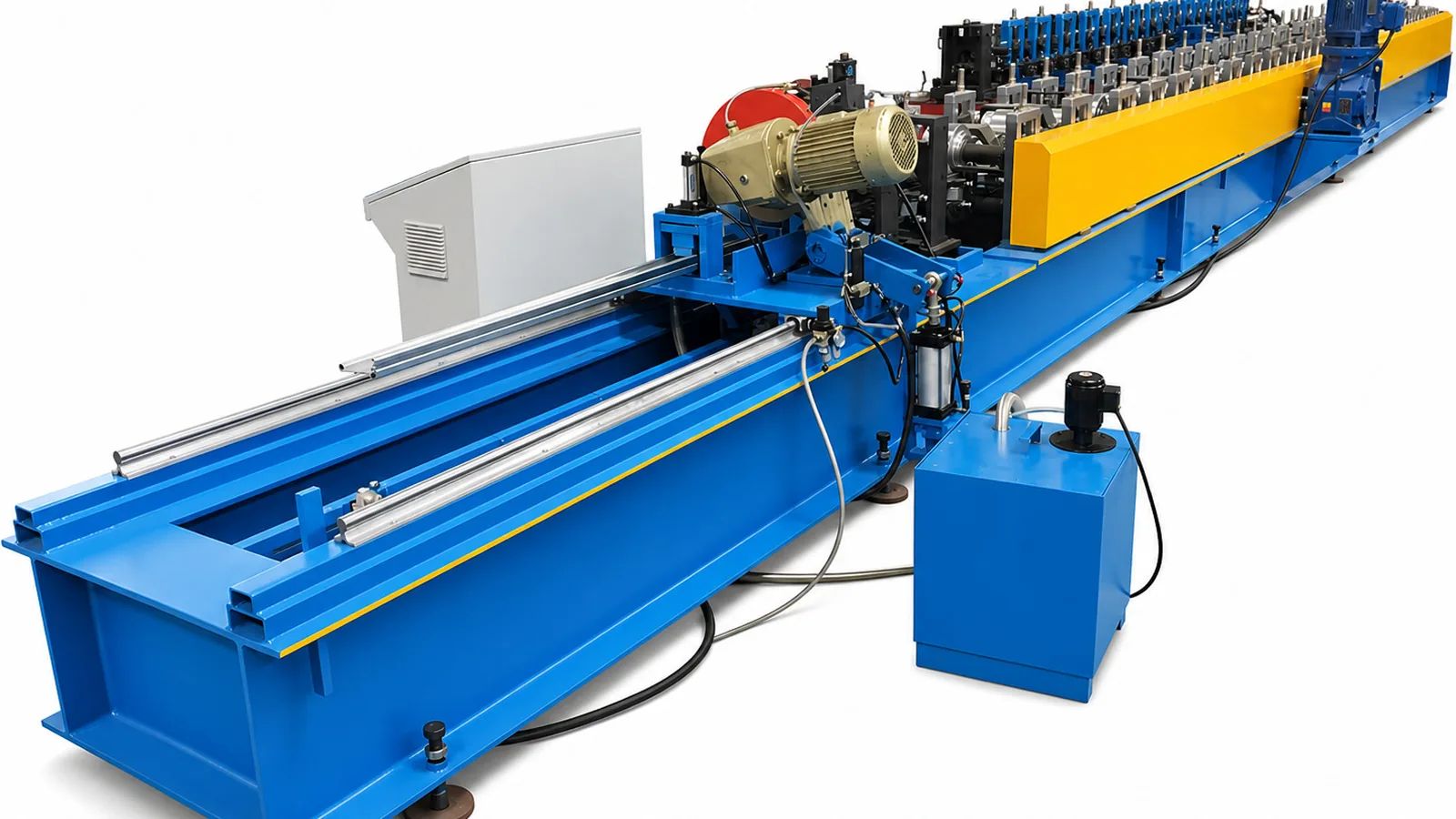
Roller Shutter Door Roll Forming Machine
Interlocking C-slat, Z-slat and perforated shutter slats — the highest-speed machine in the range because the slat section is small and light.
Technical Specifications
| Material | GI, PPGI, aluminium |
| Thickness | 0.6 – 1.2 mm |
| Slat depth | 77 / 80 / 105 mm standard · custom 60–120 mm |
| Slat types | C-slat, Z-slat, perforated, insulated |
| Forming speed | 15 – 30 m/min |
| Forming stations | 12 – 18 |
| Drive | Gearbox chain drive, 5.5 – 7.5 kW |
| Punching | Inline perforating unit, optional |
| Cutting | Flying cut to length |
| Control | PLC + HMI, batch counter |
| Certification | CE Declaration of Conformity |
| Lead time | 35 – 50 days |
Need a quote or a custom specification?
What This Machine Produces
C-slat at 77 mm — the most common shutter profile, with an interlocking hook on both edges. Used on standard commercial shutters.
C-slat heavy at 105 mm — the deeper section gives more stiffness over wide spans and higher wind load.
Z-slat at 77 or 105 mm — the Z geometry gives a more closed appearance with less visible joint, for shutters needing a flatter face.
Perforated slats at 77 mm — an inline perforating unit adds ventilation holes, used on car parks and plant rooms.
Insulated slats at 77 or 105 mm — a foam-filled slat for thermal separation, which needs a separate filling step after forming.
Custom slat depths between 60 mm and 120 mm, though a non-standard depth requires new roll design.
Slats in 0.6–1.2 mm galvanised or pre-painted steel at 15–30 m/min — the highest-speed machine in the range, because the slat section is small and light.
Recommended Configuration
A complete working line, not just the forming machine. Each item below is quoted as one package.
- 01
Decoiler and leveling unit
slats are formed and then interlocked edge to edge, so slat-to-slat fit tolerance decides how smoothly the finished curtain runs in its guides.
- 02
Roller shutter slat machine
12–18 stations on a gearbox chain drive at 5.5–7.5 kW, forming at 15–30 m/min.
- 03
Optional inline perforating unit
punches the ventilation holes during forming, which avoids a separate handling operation and keeps the holes aligned with the slat section.
- 04
Flying cut to length with batch counter
slats are cut to the shutter drop, so a set for one opening comes off together.
- 05
PLC with HMI
slat type, length and batch are selected rather than set by hand.
- 06
A note on coating: use a heavier coating weight than you would on roofing sheet. Shutter slats are handled constantly and abraded every time the curtain rolls into the box, so the coating is a wear surface rather than a finish.
- 07
A note on output: at 20 m/min average the machine produces roughly 800–1,000 m of slat per shift, which is enough for 15–25 typical shutters depending on width and height.
Production Workflow
- 01
Decoiler
Coil is loaded and uncoiled at controlled tension. The slat is a small light section, so tension variation shows as a variation in the interlocking hook rather than as a thickness change.
- 02
Leveling
The strip is straightened before forming. Because slats interlock edge to edge along the whole curtain, a bowed slat produces a curtain that runs out of line in its guides.
- 03
Perforating (optional)
Where ventilated slats are specified, the holes are punched inline while the strip is flat, which keeps the pattern registered to the slat section.
- 04
Roll forming
12–18 stations form the C-slat, Z-slat or insulated slat profile in 0.6–1.2 mm material at 15–30 m/min.
- 05
Cutting
A flying cut cuts to the shutter drop, with a batch counter.
- 06
Assembly (separate step)
Slats are interlocked and held by end caps fitted at each end, then wound onto a barrel. That assembly is a separate operation from this line — the machine produces the slats.
Key Components
- Forming stations
- 12–18
- Drive
- Gearbox chain drive, 5.5–7.5 kW
- Perforating
- Optional inline unit for ventilated slats
- Cutting
- Flying cut to length, batch counter
- Control
- PLC + HMI
- Slat depths
- 77 / 80 / 105 mm standard · custom 60–120 mm
- Output
- about 800–1,000 m of slat per shift at 20 m/min average — 15–25 typical shutters
Customization Options
Every line is built to order. These are the points buyers most often change.
| Item | What can be changed |
|---|---|
| Slat type | C-slat, Z-slat, perforated or insulated |
| Slat depth | 77 / 80 / 105 mm standard; custom depths between 60 mm and 120 mm need new roll design |
| Ventilation | Optional inline perforating for car parks and plant rooms |
| Insulation | Foam-filled slat for climate-controlled buildings — the filling is a separate step after forming |
| Material and coating | Commercial quality galvanised or pre-painted steel at 0.6–1.2 mm. Specify a heavier coating weight than for roofing, because slats abrade every time the curtain rolls in |
| Power supply | 380 V / 50 Hz / 3-phase standard; other voltages to your site |
Shutter slat variants and their applications
| Slat type | Depth | Application | Notes |
|---|---|---|---|
| C-slat | 77 mm | Standard commercial shutters | The most common profile; interlocking hook on both edges |
| C-slat heavy | 105 mm | Wide openings, high wind load | Deeper section gives more stiffness over wide spans |
| Z-slat | 77 / 105 mm | Shutters needing a flatter face | Z geometry gives a more closed appearance with less visible joint |
| Perforated | 77 mm | Shutters requiring ventilation | Inline perforating adds airflow — used on car parks and plant rooms |
| Insulated | 77 / 105 mm | Climate-controlled buildings | Foam-filled slat for thermal separation; needs a separate filling step |
Applications
FAQ — Roller Shutter Door Roll Forming Machine
What slat sizes are standard?
Can the machine produce perforated ventilation slats?
What is the difference between a shutter slat machine and a door frame machine?
What steel grade and coating are used for shutter slats?
How is the curtain assembled from the slats?
What output is typical?
Can the machine be built for our own profile?
How do we get a price for this line?
What material thickness can this machine form?
What is the production speed?
How many forming stations does it use?
What is the drive and installed power?
You May Also Need
Send us your profile and output target
Tell us the profile and the numbers that matter to you. We confirm the configuration against the specification table above and quote FOB Tianjin within 24 hours.
- MaterialGI, PPGI, aluminium
- Thickness0.6 – 1.2 mm
- Slat depth77 / 80 / 105 mm standard · custom 60–120 mm
- Slat typesC-slat, Z-slat, perforated, insulated