Gutter & Downpipe Roll Forming Machine
The complete rainwater package on one platform: half-round and K-style gutters, square and round downpipes, and steel drainage channels.
Technical Specifications
| Material | PPGI, aluminium, stainless 304, hot-rolled steel |
| Thickness | 0.5 – 0.8 mm (rainwater) · 1.5 – 3.0 mm (channel) |
| Gutter profile | Half-round, K-style, square |
| Gutter width | 100 / 125 / 150 / 200 mm |
| Channel width | 100 – 600 mm · depth 50 – 200 mm |
| Downpipe | Square 65 × 65 / 80 × 80 · round Ø 75 – 110 mm |
| Speed | 15 – 20 m/min (gutter) · 8 – 15 m/min (channel) |
| Forming stations | 14 – 20 |
| Drive | Gearbox chain drive, 5.5 – 15 kW |
| Cutting | Flying cut to length |
| Control | PLC + HMI, batch counter |
| Certification | CE Declaration of Conformity |
| Lead time | 35 – 55 days |
| Gutter-to-downpipe changeover | about 3–4 hours |
Need a quote or a custom specification?
What This Machine Produces
Half-round gutters in 100, 125, 150 and 200 mm — the traditional specification in the UK, Europe and Australia, matching the cast-iron look.
K-style gutters with a flat back and a decorative front face, the North American specification that reads as a moulded timber fascia and fixes straight to the fascia board.
Square gutters in 100–200 mm — highest flow capacity per unit width and the easiest to join, which is why they dominate industrial roofs in the Middle East and Asia.
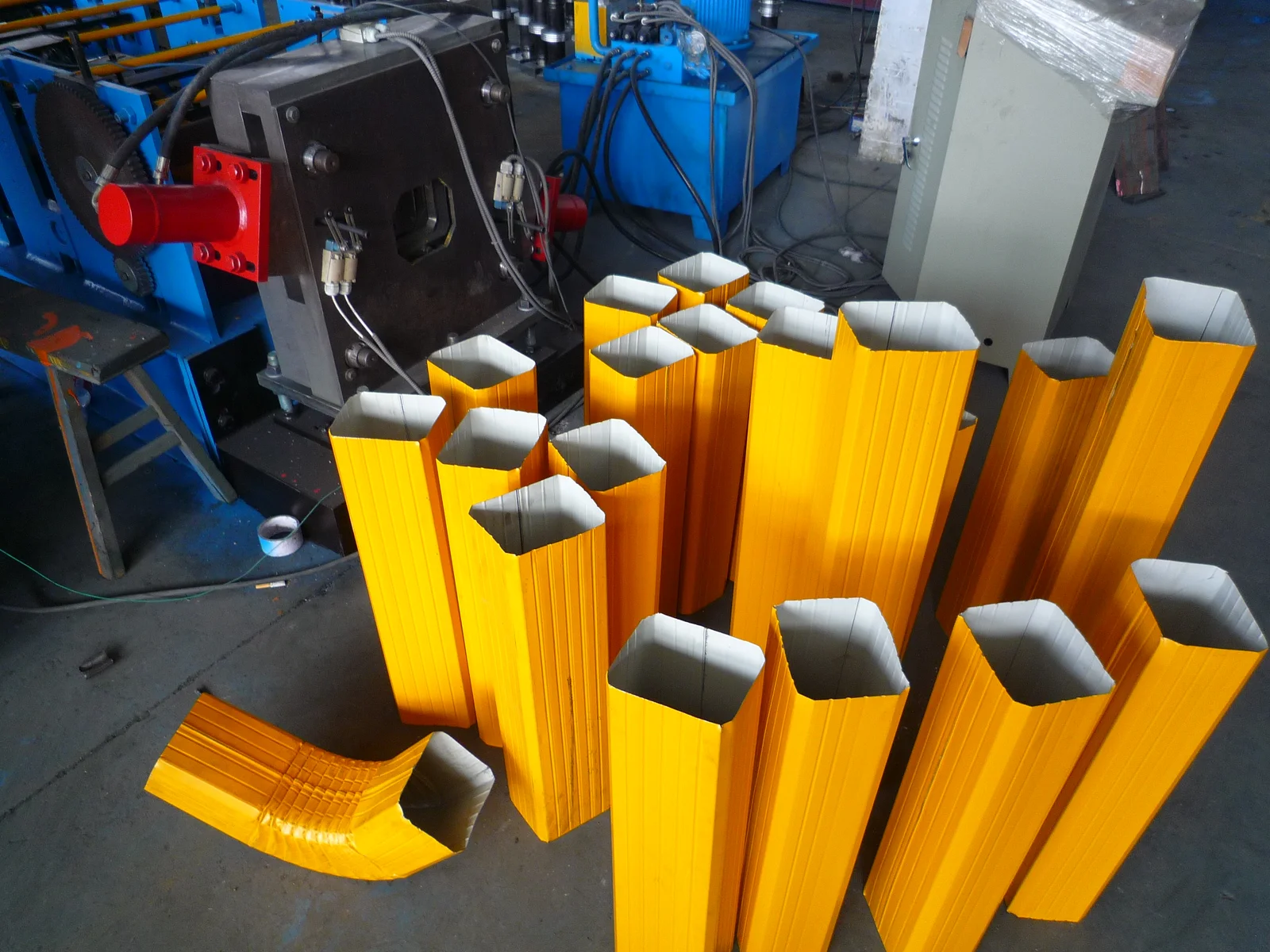
Square downpipes at 65 × 65 mm and 80 × 80 mm, and round downpipes from Ø 75 to 110 mm, formed from a slotted section closed into a tube.
Steel drainage channels — heavier U or trapezoidal sections, 100–600 mm wide and 50–200 mm deep in 1.5–3.0 mm steel, used as load-bearing ground drainage along roads, car parks and landscaped areas. Gratings and end caps are added on site, so this machine produces the channel body.
The complete rainwater package: gutters, downpipes and channels on one platform, in 0.5–0.8 mm for rainwater sections and 1.5–3.0 mm for channels.
Recommended Configuration
A complete working line, not just the forming machine. Each item below is quoted as one package.
- 01
Decoiler and leveling unit
gutter sections are visible at close range on every building, so coil set and surface marking matter more here than on roofing sheet.
- 02
Gutter / downpipe roll forming machine
14–20 stations on a gearbox chain drive at 5.5–15 kW. Rainwater sections run at 15–20 m/min; the heavier drainage channel runs at 8–15 m/min.
- 03
Two roll cassettes
a gutter is an open section and a downpipe is a closed tube formed from a slotted round or square section, so they cannot share tooling. Both are supplied on a common base frame, and changing between them takes about 3–4 hours.
- 04
Additional cassettes for each gutter profile
half-round, K-style and square have completely different geometry and cannot share tooling, but the base frame, decoiler and cutting unit are common.
- 05
Flying cut to length with encoder control
a PLC with an encoder counts the feed and triggers the shear at the programmed length, so runs are cut to the exact fascia length. Batch counting produces a whole building set in one run.
- 06
Colour choice at no extra plant cost
producing in-house from coil lets you match the gutter to the fascia, the window frames or the roof, which is a genuine selling point against buying fabricated gutter in.
Production Workflow
- 01
Decoiler
Coil is loaded and uncoiled at controlled tension. Gutters are seen at close range, so surface quality from the decoiler onward is what the customer judges.
- 02
Leveling
The strip is straightened before forming. An open gutter section shows a twisted edge line immediately.
- 03
Roll forming
14–20 stations form the selected section. Half-round, K-style and square gutters need separate cassettes; downpipes need a further cassette because the section is closed into a tube.
- 04
Cassette change
Changing between gutter and downpipe takes about 3–4 hours.
- 05
Cutting
A PLC with encoder counts the feed and triggers the flying cut at the programmed length, with batch counting for a complete building set.
- 06
Output
Gutters leave on the runout, normally bundled with the matching downpipe and accessories for the same elevation.
Key Components
- Forming stations
- 14–20
- Drive
- Gearbox chain drive, 5.5–15 kW
- Cutting
- Flying cut to length, encoder controlled
- Control
- PLC + HMI with batch counter
- Cassettes
- Gutter (half-round, K-style, square) plus a separate downpipe cassette
- Changeover
- about 3–4 hours between gutter and downpipe
- Working range
- Gutter 100–200 mm · downpipe 65 × 65 / 80 × 80 mm and Ø 75–110 mm · channel 100–600 mm wide, 50–200 mm deep
Customization Options
Every line is built to order. These are the points buyers most often change.
| Item | What can be changed |
|---|---|
| Gutter profile | Half-round, K-style (North America) or square (Middle East, Asia) — each needs its own cassette |
| Gutter width | 100 / 125 / 150 / 200 mm |
| Downpipe section | Square 65 × 65 or 80 × 80 mm; round Ø 75–110 mm |
| Drainage channel | 100–600 mm wide, 50–200 mm deep, in 1.5–3.0 mm steel for load-bearing ground drainage |
| Material | PPGI most common because it can be colour-matched to the roofing; aluminium where weight matters on long runs; stainless 304 for coastal or industrial environments |
| Colour matching | Producing in-house from coil allows the gutter to be matched to the fascia, window frames or roof as the project requires |
| Power supply | 380 V / 50 Hz / 3-phase standard; other voltages to your site |
Gutter profiles and where each is specified
| Profile | Section | Main markets | Notes |
|---|---|---|---|
| Half-round | Semi-circular, 100–150 mm | UK, Europe, Australia | Traditional specification, matches cast-iron look; needs a separate downpipe profile |
| K-style | Flat back with a decorative front face | North America | Looks like a moulded timber fascia; the flat back fixes straight to the fascia board |
| Square | Rectangular, 100–200 mm | Middle East, Asia, industrial buildings | Highest flow capacity per width and easiest to join; common on industrial roofs |
| Drainage channel | U or trapezoidal, 100–600 mm | Civil, landscape, road drainage | Load-bearing ground drainage, thicker material and gratings added on site |
Applications
FAQ — Gutter & Downpipe Roll Forming Machine
Can one machine produce both gutters and downpipes?
Can the same machine make K-style and half-round?
What material is normally used for gutters?
What is a drainage channel machine used for?
How is gutter length controlled?
Should the gutter be the same colour as the roof or the fascia?
What is the difference between a domestic and a greenhouse gutter?
Can the machine be built for our own profile?
How do we get a price for this line?
What material thickness can this machine form?
What is the production speed?
How many forming stations does it use?
You May Also Need
Send us your profile and output target
Tell us the profile and the numbers that matter to you. We confirm the configuration against the specification table above and quote FOB Tianjin within 24 hours.
- MaterialPPGI, aluminium, stainless 304, hot-rolled steel
- Thickness0.5 – 0.8 mm (rainwater) · 1.5 – 3.0 mm (channel)
- Gutter profileHalf-round, K-style, square
- Gutter width100 / 125 / 150 / 200 mm