Steel Door Frame Roll Forming Machine
L-frame, U-channel and Z-frame door profiles in 0.8–2.0 mm steel, with optional inline hole punching for hinge and strike plates.
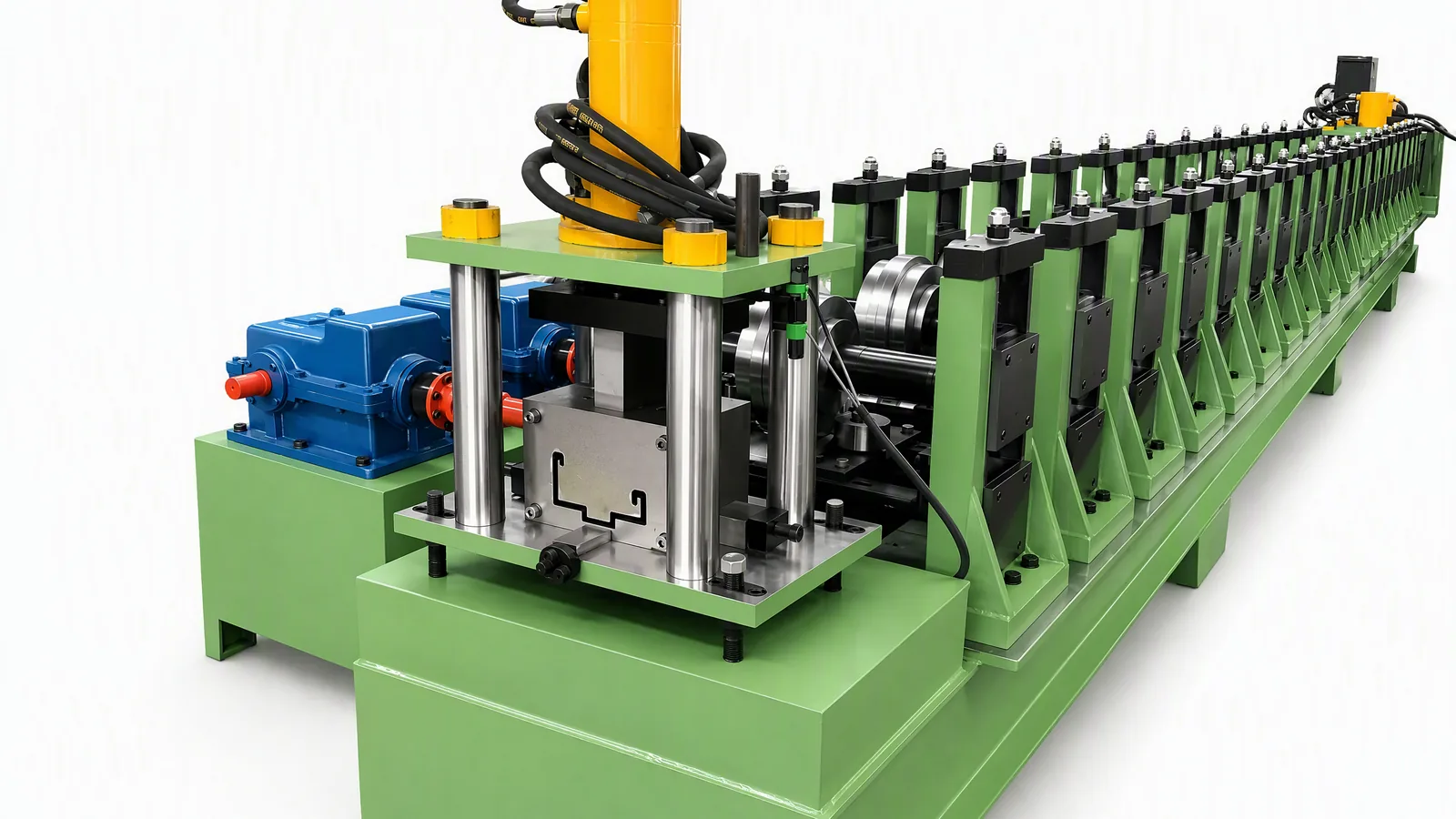
Technical Specifications
| Material | Cold-rolled steel, GI, pre-painted steel |
| Thickness | 0.8 – 2.0 mm |
| Profiles | L-frame, U-channel, Z-frame, custom section |
| Section size | 70 – 250 mm depth |
| Forming speed | 10 – 20 m/min |
| Forming stations | 12 – 16 |
| Drive | Gearbox chain drive, 5.5 – 11 kW |
| Punching | Inline hinge and strike holes, optional |
| Cutting | Hydraulic flying cut / mitre cut |
| Control | PLC + HMI, batch counter |
| Certification | CE Declaration of Conformity |
| Lead time | 40 – 55 days |
Need a quote or a custom specification?
What This Machine Produces
L-frame door sections — a single return, used where the frame is fixed into a prepared opening.
U-channel frames — the section wraps around the wall on both faces, giving a finished edge on each side. This is the usual choice for exposed blockwork or stud walls.
Z-frame sections and custom door sections, in a depth range of 70–250 mm.
Frames in 0.8–2.0 mm cold-rolled, galvanised or pre-painted steel, formed through 12–16 stations at 10–20 m/min.
Frames cut with a flying shear, or mitre cut where the frames are assembled with mitred corners rather than welded butt joints.
Punched frames — optional inline punching for hinge positions, strike plates and fixing holes, programmed from a list rather than a fixed pattern, because hinge positions vary by door height and hand.
A note on thickness and duty: 0.8–1.2 mm covers standard interior frames and light commercial doors; 1.5–2.0 mm is for fire-rated doors, external doors and heavy-duty commercial installations where the frame has to resist impact. That thickness difference is the clearest signal of what a frame is designed for.
Recommended Configuration
A complete working line, not just the forming machine. Each item below is quoted as one package.
- 01
3 T decoiler and leveling unit
a standard line includes both, plus the roll forming machine, flying cut, runout table and PLC control cabinet.
- 02
Steel door frame machine
12–16 stations on a gearbox chain drive at 5.5–11 kW, forming at 10–20 m/min.
- 03
Optional inline punch for hinge and strike holes
the punch is normally programmed from a list, because hinge positions change with door height and hand. A fixed pattern would only suit one door type.
- 04
Mitre cut unit as an alternative to the flying shear
specify this if your frames are assembled with mitred corners. If they are welded butt joints, the standard flying cut is the right choice.
- 05
Tandem stations with two roll sets where you also make the door stop
running frame and stop together is common on higher-output lines. More often producers run two separate machines, because the stop is a small simple section and runs much faster than the frame.
- 06
PLC + HMI with batch counter
a door set is frame plus stop plus fixings, so the batch counter is what keeps the set together.
Production Workflow
- 01
Decoiler
Coil is loaded and uncoiled at controlled tension. Door frames are visible in every finished room, so surface quality matters from the decoiler onward.
- 02
Leveling
The strip is straightened before forming. A door frame that is not straight will not close onto the wall opening squarely, and the error is visible at the architrave.
- 03
Punching (optional)
Hinge and strike positions are punched while the strip is flat. Because hinge positions vary with door height and hand, the punch runs from a programmed list rather than a fixed pattern.
- 04
Roll forming
12–16 stations form the L, U or Z section in 0.8–2.0 mm material at 10–20 m/min.
- 05
Cutting
A hydraulic flying cut, or a mitre cut unit where the frames are mitred rather than welded butt joints.
- 06
Output
Frames leave on the runout bundled as a door set, so frame, stop and fixings for the same opening stay together through packing and delivery.
Key Components
- Forming stations
- 12–16
- Drive
- Gearbox chain drive, 5.5–11 kW
- Punch
- Optional inline for hinge, strike and fixing holes; programmed from a list
- Cutting
- Hydraulic flying cut, or mitre cut unit
- Control
- PLC + HMI with batch counter
- Standard line items
- 3 T decoiler, leveling unit, forming machine, flying cut, runout table, PLC control cabinet
- Section range
- depth 70–250 mm · thickness 0.8–2.0 mm
Customization Options
Every line is built to order. These are the points buyers most often change.
| Item | What can be changed |
|---|---|
| Profile | L-frame, U-channel, Z-frame, or a custom door section |
| Section depth | 70–250 mm |
| Thickness and duty | 0.8–1.2 mm for standard interior and light commercial; 1.5–2.0 mm for fire-rated, external and heavy-duty commercial |
| Hole punching | Optional inline, programmed from a hinge-position list based on door height and hand |
| Cut type | Flying shear for butt-welded frames, or a mitre cut unit for mitred corner assembly |
| Door stop on the same line | Tandem stations with two roll sets, or a separate machine — the stop runs much faster than the frame |
| Power supply | 380 V / 50 Hz / 3-phase standard; other voltages to your site |
Applications
FAQ — Steel Door Frame Roll Forming Machine
Can one machine make both the door frame and the door stop?
What is the difference between an L-frame and a U-channel frame?
Does the machine punch hinge and strike holes?
What thickness is used for steel door frames?
Can the frame be mitre cut on the machine?
What is the lead time and what does the line include?
Can the machine be built for our own profile?
How do we get a price for this line?
Which coil materials can the line run?
What is the production speed?
How many forming stations does it use?
What is the drive and installed power?
You May Also Need
Send us your profile and output target
Tell us the profile and the numbers that matter to you. We confirm the configuration against the specification table above and quote FOB Tianjin within 24 hours.
- MaterialCold-rolled steel, GI, pre-painted steel
- Thickness0.8 – 2.0 mm
- ProfilesL-frame, U-channel, Z-frame, custom section
- Section size70 – 250 mm depth