Ceiling T-Bar Roll Forming Machine
Main tees, cross tees and wall angle for suspended ceiling grids — with the continuous slot that lets cross-tee clips engage.
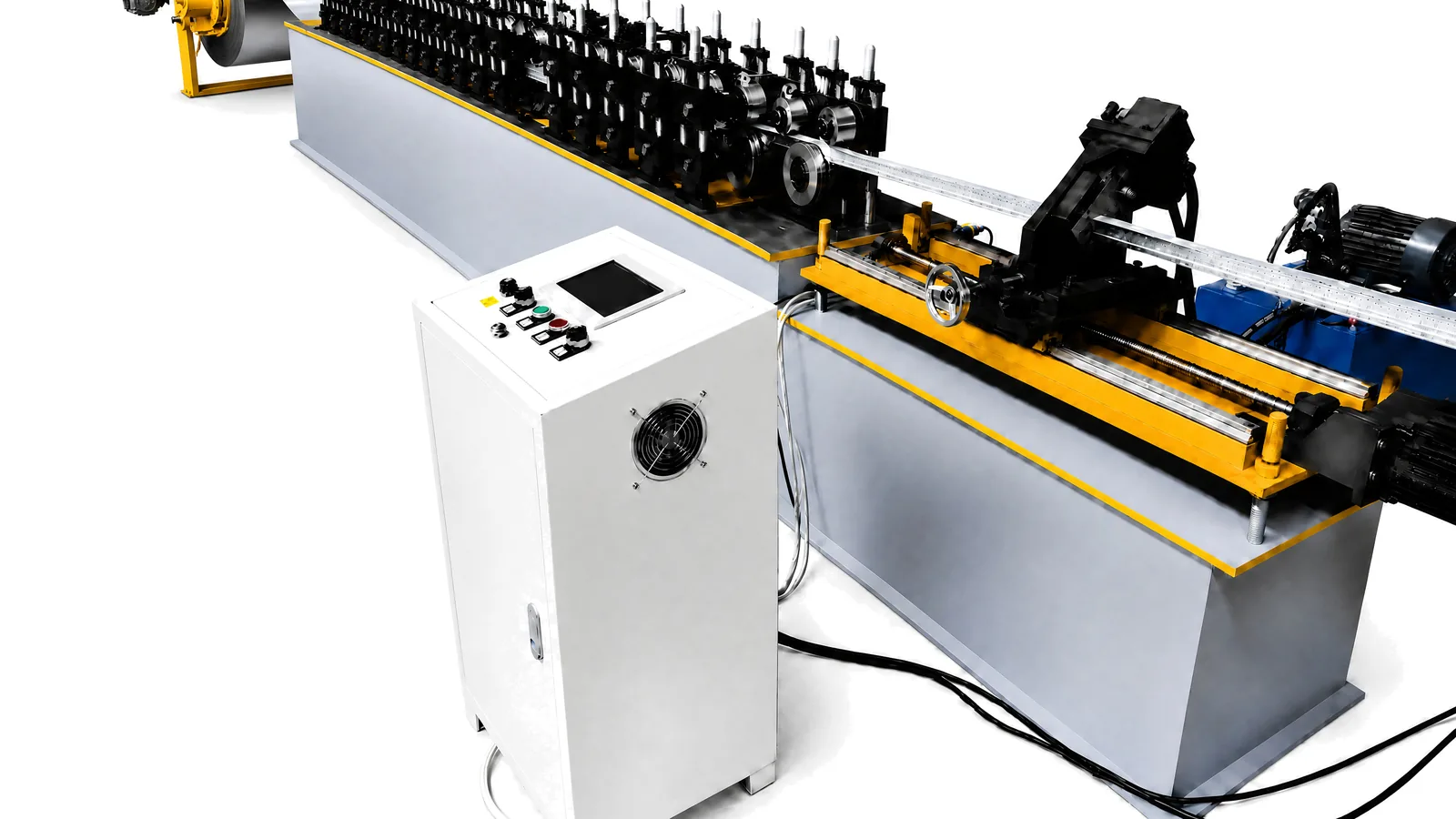
Technical Specifications
| Material | Galvanised steel, pre-painted steel |
| Thickness | 0.3 – 0.8 mm |
| Profiles | Main tee, cross tee, wall angle, ceiling channel |
| Section height | 24 / 32 / 38 mm |
| Forming speed | 20 – 35 m/min |
| Forming stations | 12 – 16 |
| Drive | Gearbox chain drive, 5.5 – 11 kW |
| Punching | Continuous slot die, inline |
| Cutting | Flying cut to length |
| Control | PLC + HMI, batch counter |
| Certification | CE Declaration of Conformity |
| Lead time | 40 – 55 days |
Need a quote or a custom specification?
What This Machine Produces
Main tees in 24, 32 and 38 mm section height — the load-carrying members that span between the hangers.
Cross tees in 24 and 32 mm — the shorter members that span between main tees and carry the tiles only.
The continuous slot along the main tee web — this is the feature that defines the machine. The slot lets cross-tee end clips engage anywhere along the tee, which is what makes the grid adjustable on site.
Wall angle — a simple L-profile that runs on the same line with an additional roll set, or on a separate small machine. Many producers keep it on a dedicated machine because its optimum line speed differs from the main tee.
Ceiling channel sections in the same thickness range, for the perimeter and the hanger detail.
Main tees, cross tees and wall angle in 0.3–0.8 mm galvanised or pre-painted steel, formed through 12–16 stations at 20–35 m/min.
A grid that assembles to the standard 600 × 600 mm module, with the end geometry formed to interlock between main and cross tees.
Recommended Configuration
A complete working line, not just the forming machine. Each item below is quoted as one package.
- 01
Decoiler and leveling unit
the sections are light and dimensionally critical, because the grid has to assemble on site without rework.
- 02
Ceiling T-bar roll forming machine
12–16 stations on a gearbox chain drive at 5.5–11 kW, forming at 20–35 m/min. Fewer stations than a structural profile, because the section is small and thin.
- 03
Inline continuous slot die
this is the unit that makes a T-bar line rather than a generic mini-profile line. The slot is punched while the strip is still flat, before the closing stations, so it stays accurately positioned through forming. Punching a closed T-section afterwards is not practical.
- 04
Flying cut to length with batch counter
main tees and cross tees are cut to different lengths for the same ceiling, so the batch counter is what keeps a grid set together.
- 05
PLC with HMI
the slot pattern, section height and cut length are selected rather than set by hand.
- 06
A note on thickness: 0.3–0.5 mm covers cross tees and light-duty main tees; 0.5–0.8 mm is for heavy-duty main tees carrying heavier tiles or services routed above the ceiling. The thickness in a specification is what tells you which duty the grid is designed for.
Production Workflow
- 01
Decoiler
Coil is loaded and uncoiled at controlled tension. The section is light and the tolerances are tight, so over-tensioning shows up as a bowed tee rather than as a thickness change.
- 02
Leveling
The strip is straightened before forming. A bowed tee will not sit in the grid plane with its neighbours.
- 03
Slot punching
The continuous slot is punched along the main tee web while the strip is flat. Doing it here rather than after forming is what keeps the slot registered to the section — a formed T-section gives the punch no clean access line.
- 04
Roll forming
12–16 stations close the T-section in 0.3–0.8 mm material at 20–35 m/min, forming the web, the two flanges and the interlocking end geometry.
- 05
Cutting
A flying cut cuts main tees and cross tees to their own lengths, with the batch counter keeping a ceiling set together.
- 06
Output
Finished lengths leave on the runout, normally bundled by member type so the installer receives main tees, cross tees and wall angle separately.
Key Components
- Forming stations
- 12–16
- Drive
- Gearbox chain drive, 5.5–11 kW
- Slot die
- Inline continuous slot, punched on the flat strip before closing
- Cutting
- Flying cut to length, batch counter
- Control
- PLC + HMI
- Section heights
- 24 / 32 / 38 mm
- Thickness by duty
- 0.3–0.5 mm for cross tees and light-duty main tees · 0.5–0.8 mm for heavy-duty main tees
Customization Options
Every line is built to order. These are the points buyers most often change.
| Item | What can be changed |
|---|---|
| Profiles | Main tee, cross tee, wall angle, ceiling channel — wall angle needs an additional roll set |
| Section height | 24 / 32 / 38 mm, selected by which member and what load it carries |
| Thickness | 0.3–0.8 mm. Choose toward the upper end where tiles are heavy or services run above the ceiling |
| Slot pattern | Continuous slot along the main tee web; the cross-tee end geometry is formed to match your grid system |
| Grid module | The standard assembly is 600 × 600 mm; other modules need the cross-tee length and end geometry set accordingly |
| Material and coating | Galvanised, or pre-painted where the grid is left exposed |
| Power supply | 380 V / 50 Hz / 3-phase standard; other voltages to your site |
Applications
FAQ — Ceiling T-Bar Roll Forming Machine
What is a ceiling T-bar grid?
How does the machine form the continuous slot?
Can the same machine make wall angle?
What is the difference between a main tee and a cross tee?
How many forming stations does a T-bar need?
What thickness is used for ceiling grid?
Can the machine be built for our own profile?
How do we get a price for this line?
Which coil materials can the line run?
What is the production speed?
What is the drive and installed power?
How is the finished profile cut to length?
You May Also Need
Send us your profile and output target
Tell us the profile and the numbers that matter to you. We confirm the configuration against the specification table above and quote FOB Tianjin within 24 hours.
- MaterialGalvanised steel, pre-painted steel
- Thickness0.3 – 0.8 mm
- ProfilesMain tee, cross tee, wall angle, ceiling channel
- Section height24 / 32 / 38 mm