Wall Angle & Corner Bead Roll Forming Machine
Corner bead, wall angle and plaster stop profiles — the low-cost accessories that every drywall contractor buys by the box.
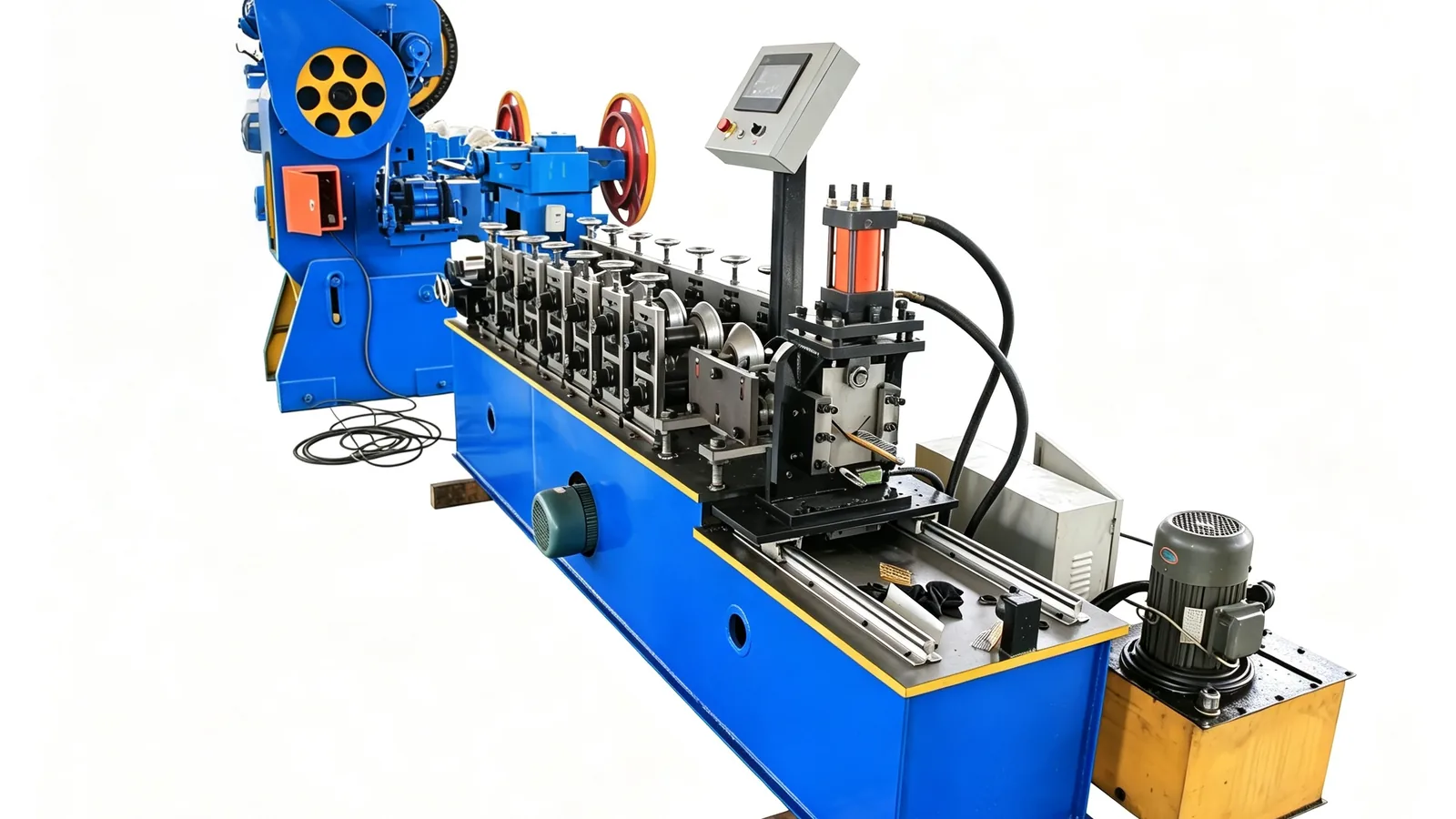
Technical Specifications
| Material | Galvanised steel, PVC-coated, stainless |
| Thickness | 0.3 – 0.8 mm |
| Profiles | L-angle, corner bead, shadow bead, plaster stop bead |
| Leg width | 20 – 50 mm |
| Standard lengths | 2.4 m / 3.0 m / custom |
| Forming speed | 20 – 40 m/min |
| Forming stations | 10 – 14 |
| Drive | Gearbox chain drive, 3 – 7.5 kW |
| Punching | Optional inline punch for fixing holes |
| Cutting | Flying cut to length |
| Control | PLC + HMI, batch counter |
| Certification | CE Declaration of Conformity |
| Lead time | 30 – 45 days |
Need a quote or a custom specification?
What This Machine Produces
L-angle and corner bead — the L-section fixed to internal and external corners and wall ends before plastering, in leg widths from 20 to 50 mm.
Internal and external corner beads — the two-leg L profiles that protect the corner from impact and give the plasterer a straight edge to work to.
Shadow beads — a profile with a small setback that creates a deliberate shadow line at the wall-to-ceiling junction, used as an architectural detail to hide minor misalignment.
Plaster stop beads with a third return or a perforated flange, for where plaster terminates against a different material.
Standard 2.4 m and 3.0 m lengths, or cut to your own length, produced in 0.3–0.8 mm steel at 20–40 m/min.
The same profiles in galvanised, PVC-coated or stainless steel, with polyurethane guide rolls and minimum forming pressure so the coating survives intact.
Recommended Configuration
A complete working line, not just the forming machine. Each item below is quoted as one package.
- 01
Small decoiler and leveling unit
the section is a simple L in thin steel, so the feeding equipment is correspondingly small. There is very little forming work to do on this line.
- 02
Wall angle / corner bead machine
10–14 stations on a gearbox chain drive at only 3–7.5 kW, forming at 20–40 m/min. This is the least expensive machine we build, and the low station count and small drive are the reason.
- 03
Optional inline punch for fixing holes
where the profile is screw-fixed rather than embedded in plaster, holes can be punched as the strip runs.
- 04
Flying cut to length with batch counter
most producers cut to 2.4 m or 3.0 m standard lengths, because that keeps handling and bundling simple.
- 05
PLC + HMI with batch counter
profile, length and batch are selected rather than set by hand.
- 06
A practical note on output: at 20–40 m/min the machine is not the constraint. Throughput is limited by how fast an operator can stack and bundle the finished lengths, so the realistic output figure is a handling figure, not a forming figure.
Production Workflow
- 01
Decoiler
Coil is loaded and uncoiled. The section is thin and light, so the machine runs comfortably faster than the operator can handle the output.
- 02
Leveling
The strip is straightened before forming. On a corner bead the whole point is a straight edge for the plasterer, so a bowed length is unusable.
- 03
Punching (optional)
Where fixing holes are needed they are punched inline while the strip is flat.
- 04
Roll forming
10–14 stations form the L, corner bead or shadow bead profile in 0.3–0.8 mm material at 20–40 m/min.
- 05
Cutting
A flying cut cuts to 2.4 m, 3.0 m or your own length, with a batch counter.
- 06
Output
Finished lengths leave on the runout for bundling by the box or pallet, which is how this product is actually sold.
Key Components
- Forming stations
- 10–14
- Drive
- Gearbox chain drive, 3–7.5 kW
- Punch
- Optional inline, for fixing holes
- Cutting
- Flying cut to length, batch counter
- Control
- PLC + HMI
- Leg width
- 20–50 mm
- Standard lengths
- 2.4 m / 3.0 m / custom
Customization Options
Every line is built to order. These are the points buyers most often change.
| Item | What can be changed |
|---|---|
| Profile | L-angle, corner bead, shadow bead, plaster stop bead — a shadow bead or a perforated stop bead needs additional stations |
| Leg width | 20–50 mm. Standard internal and external corner beads use two legs, usually 25–50 mm wide |
| Length | 2.4 m and 3.0 m standard, or cut to your own length |
| Material and coating | Galvanised, PVC-coated or stainless. PVC-coated material should run at reduced speed with polyurethane guide rolls |
| Fixing holes | Optional inline punching |
| Power supply | 380 V / 50 Hz / 3-phase standard; other voltages to your site |
Applications
FAQ — Wall Angle & Corner Bead Roll Forming Machine
What is a wall angle bead?
How many legs does a corner bead have?
Can the machine run pre-painted or PVC-coated steel?
Why is this machine so much cheaper than a purlin machine?
What is a shadow bead?
What output rate is realistic?
Can the machine be built for our own profile?
How do we get a price for this line?
What material thickness can this machine form?
How many forming stations does it use?
What is the drive and installed power?
How is the finished profile cut to length?
You May Also Need
Send us your profile and output target
Tell us the profile and the numbers that matter to you. We confirm the configuration against the specification table above and quote FOB Tianjin within 24 hours.
- MaterialGalvanised steel, PVC-coated, stainless
- Thickness0.3 – 0.8 mm
- ProfilesL-angle, corner bead, shadow bead, plaster stop bead
- Leg width20 – 50 mm