Metal Embossing Machine
Adds decorative or functional surface texture to steel and aluminium coil 鈥?wood grain, stucco, diamond and leather patterns.
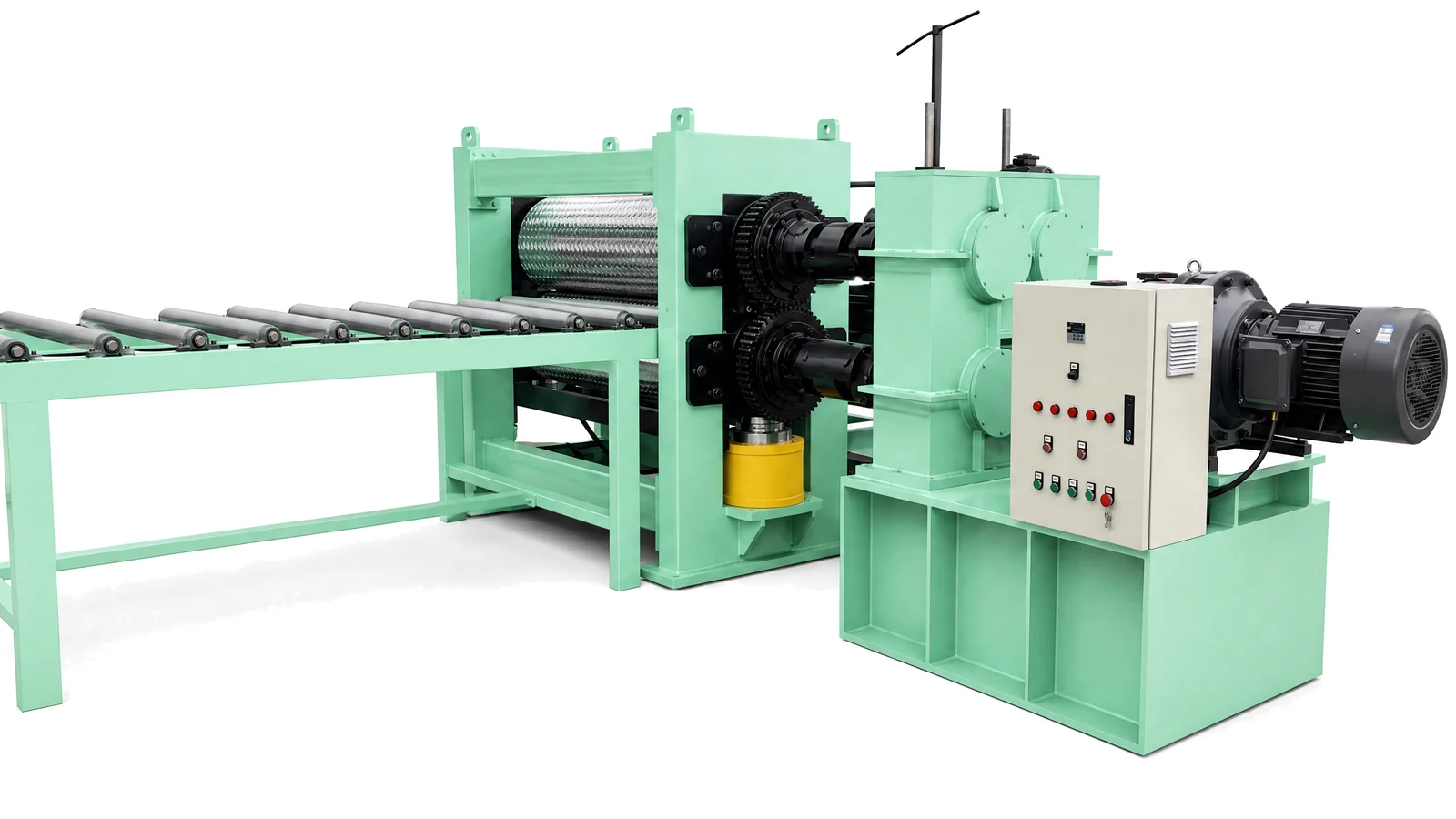
Technical Specifications
| Material | GI, PPGI, aluminium, stainless steel |
| Thickness | 0.2 鈥?1.2 mm |
| Coil width | 300 鈥?1300 mm |
| Pattern depth | 0.05 鈥?0.30 mm |
| Embossing | Single-sided or double-sided |
| Patterns | Wood grain, stucco, diamond, leather, custom engraved |
| Speed | 10 鈥?30 m/min |
| Drive | Gearbox drive with pattern synchronisation |
| Pattern rolls | Engraved hardened steel, interchangeable |
| Control | PLC + HMI, tension control |
| Certification | CE Declaration of Conformity |
| Lead time | 45 鈥?60 days |
Need a quote or a custom specification?
What This Machine Produces
Decorative embossed coil and sheet — wood grain, stucco, diamond and leather patterns, single-sided or double-sided.
Wood grain finishes for appliance panels, doors and interior cladding, where the pattern imitates timber.
Stucco and diamond patterns for functional grip — walkway and stair tread surfaces, which is a safety requirement rather than a decorative choice.
Textured sandwich panel skins — an embossed face gives the PU adhesive more surface area and a mechanical key, which improves peel strength between skin and core, and it also hides the minor oil-canning that shows up on flat panels.
Embossed strip for roll forming lines — the unit is commonly placed ahead of a profile forming machine so the coil is textured before forming.
Patterns engraved on interchangeable hardened steel rolls, so one machine can carry several designs.
Coil and sheet from 300 to 1300 mm wide and 0.2 to 1.2 mm thick, at pattern depths from 0.05 to 0.30 mm, running at 10–30 m/min.
Recommended Configuration
A complete working line, not just the forming machine. Each item below is quoted as one package.
- 01
The embossing machine itself
a gearbox drive with pattern synchronisation. On a single-sided unit the pattern must stay in register with itself along the coil; on a double-sided unit the two patterns must stay in register with each other. That is what the synchronisation is for.
- 02
Engraved hardened steel pattern rolls
the pattern is the product on this machine, so the rolls are the wear part that decides output quality and life. Standard patterns are supplied from stock; a custom design needs its own one-off tooling.
- 03
Tension control
embossing changes the local geometry of the strip, so tension has to be held steady to keep the pattern depth uniform across the coil width and along its length.
- 04
Inlet and outlet accumulator or dancer (where the unit runs inline)
if embossing sits ahead of a forming machine, the two lines have different instantaneous speeds. Without a buffer the pattern sync oscillates between the two machines.
- 05
PLC with pattern memory
pattern depth, speed and synchronisation offsets are recalled rather than re-established when you change rolls.
- 06
A note on double-sided embossing: both faces are patterned in one pass, which is used where the coil is visible from both sides. It requires a heavier frame and a more rigid drive than single-sided.
Production Workflow
- 01
Decoiling and feeding
Coil is fed into the embossing unit at controlled tension. Tension control is the single biggest factor in pattern depth consistency, because the pattern is only 0.05–0.30 mm deep.
- 02
Pattern depth setting
The gap between the upper and lower pattern rolls sets the depth. This is where pattern choice stops being free: the deeper the pattern, the more the surface is stretched locally.
- 03
Embossing
The coil passes between engraved hardened steel rolls at 10–30 m/min. A single-sided unit presses the pattern from one side; a double-sided unit patterns both faces in one pass.
- 04
Synchronisation
On a double-sided unit the two patterns must stay in register with each other, and on an inline installation the embossing unit must stay in register with the forming machine that follows it. Both are held by the gearbox pattern synchronisation and the tension control.
- 05
Coating check
Where pre-painted coil is being embossed, the pattern depth has to suit the paint system. A rigid paint will crack at the pattern shoulders, so the specific coating should be tested before committing to a depth.
- 06
Rewind or transfer
Embossed coil is either rewound for later use or passed directly to a forming line. When it feeds a forming line, the pattern position relative to the formed profile is a setup decision, not something the machine decides.
Key Components
- Pattern rolls
- Engraved hardened steel, interchangeable
- Drive
- Gearbox drive with pattern synchronisation
- Pattern depth range
- 0.05–0.30 mm
- Embossing sides
- Single-sided or double-sided
- Control
- PLC + HMI with tension control and pattern memory
- Working range
- 0.2–1.2 mm · coil width 300–1300 mm
- Standard patterns
- Wood grain, stucco, diamond, leather; custom patterns engraved to your design
Customization Options
Every line is built to order. These are the points buyers most often change.
| Item | What can be changed |
|---|---|
| Pattern | Wood grain, stucco, diamond, leather, or a custom design engraved to your artwork — a custom pattern carries a one-off roll-making cost |
| Pattern depth | 0.05–0.30 mm. Keep below about 0.2 mm where structural strength matters, and reduce depth on pre-painted coil so the paint follows the pattern without cracking |
| Single or double sided | Double-sided patterns both faces in one pass and needs a heavier frame and drive |
| Material | GI, PPGI, aluminium, stainless steel |
| Thickness and width | 0.2–1.2 mm · 300–1300 mm coil width |
| Inline installation | Can sit ahead of a profile forming machine; needs an accumulator or dancer between the two lines |
| Verification | For structural use we can supply before-and-after tensile data for the pattern depth you intend to run |
Applications
FAQ — Metal Embossing Machine
What is metal embossing used for?
Can the machine engrave a custom pattern?
Why is embossing sometimes used on sandwich panel skins?
Can embossing be done on a pre-painted coil?
Does embossing reduce the sheet's strength?
Can it run inline with a roll forming line?
How do we get a price for this line?
What material thickness can this machine form?
What is the production speed?
What is the drive and installed power?
How is the line controlled?
What working width does the line run?
You May Also Need
Send us your profile and output target
Tell us the profile and the numbers that matter to you. We confirm the configuration against the specification table above and quote FOB Tianjin within 24 hours.
- MaterialGI, PPGI, aluminium, stainless steel
- Thickness0.2 鈥?1.2 mm
- Coil width300 鈥?1300 mm
- Pattern depth0.05 鈥?0.30 mm