Sandwich Panel Production Line
One line platform for all four core types — PU, PIR, EPS and rock wool — with the core material selected as a configuration rather than a different machine.
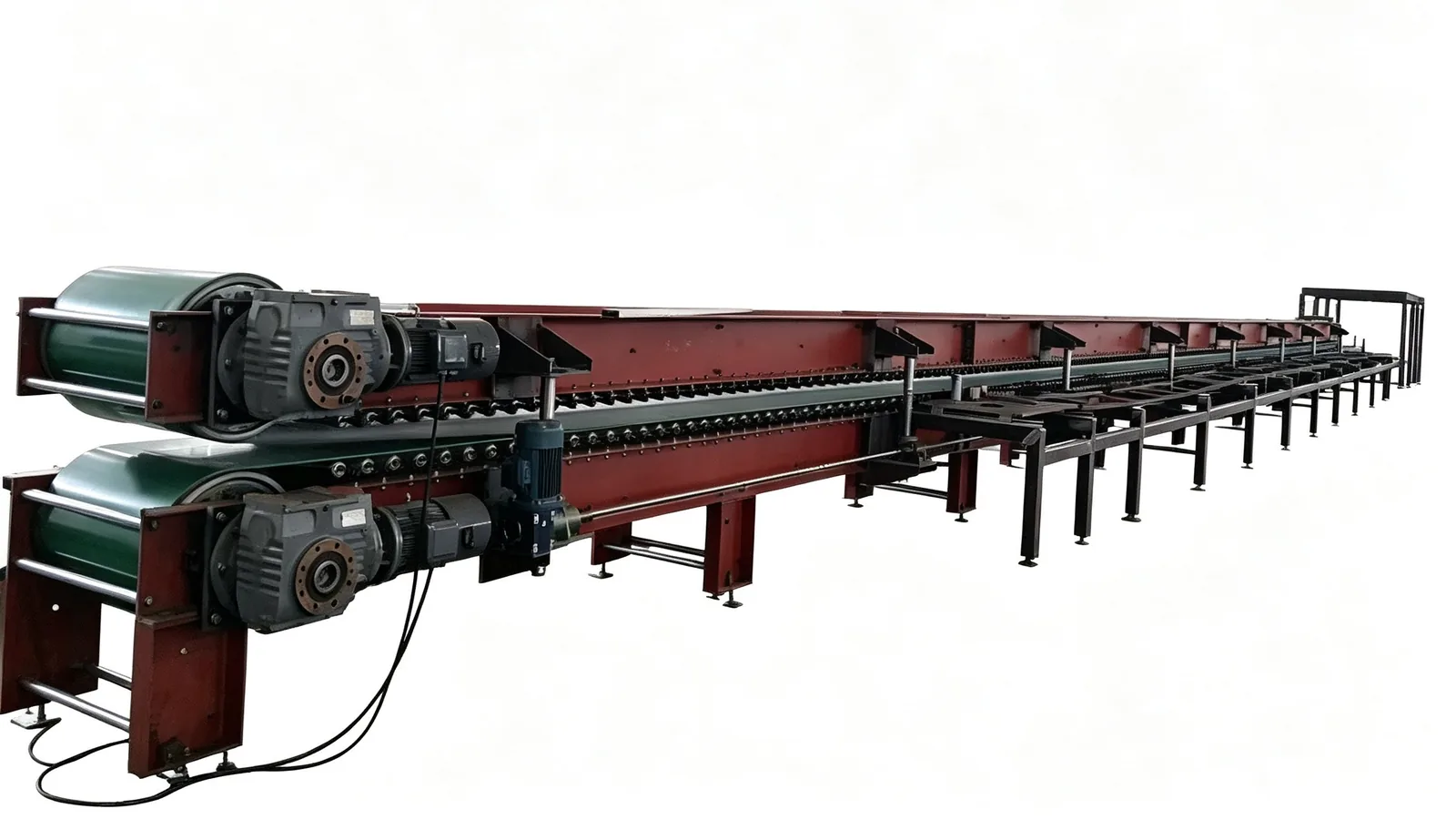
Technical Specifications
| Modes | Continuous (PU / PIR) and discontinuous (EPS / rock wool) |
| Core types | PU, PIR, EPS, rock wool, mineral wool |
| Core density | PU 38 – 45 kg/m³ · rock wool 100 – 120 kg/m³ |
| Panel thickness | 30 – 200 mm |
| Panel width | 950 / 1000 / 1150 mm |
| Face skin | 0.3 – 0.6 mm PPGI, GI, aluminium, stainless |
| Line speed | 3 – 8 m/min (PU) · 2 – 5 m/min (rock wool) |
| Profiles | Flat, micro-rib, tongue-and-groove, concealed fastener |
| Press | Heated double-belt press, PLC zone temperature control |
| Adhesive | Two-component PU glue (rock wool / EPS) |
| Cutting | Circular saw cross-cut, dust extraction |
| Control | Full-line PLC + SCADA-style HMI |
| Certification | CE Declaration of Conformity |
| Lead time | 90 – 120 days |
| Line length | 40–60 m from decoiler to stacker (continuous line) |
| Thickness note | above about 150 mm the line speed must be reduced so the core cures fully |
Need a quote or a custom specification?
What This Machine Produces
Continuous PU and PIR sandwich panels, 30–200 mm thick and 950 / 1000 / 1150 mm wide — the core is foamed in place and cures under the press.
Rock wool panels bonded with a two-component PU adhesive rather than foamed — the only core type that reaches A1 or A2, meaning non-combustible.
EPS panels — the cheapest core for non-rated, lightly loaded partitions and ceilings.
Wall and roof panels from one platform. Roof panels need an additional profile set for the overlaps and usually a higher-density core for point loading, so most customers run wall panels on the main line and switch the profile set for roof work.
Four face finishes: flat, micro-rib, tongue-and-groove, and concealed fastener.
Face skins in 0.3–0.6 mm PPGI, galvanised, aluminium or stainless steel, formed on both sides of the core.
A line for fire-rated work as well as standard industrial work: rock wool panels are what fire-rated facades, food factories, plant rooms and escape routes require, and cold store walls with fire separation are the classic case where PU cannot be used.
Recommended Configuration
A complete working line, not just the forming machine. Each item below is quoted as one package.
- 01
Two decoilers
a sandwich panel has two face skins, so the line is built around double decoiling. This is the first thing that distinguishes it from any single-skin forming line.
- 02
Two profile forming sections
one per skin. Inner and outer faces usually have different profiles, and on roof panels the overlap geometry differs from the wall detail.
- 03
Foam metering and injection unit
for PU and PIR the core is injected as liquid and expands in place. Mixing ratio and pour rate are set here, and they determine the core density (PU 38–45 kg/m³) rather than the press.
- 04
Heated double-belt press with PLC zone temperature control
a PU or PIR panel cures under heat and pressure in the belt press. Zone temperature control is what keeps the core consistent along a 40–60 m line; without it the panel varies from head to tail.
- 05
Two-component PU adhesive unit
required for rock wool and EPS, which are laid in as pre-formed slabs and bonded rather than foamed.
- 06
Circular saw cross-cut with dust extraction
panels are cut with a saw, not a shear, because the core has to be cut as well as the skins. Dust extraction is a working-condition requirement, not an accessory.
- 07
Full-line PLC with SCADA-style HMI and a panel stacker
the line is long and the parameters are interdependent, so it is controlled as one system rather than as separate machines.
- 08
A continuous PU or PIR line occupies 40–60 m from decoiler to stacker. Check that the building has the length before choosing continuous over discontinuous.
Production Workflow
- 01
Double decoiling
Two coils are loaded, one for each face skin. Both have to run at matched tension, because the skins are formed separately and brought together at the press — a tension difference shows as a bowed panel.
- 02
Profile forming
Each skin is formed to its own profile: flat, micro-rib, tongue-and-groove or concealed fastener. Wall and roof panels use different profile sets, which is why most customers keep a spare set.
- 03
Core injection or lay-in
For PU and PIR, liquid foam is injected and expands in place. For rock wool and EPS, pre-formed slabs are laid in and bonded with two-component PU adhesive. This is the step that decides whether the panel is combustible or non-combustible.
- 04
Press curing
The assembly enters the heated double-belt press, where the gap sets the panel thickness (30–200 mm) and PLC-controlled zones hold the cure temperature along the length. Above about 150 mm the line speed has to come down so the core cures fully through the thickness.
- 05
Cross-cutting
A circular saw cross-cuts the cured panel, with dust extraction. A saw is used rather than a shear because the core must be cut cleanly along with the skins.
- 06
Stacking
Finished panels are stacked and banded. Panel length is set from the building layout, so the batch counter is what keeps an elevation set together.
Key Components
- Decoilers
- Two — one per face skin
- Profile forming sections
- Two, one per skin; separate sets for roof panels
- Foam metering and injection
- For PU / PIR; sets the core density at 38–45 kg/m³
- Double-belt press
- Heated, with PLC zone temperature control; the belt gap sets panel thickness
- Adhesive unit
- Two-component PU for rock wool and EPS slab bonding
- Cross-cut
- Circular saw with dust extraction
- Control
- Full-line PLC with SCADA-style HMI
- Line length
- 40–60 m from decoiler to stacker on a continuous line
Customization Options
Every line is built to order. These are the points buyers most often change.
| Item | What can be changed |
|---|---|
| Mode | Continuous (PU / PIR) or discontinuous (EPS / rock wool) — this is the first decision, and it is driven mainly by available building length |
| Core material | PU, PIR, EPS, rock wool or mineral wool. The choice sets the fire class: PU and EPS are B2 / E, PIR is B1 / Euroclass C, rock wool is A1 / A2 non-combustible |
| Panel thickness | 30–200 mm, set by the double-belt press gap between runs |
| Panel width | 950 / 1000 / 1150 mm |
| Face skin | 0.3–0.6 mm PPGI, galvanised, aluminium or stainless steel |
| Face profile | Flat, micro-rib, tongue-and-groove or concealed fastener |
| Roof panels | Additional profile set for the overlap detail, plus a higher-density core for point loading |
| Line speed | 3–8 m/min on PU · 2–5 m/min on rock wool, because adhesive needs time to set under the press rather than foaming in place |
Core types compared — fire performance, insulation and cost
| Core | Fire class | Thermal conductivity | Relative cost | Choose when |
|---|---|---|---|---|
| PU (polyurethane) | B2 / E — combustible | 0.022 – 0.026 W/mK (best) | Lowest | Normal cold storage and industrial buildings with no strict fire rating |
| PIR (polyisocyanurate) | B1 / Euroclass C | 0.023 – 0.027 W/mK | Low–medium | Building codes require a higher fire class but you want PU-level insulation |
| EPS (expanded polystyrene) | B2 / E — combustible | 0.033 – 0.038 W/mK | Low | Cheapest option for non-rated, lightly loaded partitions and ceilings |
| Rock wool | A1 / A2 — non-combustible | 0.040 – 0.045 W/mK | Highest | Fire-rated facades, food factories, plant rooms, escape routes, cold store walls with fire separation |
Applications
FAQ — Sandwich Panel Production Line
What fire rating does each core achieve?
How long is a complete sandwich panel production line?
Can one line produce wall and roof panels?
What panel thicknesses can be produced?
Why does rock wool run slower than PU?
What determines the insulation performance?
Do I need a continuous or discontinuous line?
What is the lead time for a complete line?
Can the machine be built for our own profile?
How do we get a price for this line?
What is the production speed?
How is the finished profile cut to length?
You May Also Need
Send us your profile and output target
Tell us the profile and the numbers that matter to you. We confirm the configuration against the specification table above and quote FOB Tianjin within 24 hours.
- ModesContinuous (PU / PIR) and discontinuous (EPS / rock wool)
- Core typesPU, PIR, EPS, rock wool, mineral wool
- Core densityPU 38 – 45 kg/m³ · rock wool 100 – 120 kg/m³
- Panel thickness30 – 200 mm