Container & Modular Wall Panel Roll Forming Machine
Wall and roof panels for container conversions, modular buildings and prefabricated housing, where panels must be light, fast to fix and dimensionally consistent.
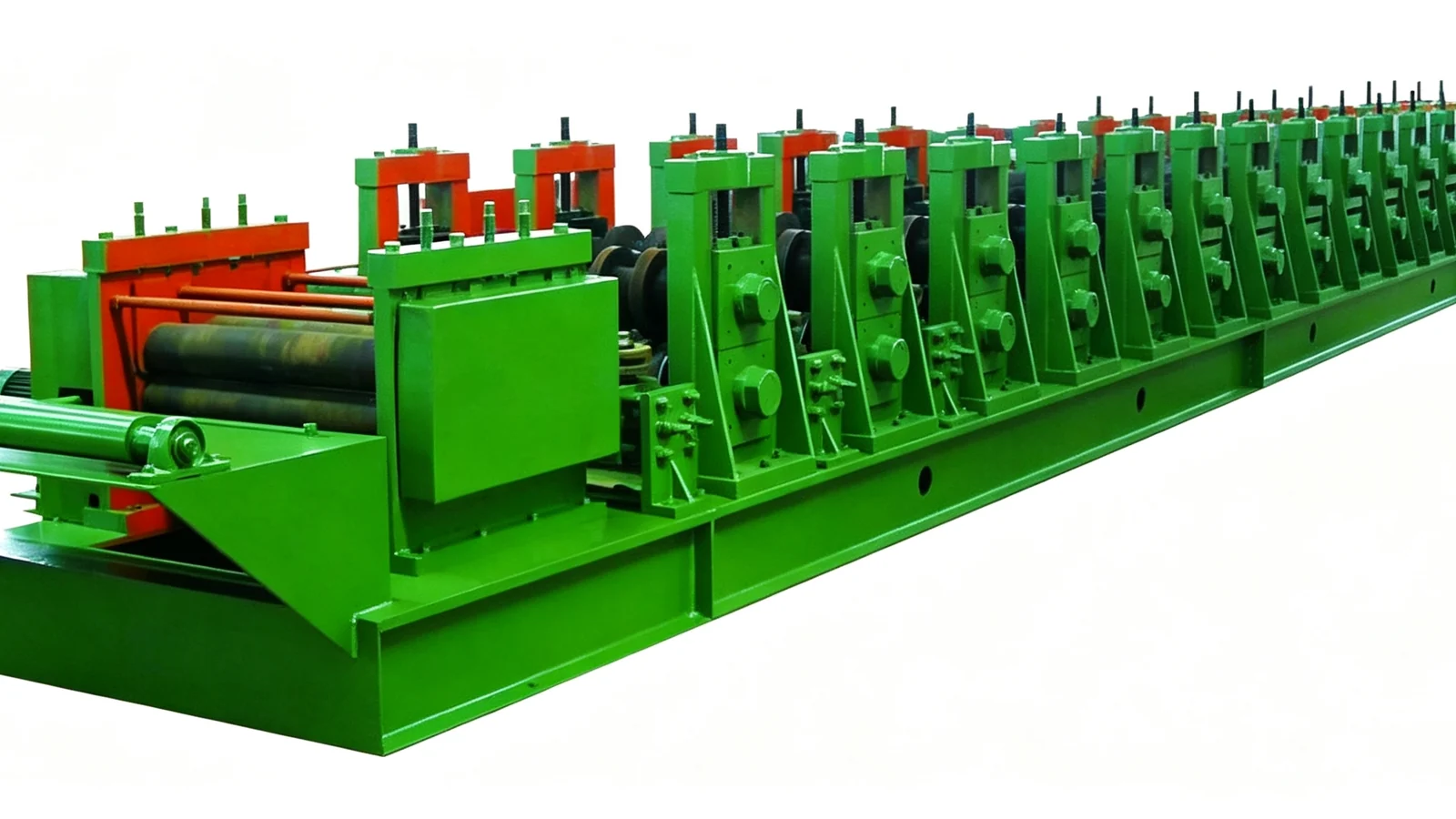
Technical Specifications
| Material | PPGI, GI, aluminium |
| Thickness | 0.3 – 0.8 mm |
| Effective width | 600 – 1100 mm |
| Profile types | Ribbed, micro-rib, flat, insulated sandwich skin |
| Forming speed | 15 – 28 m/min |
| Forming stations | 12 – 18 |
| Drive | Gearbox chain drive, 5.5 – 11 kW |
| Cutting | Flying cut to length |
| Control | PLC + HMI, batch counter |
| Certification | CE Declaration of Conformity |
| Lead time | 35 – 50 days |
| Minimum practical thickness | 0.3 mm — below this the strip buckles between stations and the panel shows oil-canning |
Need a quote or a custom specification?
What This Machine Produces
Thin ribbed or micro-rib wall panels in 0.3–0.5 mm — the normal specification for container conversions and modular buildings, because the container frame already carries the structural load and the panel only has to close the opening.
Deeper-rib roof panels for the same structures: the roof panel needs a deeper rib for spanning and water run-off, while the wall panel uses a shallower rib. Both run on the same frame with two cassettes.
Flat panels where a clean, unribbed face is wanted — the most demanding product on this line, because a flat surface shows every defect a rib would hide.
Insulated sandwich panel skins — where thermal performance is required, the single skin is replaced by an insulated sandwich panel, and this line forms the steel skins.
Panels in effective widths of 600–1100 mm at 15–28 m/min — one of the faster lines we build, because these are thin, simple sections.
Dimensionally consistent modules: because panels are cut to a fixed module size and assembled off-site, effective width has to hold. If it varies, modules do not line up and panels get re-cut on site, which destroys the time saving that makes modular construction worthwhile.
Recommended Configuration
A complete working line, not just the forming machine. Each item below is quoted as one package.
- 01
Decoiler and leveling unit
pre-painted coil at 0.3 mm marks easily, and a flat panel will show any leveling defect across its whole face.
- 02
Container and modular panel roll forming machine
12–18 stations on a gearbox chain drive at 5.5–11 kW, forming at 15–28 m/min.
- 03
Polyurethane or nylon guide rolls
we set roll pressure to the minimum that still forms the profile, which is what keeps the paint film intact on pre-painted panel.
- 04
Two cassettes for wall and roof
the rib depth differs between the two products, so they cannot share tooling, but the base frame, decoiler and cutting unit are common.
- 05
Flying cut to length with batch counter
modular panels are cut to module dimensions, so a whole module set is produced in one run.
- 06
A word on thickness: 0.3 mm is the practical minimum. Below that the strip tends to buckle between stations and the finished panel shows oil-canning, which is visible on a flat or shallow-rib face.
Production Workflow
- 01
Decoiler
Coil is loaded and uncoiled at controlled tension. At 0.3–0.5 mm the material is very light, so over-tensioning is a common cause of edge wave.
- 02
Leveling
The strip is straightened at minimum pressure, because a heavier setting would mark the pre-painted surface.
- 03
Roll forming
12–18 stations form the ribbed, micro-rib or flat section at 15–28 m/min. Rib depth is the variable that distinguishes a wall panel from a roof panel on the same frame.
- 04
Cassette change
Wall and roof panels use different rib depths, so they run on separate cassettes on the common frame.
- 05
Cutting
A flying cut cuts to the module length with a batch counter.
- 06
Output
Panels leave on the runout, bundled by module so the off-site assembly sequence is respected. For a small modular builder, 15–20 m/min is ample — roughly 600–800 m of panel per shift, which supports several modules a day.
Key Components
- Forming stations
- 12–18
- Drive
- Gearbox chain drive, 5.5–11 kW
- Cutting
- Flying cut to length, batch counter
- Control
- PLC + HMI
- Guide rolls
- Polyurethane or nylon for pre-painted coil
- Working range
- 0.3–0.8 mm · effective width 600–1100 mm
- Profile types
- Ribbed, micro-rib, flat, insulated sandwich skin
Customization Options
Every line is built to order. These are the points buyers most often change.
| Item | What can be changed |
|---|---|
| Profile set | Wall panel, roof panel, micro-rib, flat, or sandwich panel skin |
| Effective width | 600–1100 mm |
| Thickness | 0.3–0.5 mm typical for container conversions; 0.3 mm is the practical minimum before oil-canning appears |
| Coating | Pre-painted coil with polyurethane or nylon guide rolls and minimum roll pressure |
| Wall and roof on one frame | Yes, with two cassettes — the rib depths differ |
| Insulated panel | Where thermal performance is required, this line forms the steel skins for a sandwich panel |
| Power supply | 380 V / 50 Hz / 3-phase standard; other voltages to your site |
Applications
FAQ — Container & Modular Wall Panel Roll Forming Machine
What panel is used on container conversions?
Can the machine produce both wall and roof panels for a container?
Why is dimensional consistency important for modular buildings?
What is the minimum thickness you can run?
Can it form pre-painted panels without marking?
What output rate is typical?
Can the machine be built for our own profile?
How do we get a price for this line?
Which coil materials can the line run?
How many forming stations does it use?
What is the drive and installed power?
How is the finished profile cut to length?
You May Also Need
Send us your profile and output target
Tell us the profile and the numbers that matter to you. We confirm the configuration against the specification table above and quote FOB Tianjin within 24 hours.
- MaterialPPGI, GI, aluminium
- Thickness0.3 – 0.8 mm
- Effective width600 – 1100 mm
- Profile typesRibbed, micro-rib, flat, insulated sandwich skin