Roof Sheet Roll Forming Machine
One base frame, interchangeable roll cassettes, 0.3–0.8 mm pre-painted or galvanized coil. The workhorse line behind most roofing roll forming businesses.
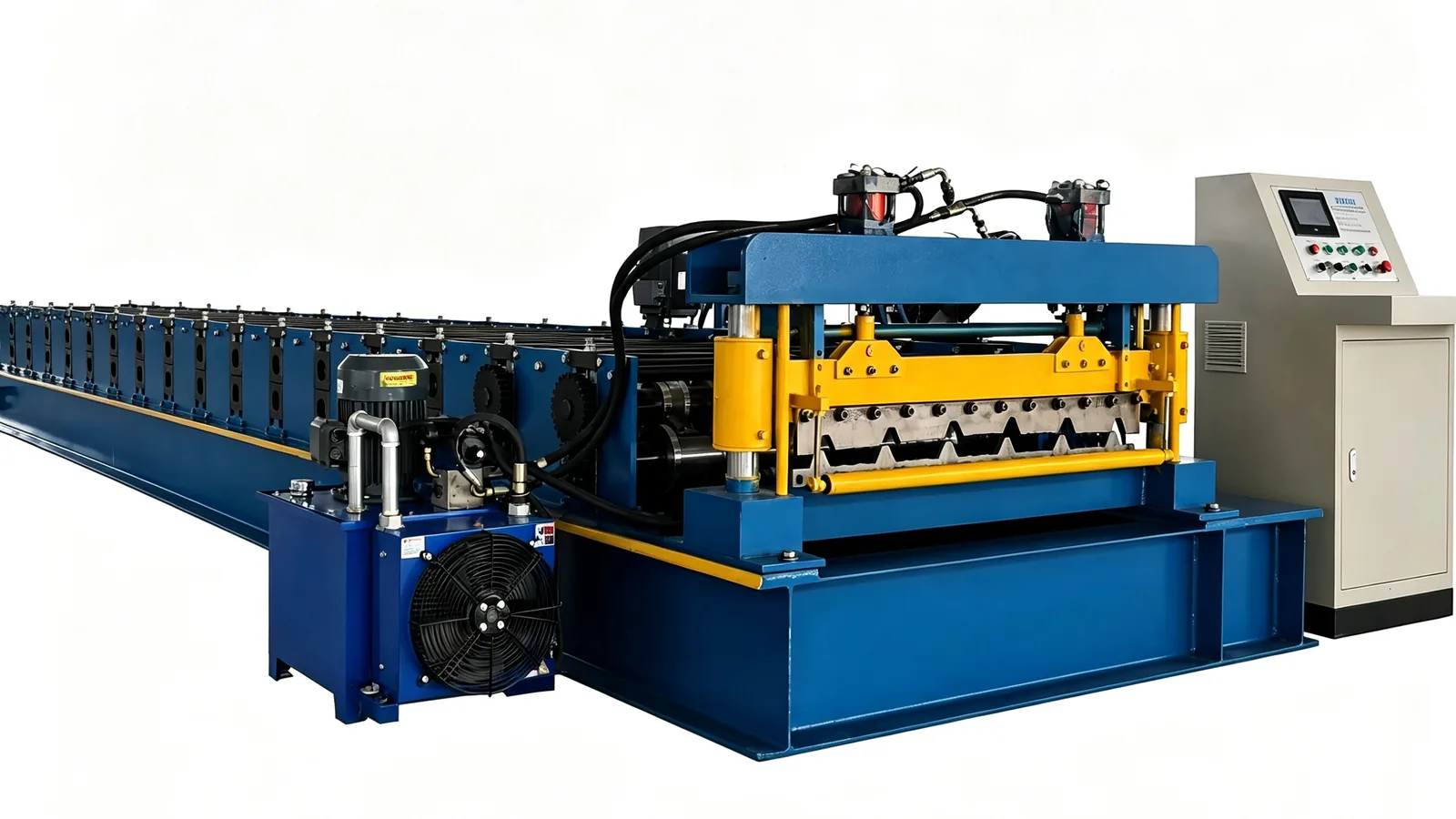
Technical Specifications
| Material | PPGI, GI, colour-coated steel coil |
| Thickness | 0.3 – 0.8 mm |
| Yield strength | ≤ 550 MPa |
| Forming speed | 15 – 25 m/min |
| Forming stations | 18 – 24 |
| Drive | Gearbox / chain, 7.5 – 15 kW |
| Shaft diameter | Ø 70 – 95 mm, 45# steel, hard chrome |
| Roller material | GCr15 bearing steel, HRC 58–62 |
| Cutting | Hydraulic post-cut or flying cut |
| Control | PLC + 7″ touch-screen HMI, auto length + batch |
| Tooling change | 4 – 6 hours (servo-assist option: under 2 h) |
| Certification | CE Declaration of Conformity |
| Lead time | 45 – 60 days |
| Coil width | 914 / 1000 mm (trapezoidal) · 800 mm (762 mm corrugated) |
Need a quote or a custom specification?
What This Machine Produces
Trapezoidal roof sheets in the TR4 / TR5 family — the profile most European and Middle Eastern industrial roofs are built from.
IBR (inverted box rib) sheet — the box-rib geometry specified across much of Africa, the UK, Ireland and Australia.
C20 / C35 / C44 narrow-rib sheets for markets where a finer rib spacing is the norm.
Wave-effect and stepped profiles where the local market expects a tiled appearance from a metal roof.
One base frame, several roll cassettes — the most common combinations customers run are IBR + corrugated, TR4 + TR5, and C20 + C35.
Sheets in 0.3–0.8 mm pre-painted or galvanised coil up to 550 MPa yield, formed at 15–25 m/min.
Recommended Configuration
A complete working line, not just the forming machine. Each item below is quoted as one package.
- 01
Decoiler sized to your coil
trapezoidal profiles normally run on 914 mm or 1000 mm coil, and 762 mm corrugated uses 800 mm coil. We match the decoiler and feeding width to the coil you actually buy, so tell us your coil spec at enquiry stage.
- 02
Leveling unit
0.3–0.8 mm pre-painted coil marks and distorts easily, so the strip is straightened before it reaches the first station. This is also where cross-bow is removed; it cannot be corrected after forming.
- 03
Roof sheet roll forming machine
18–24 stations on a gearbox chain drive at 7.5–15 kW, running at 15–25 m/min. Stations are on Ø 70–95 mm shafts in 45# steel with hard chrome, carrying GCr15 rolls at HRC 58–62.
- 04
Interchangeable roll cassettes
this is what turns one frame into a multi-profile business. A cassette change takes 4–6 hours, or under 2 hours with the servo-assist option.
- 05
Hydraulic post-cut or flying cut
flying cut keeps the line running for long production runs; post-cut is chosen where the sheet length changes constantly.
- 06
PLC with 7-inch touch-screen HMI and batch counter
length and batch are entered rather than measured, which is what makes repetitive roofing production practical.
Production Workflow
- 01
Decoiler
The coil is loaded on the mandrel and uncoiled at controlled tension. Matching the decoiler width to your actual coil is the first decision on this line: a 1000 mm coil cannot be run on a machine built around 914 mm without waste at the edges.
- 02
Leveling
The strip is straightened before forming. On thin pre-painted coil this step also determines whether the coating survives the line, because a badly set leveler will mark the surface.
- 03
Roll forming
18–24 stations form the trapezoidal, IBR or narrow-rib section progressively. Shafts are Ø 70–95 mm in 45# steel with hard chrome; rolls are GCr15 bearing steel at HRC 58–62.
- 04
Cassette change
When the next job needs a different profile, the roll cassettes are exchanged on the same base frame — 4–6 hours by hand, under 2 hours with servo assist.
- 05
Cutting
A hydraulic post-cut or flying cut cuts to the length entered on the HMI and counts the batch automatically.
- 06
Output
Sheets leave on the runout table. Roofing sheet is long and light, so the runout is what stops the sheet kinking as it comes off the cut.
Key Components
- Forming stations
- 18–24
- Shafts
- Ø 70–95 mm, 45# steel, hard chrome
- Rolls
- GCr15 bearing steel, HRC 58–62
- Drive
- Gearbox / chain, 7.5–15 kW
- Cutting
- Hydraulic post-cut or flying cut
- Control
- PLC + 7-inch touch-screen HMI, auto length and batch
- Tooling change
- 4–6 hours · under 2 hours with servo assist
Customization Options
Every line is built to order. These are the points buyers most often change.
| Item | What can be changed |
|---|---|
| Profile set | IBR, TR4/TR5, C20/C35/C44, corrugated or wave-effect — tell us the combination so we can size the cassette count |
| Coil width | 914 mm or 1000 mm for trapezoidal; 800 mm for 762 mm corrugated |
| Thickness and grade | 0.3–0.8 mm up to 550 MPa yield. Above 550 MPa — for example G550 at 0.8 mm — we upgrade to hardened rolls at HRC 60–62 and increase drive power |
| Power supply | 380 V 50 Hz standard; 415 V 50 Hz / 440 V 60 Hz / 220 V 60 Hz available — state the destination country so we build the correct panel |
| Tooling change | Manual 4–6 hours, or the servo-assist option at under 2 hours |
| Cut type | Flying cut for long runs, post-cut where lengths change constantly |
Applications
FAQ — Roof Sheet Roll Forming Machine
Can one machine produce several roofing profiles?
What coil width does the machine accept?
What electrical specification do you supply?
Is CE certification included?
What is the lead time and shipping term?
Can it form 0.8 mm high-tensile steel?
Can the machine be built for our own profile?
How do we get a price for this line?
What material thickness can this machine form?
What is the production speed?
How many forming stations does it use?
What is the drive and installed power?
You May Also Need
Send us your profile and output target
Tell us the profile and the numbers that matter to you. We confirm the configuration against the specification table above and quote FOB Tianjin within 24 hours.
- MaterialPPGI, GI, colour-coated steel coil
- Thickness0.3 – 0.8 mm
- Yield strength≤ 550 MPa
- Forming speed15 – 25 m/min