Roof Panel Curving Machine
Turns flat profiled sheets into arched panels — for curved canopies, barrel roofs, arched warehouses and architectural feature roofs.
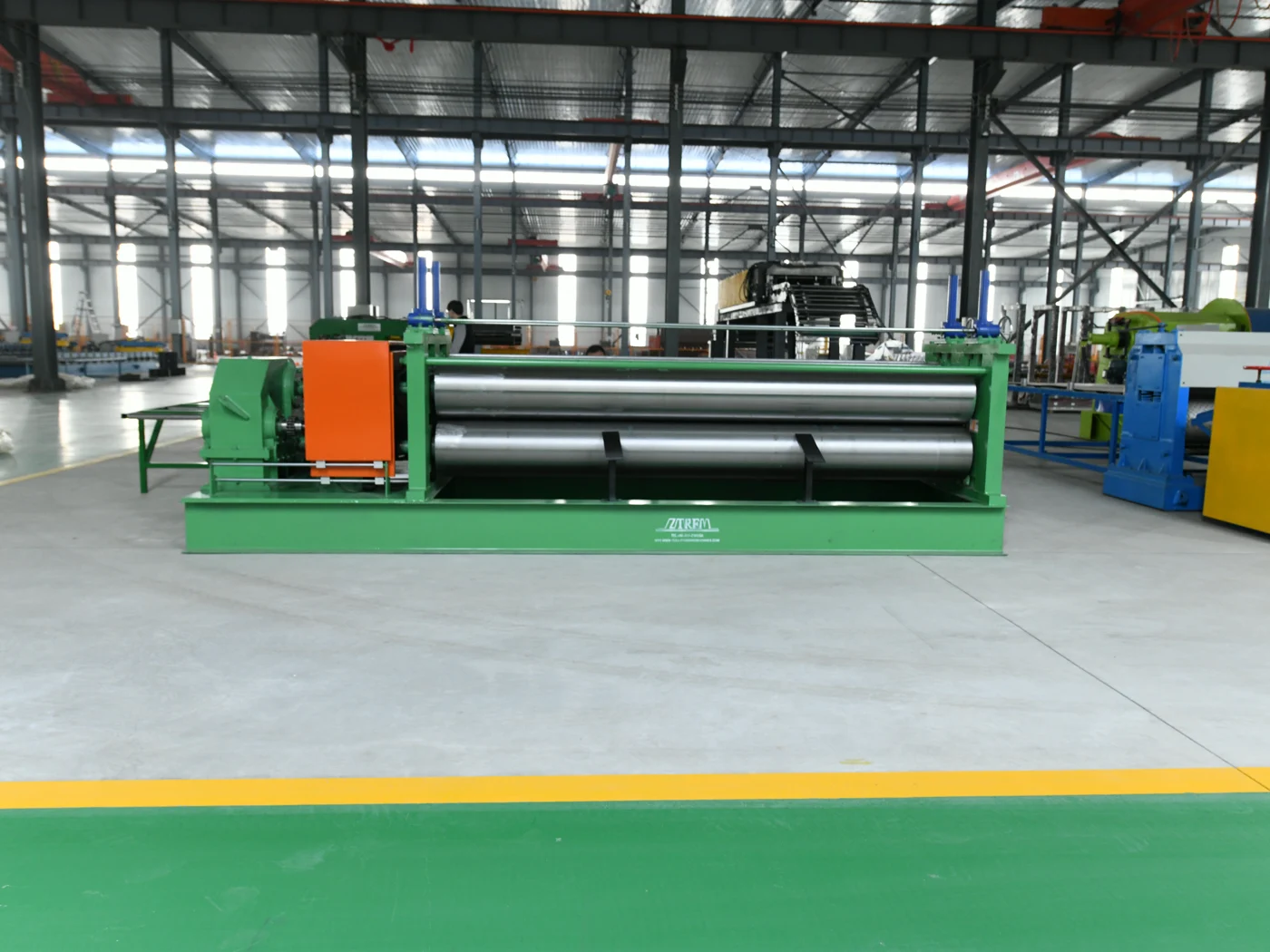
Technical Specifications
| Method | Crimp curving (rolls + forming bars) or roll curving |
| Sheet thickness | 0.3 – 1.0 mm |
| Sheet width | up to 1250 mm |
| Specimen length | 300 – 12,000 mm |
| Radius range | minimum 3,000 mm (profile dependent) |
| Speed | 5 – 15 m/min |
| Drive | Motorised, variable frequency control |
| Control | Digital radius setting, memory for repeat jobs |
| Certification | CE Declaration of Conformity |
| Lead time | 30 – 45 days |
Need a quote or a custom specification?
What This Machine Produces
Arched and curved roof panels — the machine turns a flat profiled sheet into a curve, rather than forming a profile from coil.
Barrel roofs, curved canopies, arched warehouses and architectural feature roofs.
Curved panels down to a minimum radius of about 3,000 mm, profile dependent: shallow trapezoidal profiles reach the tightest radius because there is more rib material available to crimp.
Sheets from 300 mm to 12,000 mm long and up to 1,250 mm wide, in 0.3–1.0 mm material.
Crimp-curved panels — narrow transverse crimps are pressed into the ribs as the sheet passes through, which bends the panel without distorting the profile or stretching the coating.
Roll-curved panels — the sheet passes through a set of curved rolls. This suits deeper profiles and thicker material, but is limited in how tight a radius it can achieve.
On-site curving where needed: crimp curving machines are compact enough to be container- or trailer-mounted, which is common on large architectural roofs where transporting pre-curved panels is impractical.
Recommended Configuration
A complete working line, not just the forming machine. Each item below is quoted as one package.
- 01
Crimp curving machine
the right starting point for most buyers. It works by localised forming rather than stretching, so pre-painted coatings normally survive intact. Contact rolls are polyurethane where coated material is run.
- 02
Roll curving unit
add this only if you need deeper profiles or thicker sheet than crimp curving handles. It stretches the outer surface slightly, so roll pressure and contact rolls have to be set accordingly on coated material.
- 03
Digital radius setting with job memory
curved roof work is repeat-heavy, and recalling the radius and settings for a previous job is what makes short architectural runs economical.
- 04
Variable frequency drive
curving runs at 5–15 m/min and the practical speed depends on the profile and the radius, so stepless speed control is more useful here than headline power.
- 05
Table and support arrangement sized to your longest sheet
a 12,000 mm curved panel needs support along its whole length, not just at the rolls.
- 06
Container or trailer mounting (optional)
worth specifying if you expect to quote large architectural roofs, because forming the curve on site avoids transporting pre-curved panels.
Production Workflow
- 01
Sheet preparation
This machine takes a flat profiled sheet, not coil. The sheet is normally produced on your own roll forming line, then transferred — which is why curving is usually added as a second machine rather than integrated into the forming line.
- 02
Method selection
Crimp curving or roll curving. Crimp is used where the coating must survive untouched and the profile has ribs to crimp; roll curving is used for deeper profiles and thicker material.
- 03
Radius setting
The radius is set digitally and stored, so a repeat job is recalled rather than re-established. The achievable minimum depends on profile depth and how much rib material is available.
- 04
Curving
The sheet passes through at 5–15 m/min. Crimp curving presses narrow transverse crimps into the ribs without stretching; roll curving bends it through curved rolls.
- 05
Checking
The curve is checked against a radius template or setting-out on the floor before the batch is released, because curved panels are made to a roof geometry rather than to a length.
- 06
Output and transport
Curved panels are bulky in proportion to their weight. Where the roof is large, on-site curving avoids the transport problem entirely.
Key Components
- Method
- Crimp curving (rolls plus forming bars) or roll curving
- Drive
- Motorised with variable frequency control
- Control
- Digital radius setting with memory for repeat jobs
- Working range
- 0.3–1.0 mm · sheet width up to 1,250 mm · sheet length 300–12,000 mm
- Radius range
- minimum about 3,000 mm, profile dependent
- Speed
- 5–15 m/min
- Mounting
- Bench, or container- / trailer-mounted for on-site curving
Customization Options
Every line is built to order. These are the points buyers most often change.
| Item | What can be changed |
|---|---|
| Curving method | Crimp curving for coating-safe work on ribbed profiles; roll curving for deeper profiles and thicker material |
| Profile suitability | Standing seam, trapezoidal and corrugated profiles curve well. Glazed tile and Spanish tile generally cannot be curved, because their geometry is already fully formed |
| Radius | Minimum about 3,000 mm for shallow trapezoidal profiles; deeper profiles need a larger radius. Send us the profile and we will confirm the achievable minimum |
| Sheet dimensions | 0.3–1.0 mm, up to 1,250 mm wide, 300–12,000 mm long |
| Mounting | Bench, container-mounted or trailer-mounted for site work |
| Coating protection | Polyurethane contact rolls and reduced roll pressure on pre-painted material |
Applications
FAQ — Roof Panel Curving Machine
What is the difference between crimp curving and roll curving?
What is the tightest radius possible?
Can curved panels be made on site?
Does curving damage the coating?
Which profiles can be curved?
Do I need a curving machine if I only make straight sheets?
Can the machine be built for our own profile?
How do we get a price for this line?
What material thickness can this machine form?
What is the production speed?
What is the drive and installed power?
How is the line controlled?
You May Also Need
Send us your profile and output target
Tell us the profile and the numbers that matter to you. We confirm the configuration against the specification table above and quote FOB Tianjin within 24 hours.
- MethodCrimp curving (rolls + forming bars) or roll curving
- Sheet thickness0.3 – 1.0 mm
- Sheet widthup to 1250 mm
- Specimen length300 – 12,000 mm