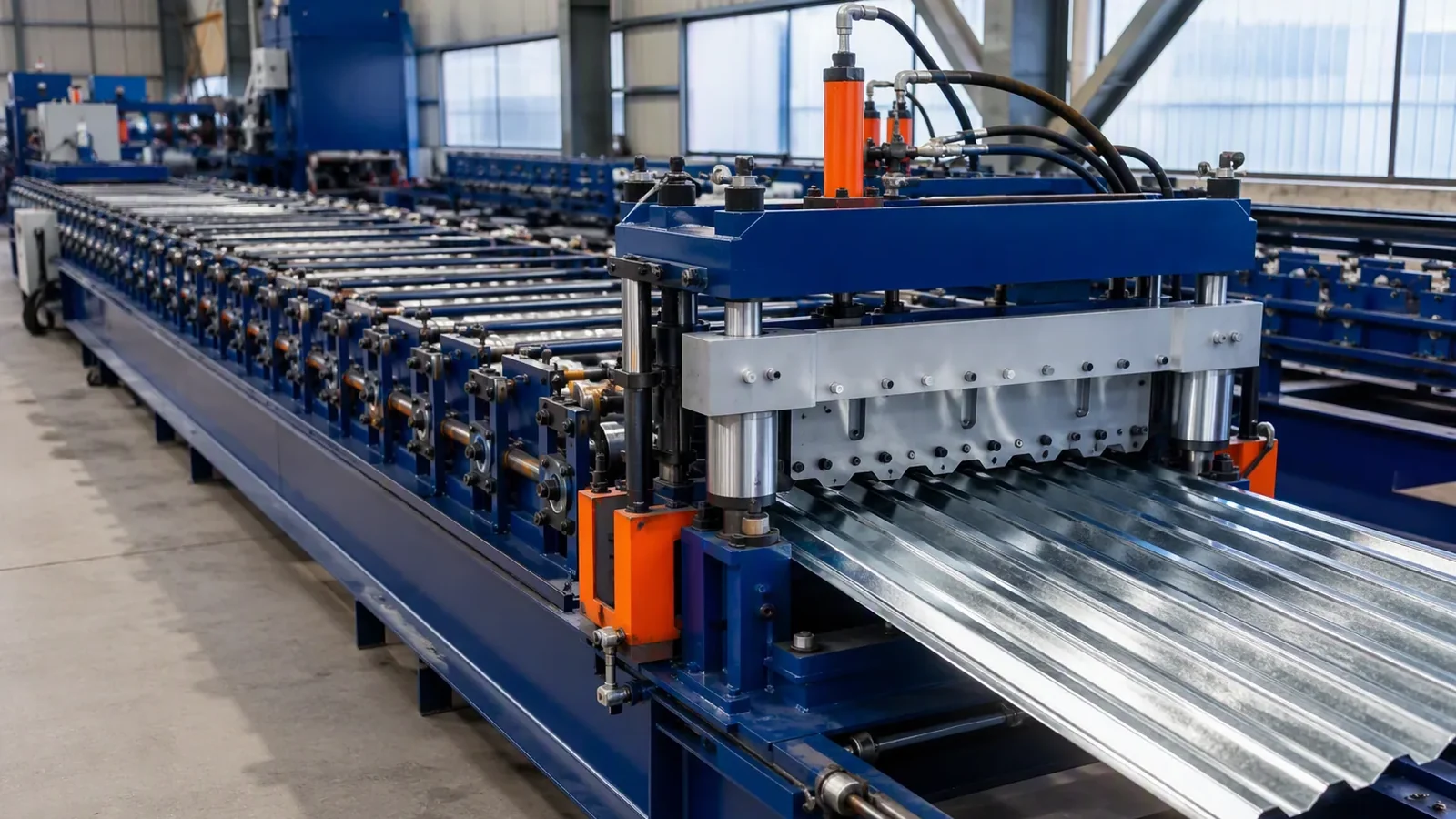
Corrugated Iron Sheet Roll Forming Machine
762 / 900 / 1000 mm corrugated iron roofing sheet at up to 30 m/min. The highest-throughput profile in the roofing range because the wave geometry is simple.
Technical Specifications
| Material | GI, PPGI, colour-coated steel |
| Thickness | 0.3 – 0.8 mm |
| Effective width | 762 / 900 / 1000 mm |
| Wave pitch | 32 mm (standard) |
| Wave height | 17 – 19 mm |
| Forming speed | 20 – 30 m/min |
| Forming stations | 12 – 16 |
| Drive | Gearbox chain drive, 7.5 – 11 kW |
| Cutting | Hydraulic flying cut |
| Control | PLC + HMI, auto length + batch |
| Certification | CE Declaration of Conformity |
| Lead time | 35 – 50 days |
| Length tolerance | ±2 mm at 20 m/min |
| Wave height tolerance | ±0.3 mm |
Need a quote or a custom specification?
What This Machine Produces
762 mm corrugated iron sheet — 12 full waves across the sheet, the traditional specification in the UK, Ireland, Australia and much of Africa.
900 mm corrugated sheet — 14 waves, common in Southeast Asia and the Middle East because it uses coil more efficiently than 762 mm.
1000 mm corrugated sheet — 16 waves, the lowest sheet cost per square metre where wider coil stock is available.
A consistent wave pitch of 32 mm with wave height of 17–19 mm, so sheets from different production runs still nest and lap correctly.
Sheets in 0.3–0.8 mm galvanised, pre-painted or colour-coated steel at 20–30 m/min — the highest throughput in the roofing range, because the wave geometry is the simplest we form.
Trapezoidal profile as well, if you order an additional roll cassette: corrugated and trapezoidal are different wave geometries, so the tooling is not shared, but the base frame, decoiler, cutting unit and control system are common.
Recommended Configuration
A complete working line, not just the forming machine. Each item below is quoted as one package.
- 01
3-tonne hydraulic decoiler
included as standard. 5 T and 10 T decoilers are available where you buy coil in heavier weights.
- 02
7-roller leveling unit
included as standard. Corrugated is a shallow, wide wave, so any coil set shows across the full sheet width rather than being hidden by the profile.
- 03
Corrugated sheet roll forming machine
12–16 stations on a gearbox chain drive at 7.5–11 kW, forming 0.3–0.8 mm at 20–30 m/min.
- 04
Hydraulic flying cut
for a roofing producer running long batches of the same sheet, stopping the line at every cut is what kills throughput.
- 05
PLC with encoder-based length control
the encoder counts coil feed and triggers the shear at the programmed length, so sheets are cut to length and counted in batches automatically.
- 06
Runout table
762 mm corrugated is stiff and awkward; a supported runout keeps the sheet flat and stops it marking the next one.
Production Workflow
- 01
Decoiler
Coil is loaded on the 3 T hydraulic decoiler and uncoiled at controlled tension. Corrugated runs at 20–30 m/min, so the decoiler has to keep up without inducing tension variation along the sheet.
- 02
Leveling
A 7-roller leveling unit removes coil set from the 0.3–0.8 mm strip before forming. Because corrugated is a wide shallow wave, residual bow appears as a twist across the sheet rather than in the profile.
- 03
Roll forming
12–16 stations form the 32 mm pitch wave. The station count is low because the wave geometry is simple — this is the reason the line runs faster than any other profile we build.
- 04
Speed management
At 0.3–0.5 mm with correctly set die clearance the line runs at up to 30 m/min. For 0.6–0.8 mm we recommend 20–22 m/min so that profile geometry stays consistent and the coating is not marked.
- 05
Cutting
The hydraulic flying cut is triggered by the PLC encoder at the programmed length, with a batch counter.
- 06
Output
Finished sheets leave on the runout table, already counted in batches.
Key Components
- Decoiler
- 3 T hydraulic, included as standard; 5 T / 10 T optional
- Leveling unit
- 7 rollers, included as standard
- Forming stations
- 12–16
- Drive
- Gearbox chain drive, 7.5–11 kW
- Cutting
- Hydraulic flying cut
- Control
- PLC + HMI, encoder length control, auto length and batch
- Verification
- Length tolerance ±2 mm at 20 m/min; wave height tolerance ±0.3 mm
Customization Options
Every line is built to order. These are the points buyers most often change.
| Item | What can be changed |
|---|---|
| Effective width | 762 mm (12 waves), 900 mm (14 waves) or 1000 mm (16 waves) — each needs its own tooling on the same base frame |
| Additional profiles | Trapezoidal cassette available for the same frame |
| Optimised widths | In 762 mm form the line can be set to 760, 810, 820 or 828 mm effective width |
| Material | Galvanised, pre-painted or colour-coated steel |
| Thickness | 0.3–0.8 mm — the 30 m/min figure applies to 0.3–0.5 mm |
| Decoiler capacity | 3 T standard, or 5 T / 10 T for heavier coil |
| Power supply | 380 V / 50 Hz / 3-phase standard; other voltages to your site |
Corrugated sheet widths and where each is used
| Effective width | Wave count | Main markets | Notes |
|---|---|---|---|
| 762 mm | 12 full waves | UK, Ireland, Australia, West & East Africa | The classic corrugated iron specification; heaviest fixing density |
| 900 mm | 14 waves | Southeast Asia, Middle East | Better material utilisation, common where 900 coil is cheaper |
| 1000 mm | 16 waves | Middle East, North Africa, Latin America | Lowest sheet cost per m², requires wider coil stock |
Applications
FAQ — Corrugated Iron Sheet Roll Forming Machine
What is the difference between 762 and 900 corrugated sheet?
Is 30 m/min realistic?
Can this machine also make trapezoidal profile?
Does the line include a decoiler?
How is the sheet length controlled?
What is the finished sheet tolerance?
Can the machine be built for our own profile?
How do we get a price for this line?
What material thickness can this machine form?
How many forming stations does it use?
What is the drive and installed power?
How is the finished profile cut to length?
You May Also Need
Send us your profile and output target
Tell us the profile and the numbers that matter to you. We confirm the configuration against the specification table above and quote FOB Tianjin within 24 hours.
- MaterialGI, PPGI, colour-coated steel
- Thickness0.3 – 0.8 mm
- Effective width762 / 900 / 1000 mm
- Wave pitch32 mm (standard)