Glazed Tile Roll Forming Machine
Roman, Spanish and Japanese tile profiles in 0.3–0.6 mm coated steel, including stone-chip coated sheet, for markets where customers want a tiled roof appearance.
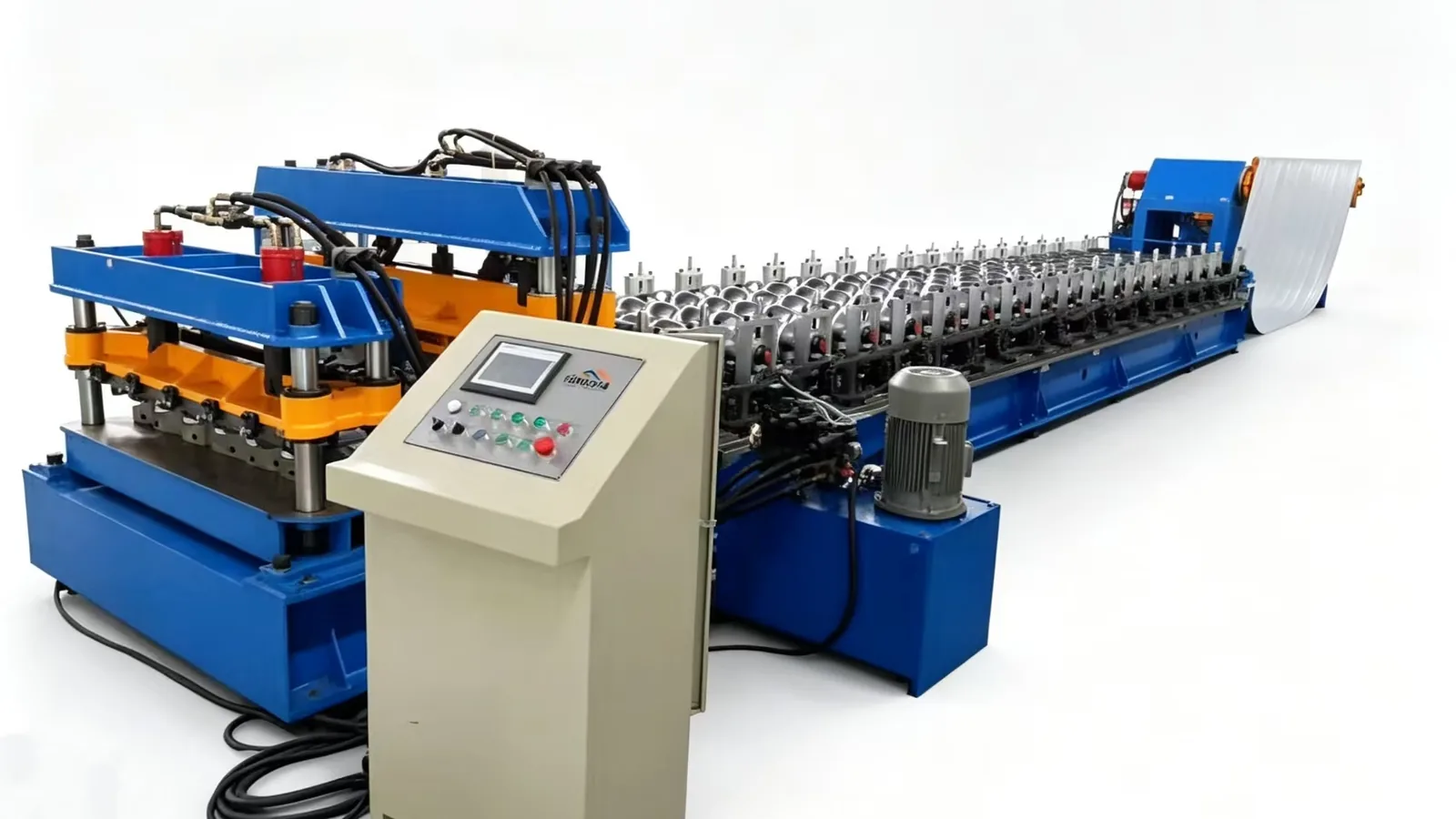
Technical Specifications
| Material | PPGI, stone-chip coated steel, aluminium |
| Thickness | 0.3 – 0.6 mm |
| Effective cover width | 828 / 1050 mm |
| Profile depth | 25 – 35 mm |
| Forming speed | 10 – 15 m/min |
| Forming stations | 18 – 22 |
| Drive | Gearbox chain drive, 7.5 – 11 kW |
| Coating | PE, PVDF, HDP, stone chip |
| Cutting | Hydraulic guillotine, auto length |
| Control | PLC + touch-screen HMI |
| Certification | CE Declaration of Conformity |
| Lead time | 45 – 60 days |
| Stone-chip forming speed | 8–10 m/min with polyurethane guide rolls |
Need a quote or a custom specification?
Glazed Tile Roll Forming Machine in Our Workshop
 1:10
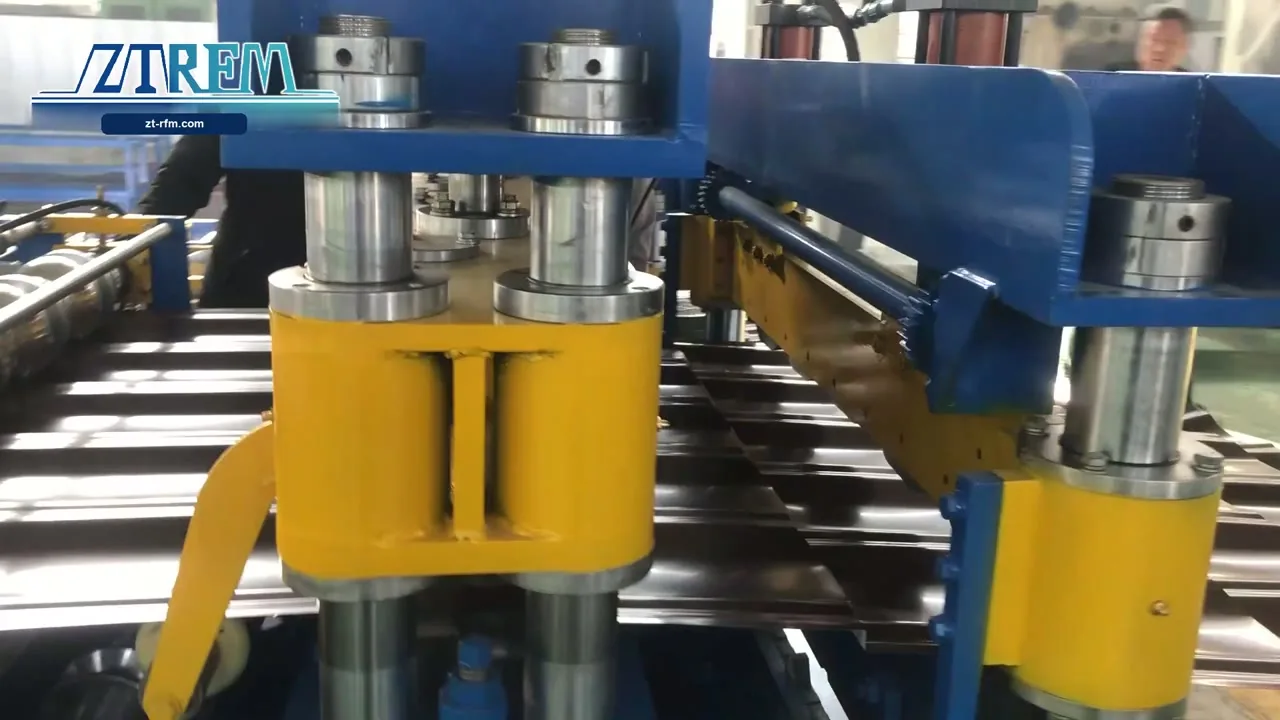
1:10 Glazed Tile Roll Forming Machine — Forming Station Close-Up | ZTRFM
a forming station of the glazed tile line, where the step profile is pressed into the sheet.
Machine specifications →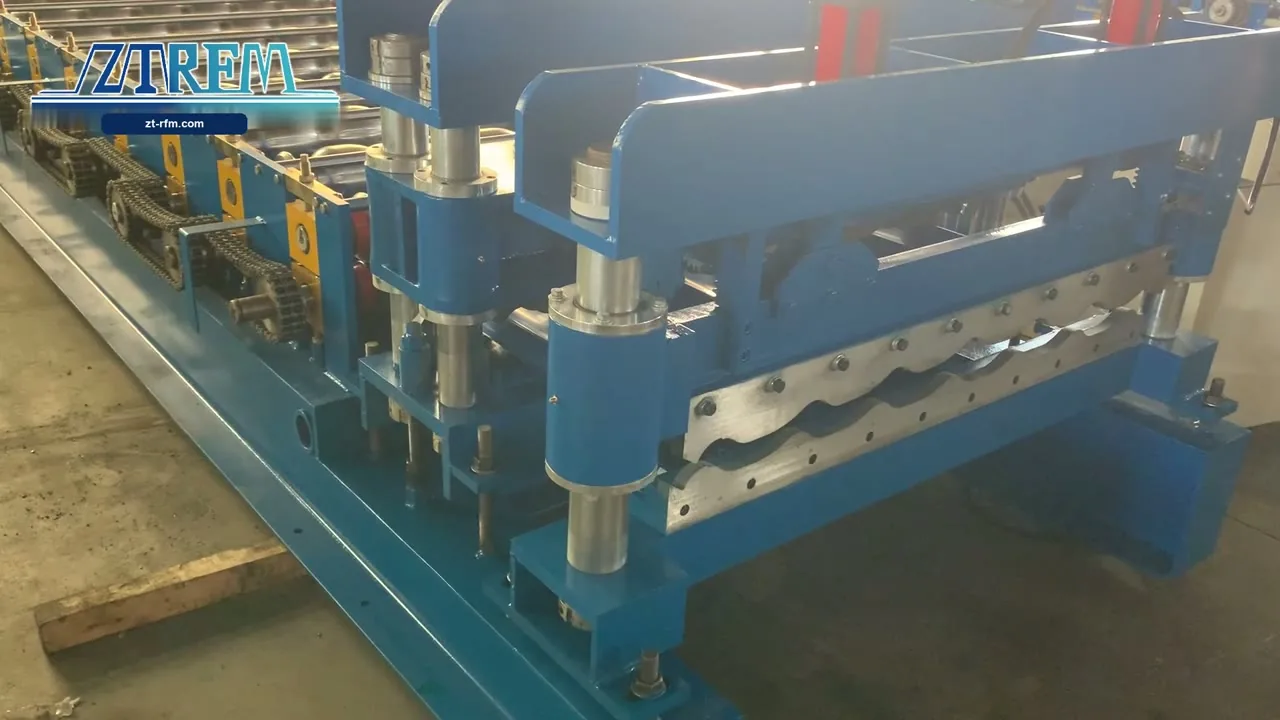 1:10
1:10 Glazed Tile Roll Forming Machine — Line Overview | ZTRFM
an overview of the glazed tile line, showing the frame and the forming section.
Machine specifications →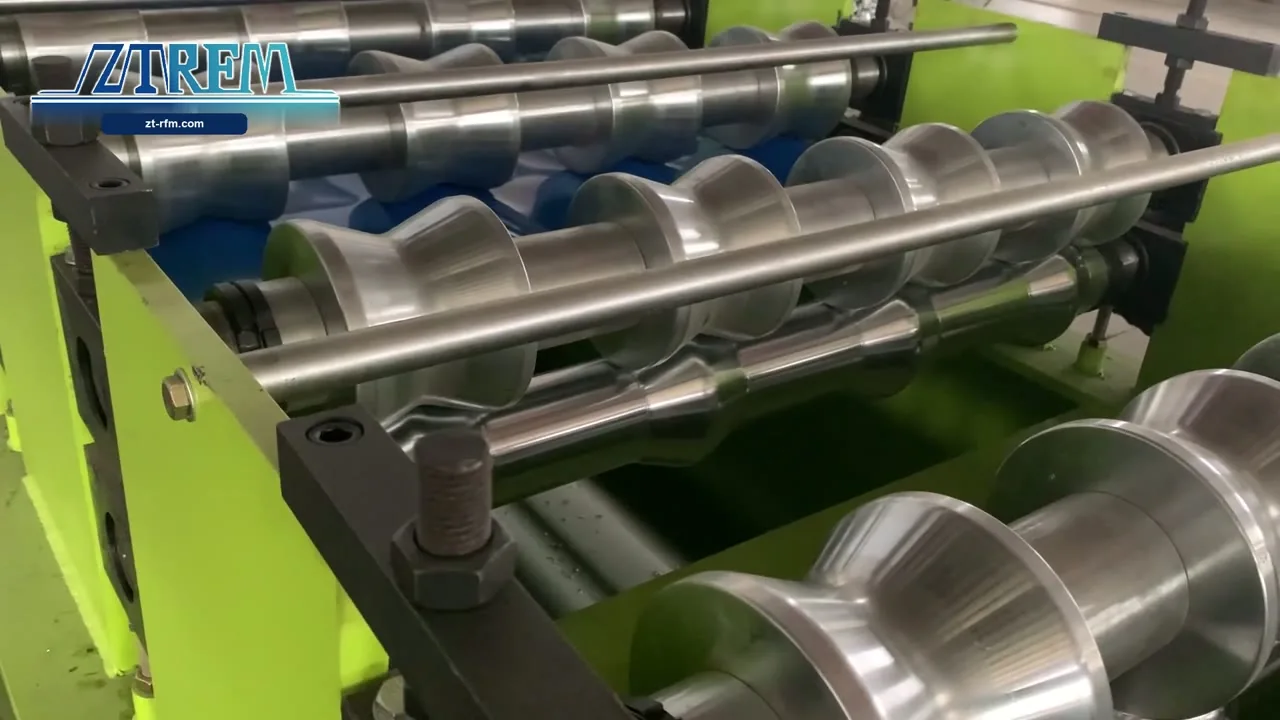 1:10
1:10 Glazed Tile Roll Forming Machine — Tile Profile Rolls | ZTRFM
the roll set that produces the tile profile, shown close up.
Machine specifications →What This Machine Produces
Roman tile profiles — the rounder, double-curved tile silhouette most European customers picture as a “tiled roof”.
Spanish tile profiles — the deeper S-curve tile, common across the Mediterranean, Latin America and much of Asia.
Japanese-style tile profiles, which use a smaller module and are common in Southeast Asian housing.
Stone-chip coated tile sheet, where the surface texture mimics concrete tile closely enough to be used on residential projects with appearance rules.
Effective cover widths of 828 mm and 1050 mm, with a profile depth of 25–35 mm.
Sheets in 0.3–0.6 mm PPGI, stone-chip coated steel or aluminium at 10–15 m/min, with PE, PVDF, HDP or stone-chip coatings.
Recommended Configuration
A complete working line, not just the forming machine. Each item below is quoted as one package.
- 01
Decoiler and leveling unit
tile profiles are complex and closely toleranced, so strip straightness of the 0.3–0.6 mm coil is the first thing that decides whether the tile oversteps line up.
- 02
Glazed tile roll forming machine
18–22 stations on a gearbox chain drive at 7.5–11 kW, forming at 10–15 m/min.
- 03
Interchangeable cassettes for Roman and Spanish
the two geometries are different, so they need separate cassettes. Both can run on a common base frame, with roughly 4 hours allowed for the changeover.
- 04
Polyurethane guide rolls for stone-chip sheet
the chip surface marks easily under steel rolls, so this unit is effectively mandatory if you intend to run stone-chip material.
- 05
Hydraulic guillotine with auto length
tile sheet is cut to the roof module length, and a guillotine gives a cleaner edge on a coated product than a shear.
- 06
PLC with touch-screen HMI
profile, length and batch are selected rather than set by hand.
Production Workflow
- 01
Decoiler
Coil is loaded and uncoiled at controlled tension. Tile profiles have more forming steps than flat sheet, so a tension variation that would be invisible on a roof sheet shows up as a mis-stepped tile.
- 02
Leveling
The strip is straightened before forming. On stone-chip coated material this step runs at reduced pressure, because the coating is the product.
- 03
Roll forming
18–22 stations form the tile silhouette progressively in 0.3–0.6 mm coated steel at 10–15 m/min.
- 04
Stone-chip handling
Stone-chip sheet is run at a reduced speed of 8–10 m/min with polyurethane guide rolls, because the chip surface marks under pressure. Steel-roll settings that are correct for painted coil will damage it.
- 05
Cassette change
Roman and Spanish tiles need separate cassettes. Both can be carried on a common base frame, with about 4 hours for the changeover.
- 06
Cutting and output
A hydraulic guillotine cuts to the roof module length set on the HMI, and sheets leave on the runout.
Key Components
- Forming stations
- 18–22
- Drive
- Gearbox chain drive, 7.5–11 kW
- Cutting
- Hydraulic guillotine with auto length
- Control
- PLC + touch-screen HMI
- Coatings handled
- PE, PVDF, HDP, stone chip
- Working range
- 0.3–0.6 mm · cover width 828 / 1050 mm · profile depth 25–35 mm
- Changeover
- Roman to Spanish cassette change approximately 4 hours
Customization Options
Every line is built to order. These are the points buyers most often change.
| Item | What can be changed |
|---|---|
| Tile profile | Roman, Spanish or Japanese module — each needs its own cassette |
| Coating | PE, PVDF, HDP or stone chip. Stone-chip sheet is run at 8–10 m/min with polyurethane guide rolls |
| Cover width | 828 mm or 1050 mm |
| Profile depth | 25–35 mm |
| Material | PPGI, stone-chip coated steel, or aluminium 0.5–0.9 mm for coastal projects |
| Minimum run | Around 500 m per colour and profile is the practical economic minimum, because setup dominates below that |
| Power supply | 380 V / 50 Hz / 3-phase standard; other voltages to your site |
Applications
FAQ — Glazed Tile Roll Forming Machine
Can one machine produce both Roman and Spanish tile profiles?
What coating types can be formed?
Why choose a tile-effect metal roof instead of real tiles?
What is the minimum run length for a tile profile?
How is the tile overlap sealed?
Does the machine handle aluminium?
Can the machine be built for our own profile?
How do we get a price for this line?
What material thickness can this machine form?
What is the production speed?
How many forming stations does it use?
What is the drive and installed power?
You May Also Need
Send us your profile and output target
Tell us the profile and the numbers that matter to you. We confirm the configuration against the specification table above and quote FOB Tianjin within 24 hours.
- MaterialPPGI, stone-chip coated steel, aluminium
- Thickness0.3 – 0.6 mm
- Effective cover width828 / 1050 mm
- Profile depth25 – 35 mm