Sound Barrier Panel Roll Forming Machine
Perforated and corrugated acoustic panels for highway and railway noise walls, where the panel must be both structurally sound and acoustically open.
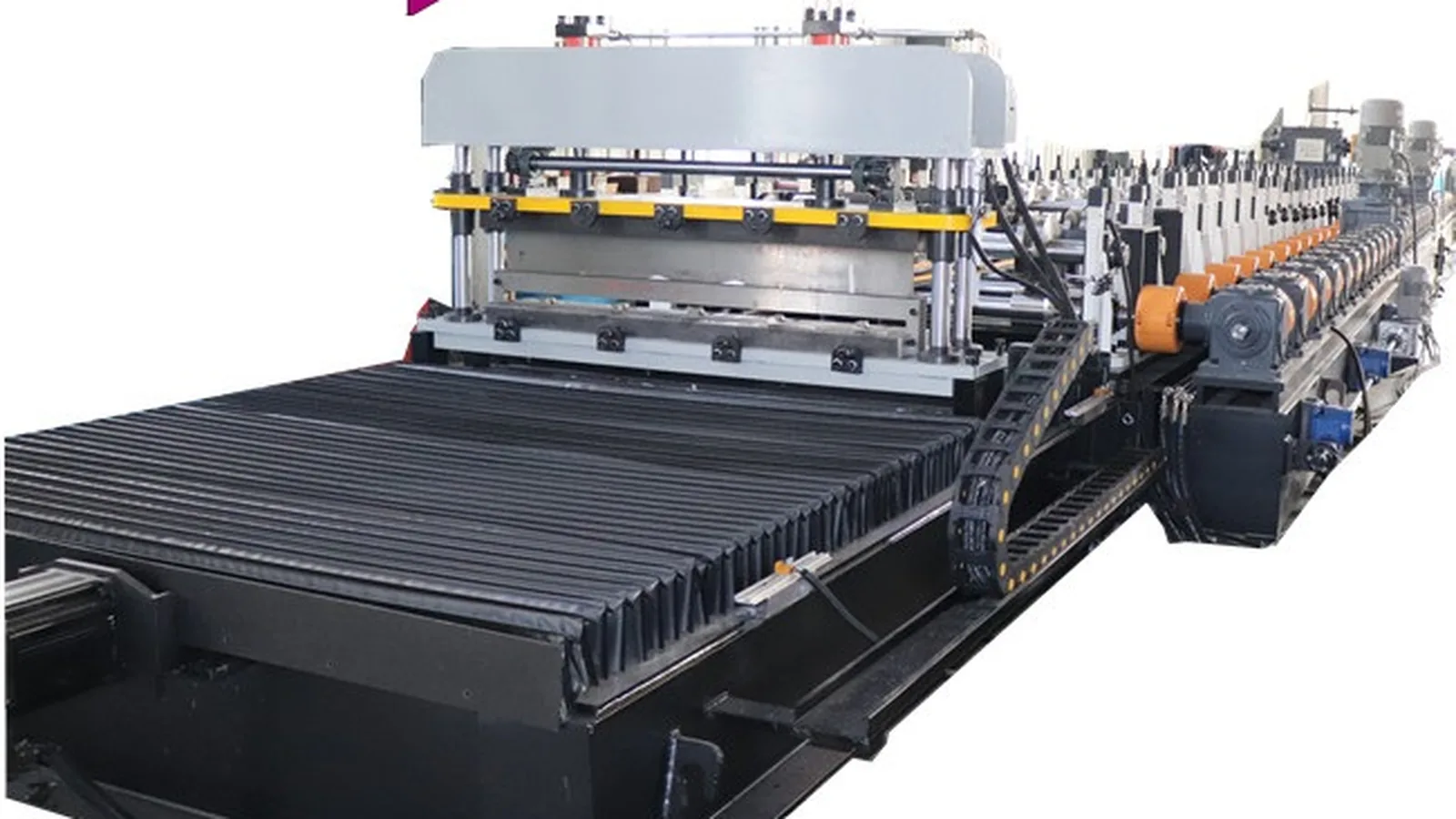
Technical Specifications
| Material | GI, Zincalume, aluminium, weathering steel |
| Thickness | 1.0 – 2.5 mm |
| Effective width | 500 – 1000 mm |
| Perforation | 6 mm round, 10 mm staggered pitch (38% open area) |
| Forming speed | 8 – 15 m/min |
| Forming stations | 16 – 20 |
| Drive | Gearbox chain drive, 11 – 15 kW |
| Punching | Inline perforating unit, optional |
| Cutting | Hydraulic flying cut |
| Control | PLC + HMI |
| Certification | CE Declaration of Conformity |
| Lead time | 50 – 65 days |
Need a quote or a custom specification?
What This Machine Produces
Perforated sound barrier panels — the standard perforated pattern is 6 mm round holes at 10 mm staggered pitch, giving around 38% open area.
Plain corrugated barrier panels — disabling the perforating unit and running the same roll tooling produces a solid panel, which is what most noise walls use for their upper, non-acoustic sections.
Panels with effective widths of 500–1000 mm and edge geometry formed to match the H-section post detail, which is the dimension that decides whether the wall assembles on site.
Panels in 1.0–2.5 mm galvanised, Zincalume, aluminium or weathering steel (Corten), formed on 16–20 stations at 8–15 m/min.
Absorptive noise wall panels where a backing layer sits behind the perforated face. Providing the perforated face and the backing as one unit is usually what the acoustic engineer specifies.
Heavier material than most roofing work: at 1.0–2.5 mm these panels are structural members, so thickness is a design variable rather than a fixed figure.
Recommended Configuration
A complete working line, not just the forming machine. Each item below is quoted as one package.
- 01
Inline perforating unit (optional but strongly recommended)
punching the 6 mm holes while the strip is still flat and accurately positioned is what holds the 10 mm staggered pitch and the 38% open area. Doing it as a separate operation means handling flat sheets and losing that positional accuracy.
- 02
Sound barrier panel roll forming machine
16–20 stations on a gearbox chain drive at 11–15 kW, forming 1.0–2.5 mm at 8–15 m/min.
- 03
Leveling unit
at 2.5 mm the material is stiff enough that residual coil set passes straight through into the finished panel and shows as a bow along the wall line.
- 04
Hydraulic flying cut
panels are cut to the post spacing, and the edge geometry has to be right on every panel because it engages the post.
- 05
PLC with HMI
perforation on/off, length and batch are selected on the control. Switching to plain corrugated panel is a control action plus a change of the perforating unit’s engagement.
- 06
Note on specification: noise barrier panels are normally specified against a project acoustic requirement rather than a single product standard, so the perforation pattern usually follows the acoustic engineer’s design. Custom hole sizes and patterns are available.
Production Workflow
- 01
Decoiler
Coil is loaded and uncoiled at controlled tension. This line runs heavier material than a roofing line, so coil handling and tension control are sized accordingly.
- 02
Leveling
The strip is straightened before forming. At 1.0–2.5 mm, coil set cannot be corrected after forming and would show as a bow along the whole wall run.
- 03
Perforating
Where specified, 6 mm round holes are punched at 10 mm staggered pitch — around 38% open area — while the strip is flat. This step is what delivers both the acoustic performance and the positional accuracy of the pattern.
- 04
Roll forming
16–20 stations form the panel section in 1.0–2.5 mm material at 8–15 m/min.
- 05
Cutting
A hydraulic flying cut cuts to the post spacing. The edge geometry engages the H-section post, so it is checked on every panel rather than sampled.
- 06
Output
Panels leave on the runout in the order they will be erected along the wall.
Key Components
- Forming stations
- 16–20
- Drive
- Gearbox chain drive, 11–15 kW
- Perforating unit
- Inline, optional — 6 mm round at 10 mm staggered pitch, 38% open area
- Cutting
- Hydraulic flying cut
- Control
- PLC + HMI with perforating on/off
- Working range
- 1.0–2.5 mm · effective width 500–1000 mm
- Materials
- Galvanised or Zincalume standard; weathering steel (Corten) where a rusted aesthetic is wanted; aluminium where weight matters
Customization Options
Every line is built to order. These are the points buyers most often change.
| Item | What can be changed |
|---|---|
| Perforation pattern | 6 mm round at 10 mm staggered pitch (38% open area) is standard; custom hole sizes and patterns to an acoustic engineer’s design |
| Acoustic or plain | Perforating can be disengaged to run plain corrugated panels for the non-acoustic sections of the same wall |
| Effective width | 500–1000 mm |
| Material and thickness | 1.0–2.5 mm. Galvanised or Zincalume standard; Corten for a rusted aesthetic; aluminium for weight |
| Edge geometry | Formed to match your H-section post detail — send us the post drawing |
| Power supply | 380 V / 50 Hz / 3-phase standard; other voltages to your site |
Applications
FAQ — Sound Barrier Panel Roll Forming Machine
What perforation pattern is standard for sound barrier panels?
How is the panel installed on a noise wall?
Why is perforation done inline rather than as a separate operation?
What material is used for highway noise walls?
Can the machine also make plain corrugated barrier panels?
Does the panel need to pass any standard?
Can the machine be built for our own profile?
How do we get a price for this line?
What material thickness can this machine form?
What is the production speed?
How many forming stations does it use?
What is the drive and installed power?
You May Also Need
Send us your profile and output target
Tell us the profile and the numbers that matter to you. We confirm the configuration against the specification table above and quote FOB Tianjin within 24 hours.
- MaterialGI, Zincalume, aluminium, weathering steel
- Thickness1.0 – 2.5 mm
- Effective width500 – 1000 mm
- Perforation6 mm round, 10 mm staggered pitch (38% open area)