Spanish Tile Roll Forming Machine
S-tile and barrel profiles that reproduce the look of traditional Spanish and Mediterranean clay tiles in lightweight coated steel.
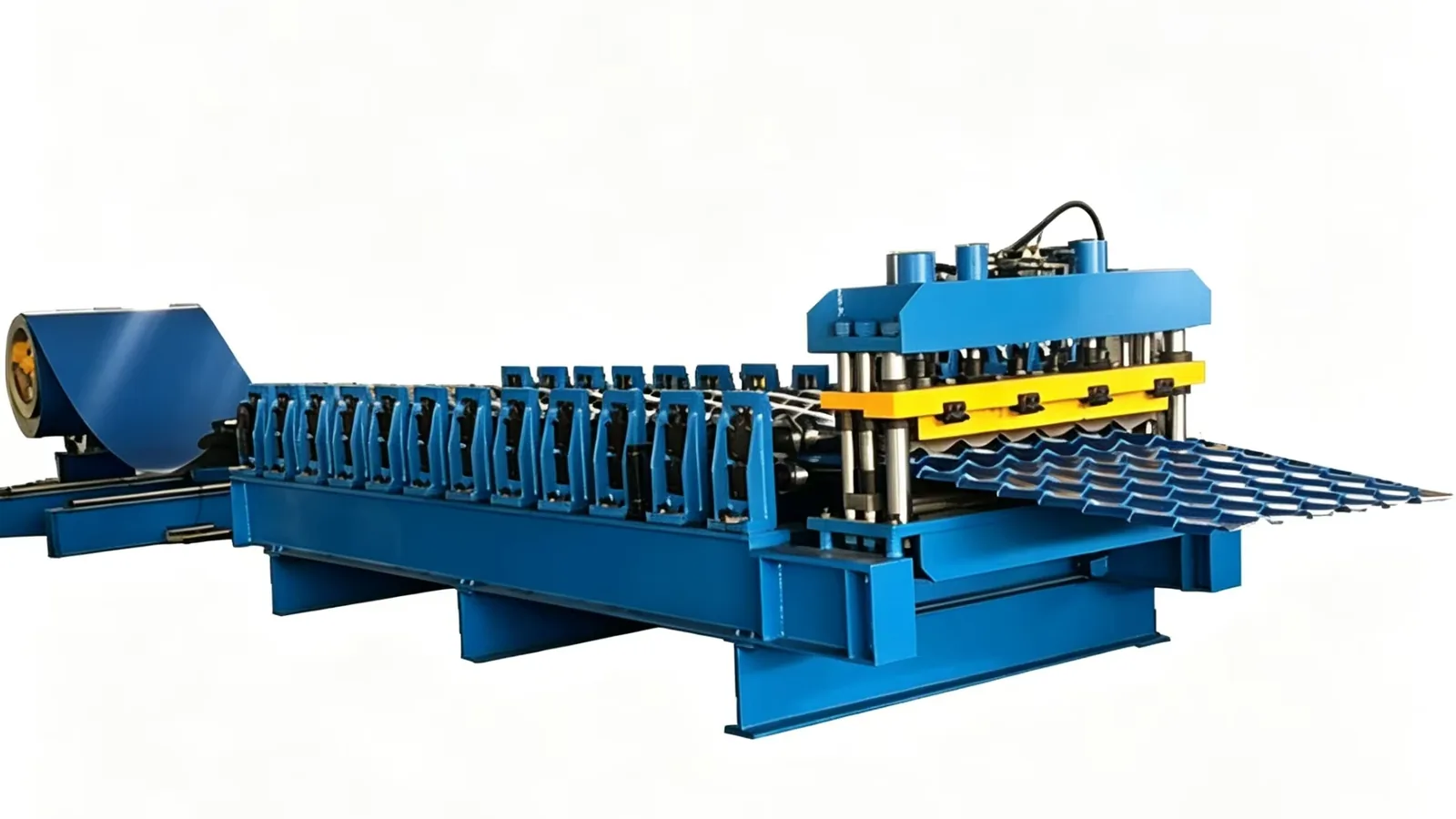
Technical Specifications
| Material | PPGI, aluminium, stone-chip coated steel |
| Thickness | 0.3 – 0.6 mm |
| Effective cover width | 1000 / 1050 mm |
| Profile depth | 30 – 40 mm |
| Forming speed | 10 – 15 m/min |
| Forming stations | 20 – 24 |
| Drive | Gearbox chain drive, 7.5 – 11 kW |
| Cutting | Hydraulic guillotine, auto length |
| Control | PLC + HMI |
| Certification | CE Declaration of Conformity |
| Lead time | 45 – 60 days |
| Minimum roof pitch | about 15–17° (side lap is not a sealed seam) |
| Weight versus clay tile | roughly 5–7 kg/m² against 40–50 kg/m² for clay or concrete tiles |
Need a quote or a custom specification?
What This Machine Produces
Spanish tile (S-tile) panels — an S-shaped or barrel profile with a pronounced side-to-side curve, reproducing the silhouette of traditional Mediterranean clay tile.
Barrel tile panels with an effective cover width of 1000 or 1050 mm, which works out at roughly five or six tiles across the panel.
Stone-chip coated tile panels — the surface texture closely mimics clay, which is why this coating is popular specifically for Spanish tile rather than for plain roof sheet.
Panels in 0.3–0.6 mm PPGI, aluminium or stone-chip coated steel, formed through 20–24 stations at 10–15 m/min.
A roof that weighs roughly 5–7 kg/m² against 40–50 kg/m² for clay or concrete tiles — the weight saving is usually what lets the roof structure, purlins and foundation be reduced.
Profile depth of 30–40 mm, which is deeper than a trapezoidal sheet because the tile look depends on the visible curve.
Recommended Configuration
A complete working line, not just the forming machine. Each item below is quoted as one package.
- 01
Decoiler and leveling unit
the profile is deep and closely toleranced, so strip straightness of the 0.3–0.6 mm coil decides whether adjacent tile modules line up along the roof.
- 02
Spanish tile roll forming machine
20–24 stations on a gearbox chain drive at 7.5–11 kW, forming at 10–15 m/min. The station count is high because the barrel curve has to be built up progressively without stretching the coating.
- 03
Polyurethane guide rolls for stone-chip sheet
the chipped surface marks under steel rolls, so this is effectively mandatory if you intend to run stone-chip material. It also runs at reduced speed.
- 04
Hydraulic guillotine with auto length
a guillotine gives a cleaner cut edge on a thick decorative coating than a shear does, and the panel is cut to the roof module length.
- 05
PLC with HMI
profile, length and batch are selected rather than set by hand.
- 06
Note on roof pitch: the side lap is not a sealed seam, so most Spanish tile profiles require a minimum pitch of about 15–17°, roughly the same as the clay tiles they imitate. Below that, specify standing seam or trapezoidal sheet instead.
Production Workflow
- 01
Decoiler
Coil is loaded and uncoiled at controlled tension. The barrel profile has more forming steps than flat sheet, so a tension variation that would be invisible on a trapezoidal roof shows up as a mis-aligned tile module.
- 02
Leveling
The strip is straightened before forming. On stone-chip coated material this runs at reduced pressure, because the coating is the product.
- 03
Roll forming
20–24 stations build the barrel curve progressively in 0.3–0.6 mm material at 10–15 m/min.
- 04
Stone-chip handling
Stone-chip sheet runs at reduced speed with polyurethane guide rolls. Settings that are correct for painted coil will mark the chip surface.
- 05
Cutting
A hydraulic guillotine cuts to the roof module length set on the HMI.
- 06
Output
Panels leave on the runout, stacked by the five or six tiles across the width so the roofer can lay them in course order.
Key Components
- Forming stations
- 20–24 — required to build the barrel curve without stretching the coating
- Drive
- Gearbox chain drive, 7.5–11 kW
- Cutting
- Hydraulic guillotine, auto length
- Control
- PLC + HMI
- Working range
- 0.3–0.6 mm · cover width 1000 / 1050 mm · profile depth 30–40 mm
- Materials
- PPGI, aluminium, stone-chip coated steel
- Guide rolls
- Polyurethane for stone-chip material
Customization Options
Every line is built to order. These are the points buyers most often change.
| Item | What can be changed |
|---|---|
| Tile pitch and width | Effective cover width 1000 or 1050 mm, about five or six tiles across. Custom tile pitches need new roll design |
| Coating | PPGI, aluminium, or stone-chip coated steel at reduced speed with polyurethane guide rolls |
| Material and thickness | 0.3–0.6 mm |
| Roof pitch constraint | Most profiles need a minimum pitch of about 15–17° because the side lap is not a sealed seam |
| Tooling | Spanish tile and glazed tile need different tooling — the geometries are not interchangeable |
| Power supply | 380 V / 50 Hz / 3-phase standard; other voltages to your site |
Applications
FAQ — Spanish Tile Roll Forming Machine
How is Spanish tile different from glazed tile?
Is Spanish tile suitable for low-pitch roofs?
What is the typical market for Spanish tile metal roofing?
Can the profile be made in different tile widths?
Does the machine handle stone-chip coated sheet?
What is the weight advantage over real tiles?
Can the machine be built for our own profile?
How do we get a price for this line?
What material thickness can this machine form?
What is the production speed?
How many forming stations does it use?
What is the drive and installed power?
You May Also Need
Send us your profile and output target
Tell us the profile and the numbers that matter to you. We confirm the configuration against the specification table above and quote FOB Tianjin within 24 hours.
- MaterialPPGI, aluminium, stone-chip coated steel
- Thickness0.3 – 0.6 mm
- Effective cover width1000 / 1050 mm
- Profile depth30 – 40 mm